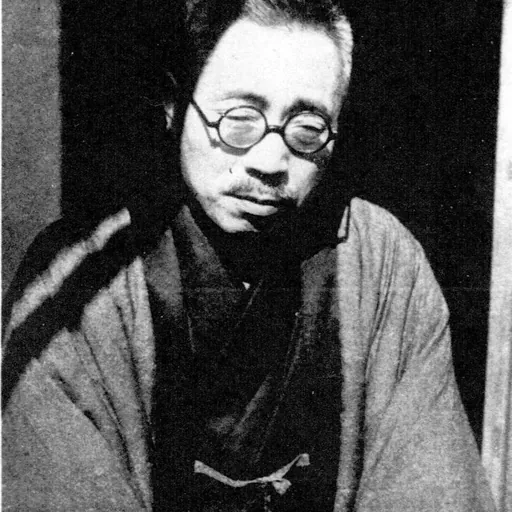
About Ōmi Komaki
Lived 1894 – 1978 (aged 84). Ōmi Komaki was a Japanese translator, writer and university teacher.
was the pen-name of a scholar and translator of French literature in Taishō and Shōwa period Japan. His real name was Komaki Ōmiya.
Early life Komaki was born in Tsuchizaki-Minato town, Akita prefecture, as the son of a politician. He dropped out of middle school in order to accompany his father to an international conference of legislators in France, and stayed on, working his way through the Law Department of Paris University. He was greatly influenced by the philosophy of Romain Rolland and the Clarté ("Clarity") movement of the French novelist, Henri Barbusse, which encouraged him to participate in pacifist activities.
Literary career Komaki returned to Japan in 1919 and founded the literary magazine Tane Maku Hito ("The Sowers") in October 1921, named after the famous painting by the French artist Jean-François Millet. He used this as his platform to promote his pacifist and Marxist ideals through poems and essays, many of which he wrote. He was one of the first Japanese members of Comintern, and a pioneer in the Proletarian literature movement. The movement attracted the attention of Arishima Takeo, and other noted leftist writers. In 1924 another literary magazine Bungei Sensen ("Literary Battlefront") spun out from the original Tane Maku Hito group.
When Komaki had spare time from promoting communist revolution and avoiding the thought police, he worked at translating works of French literature into Japanese. His most noted works are translations of Charles-Louis Philippe's Dans la Petite Ville and André Gide's biography, Charles-Louis Philippe.
After World War II, Komaki became a professor at Hosei University, and continued to pursue his pacifist and Marxist philosophies.
His works include Ikoku no Senso (Other Countries’ Wars) and Furansu Kakumei Yobanashi (Evening Conversations on the French Revolution).
Komaki relocated from Tokyo to Kamakura, Kanagawa prefecture in 1925. He later spent some years in French Indochina, but returned after World War II to Kamakura, where he lived until his death in 1978 at the age of 84.
Don’t just read it —
keep it.
Full-length biographies made to live with: read them, listen on the way to work, watch them tonight.
- E-book
- Audio
- Video
Instant download · yours to keep · every purchase keeps this site free
Important facts
People in Ōmi Komaki's life
Named in this biography and alive at the same time




Related people
Same field, nearest in time

Contemporaries
People whose lives overlapped Ōmi Komaki's


Frequently asked questions
Who was Ōmi Komaki?
Japanese scholar and translator
When was Ōmi Komaki born?
Ōmi Komaki was born on 11 May 1894 in Akita.
When did Ōmi Komaki die?
Ōmi Komaki died on 29 October 1978 in Kamakura.
What was Ōmi Komaki's occupation?
Ōmi Komaki was a translator, writer and university teacher.
What nationality was Ōmi Komaki?
Ōmi Komaki was Japanese.
Sources & further reading
Cite this page
APA: Biography.guide. (2026). Ōmi Komaki. https://biography.guide/omi-komaki/
MLA: "Ōmi Komaki." Biography.guide, https://biography.guide/omi-komaki/.
Chicago: "Ōmi Komaki." Biography.guide. https://biography.guide/omi-komaki/.
Data last updated: 2026-09-20 · Spot an error? Report a correction.
Portrait: Wikimedia Commons · author & licence
Page generated 2026-09-27 04:58 UTC