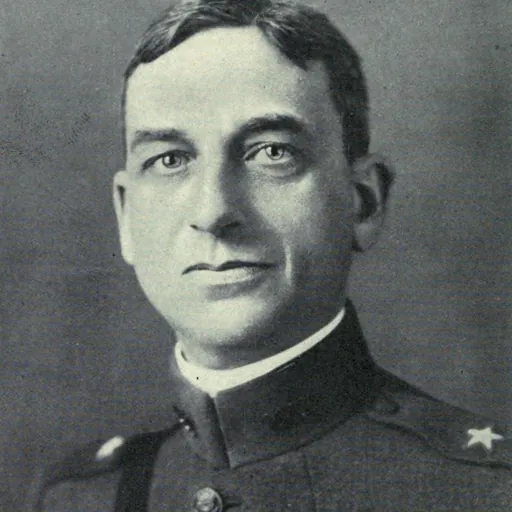
About Oliver Lyman Spaulding
Lived 1875 – 1947 (aged 71–72). Oliver Lyman Spaulding was a military leader and military personnel.
Oliver Lyman Spaulding Jr. (June 27, 1875 – March 27, 1947) was a career officer in the United States Army. A veteran of the China Relief Expedition, Philippine–American War, Pancho Villa Expedition, World War I, and World War II, he attained the rank of brigadier general, and was a recipient of the Army Distinguished Service Medal and Legion of Merit from the United States, and the Order of the Black Star (Commander) from France.
A native of St. Johns, Michigan, Spaulding was the son of Oliver L. Spaulding, a Union Army veteran of the American Civil War who attained the rank of brigadier general by brevet and later served as Michigan Secretary of State and a member of the United States House of Representatives. Spaulding graduated from Washington, D.C.'s Central High School in 1891, and received a Bachelor of Arts degree from the University of Michigan in 1895 and a Bachelor of Laws from the University of Michigan Law School in 1896. In 1898, Spaulding applied for an army commission and was appointed a second lieutenant of Field Artillery.
Spaulding's initial assignments included a posting to Alaska and participation in the China Relief Expedition. He was a 1903 graduate of the Artillery School at Fort Monroe, and a 1905 graduate of the United States Army Command and General Staff College. After serving as an instructor at the staff college, in 1911, he graduated from the United States Army War College. After service in the Philippines for the second time and assignment to the Mexico–United States border during the Pancho Villa Expedition, Spaulding served as assistant commandant of the Field Artillery School at Fort Sill. During World War I, Spaulding served in Europe as commander of several Field Artillery brigades and chief of the historical section on the American Expeditionary Forces staff, and received promotion to temporary brigadier general. Spaulding's historical works were published beginning in 1918, and he was the author of six books.
After World War I, Spaulding was an instructor at the Army War College from 1919 to 1924, served as commander of the 13th Field Artillery Regiment in Hawaii from 1926 to 1929, and was assigned as professor of military science at Harvard University from 1929 to 1935. In 1932, he received a Master of Arts degree from Harvard. From 1935 until his June 1939 retirement, Spaulding was again assigned as an instructor at the Army War College. During his retirement, he was a lecturer in history at the Lowell Institute and George Washington University. In March 1941, he was recalled to active duty for World War II and served as an instructor at the Army War College. After retiring for the second time in April 1946, Spaulding resided in Washington, D.C. He died in Washington on March 27, 1947, and was buried at Arlington National Cemetery.
Early life Oliver L. Spaulding Jr. was born in St. Johns, Michigan on June 27, 1875, He graduated from Washington, D.C.'s Central High School in 1891, then began attendance at the University of Michigan.
Start of career With the United States Army expanding for the Spanish–American War, in 1898, Spaulding applied for an army commission. Spaulding subsequently took part with his regiment in the 1900 China Relief Expedition. In 1903, he graduated from the Artillery School at Fort Monroe, and was promoted to captain. From 1903 to 1904 he commanded the 100th Coast Artillery Company at Fort Terry, New York. He was a 1905 graduate of the United States Army Staff College. In 1906, he assumed command of the 1st Coast Artillery Company at Fort De Soto. After another assignment as an instructor at the command and general staff college, he attended the United States Army War College, from which he graduated in 1911. In November 1912, he was assigned to command the 4th Coast Artillery Company at Fort Mott, New Jersey. In the years immediately prior to World War I, Spaulding served as assistant commandant of the Field Artillery School at Fort Sill. In 1918, he was promoted to colonel, and he performed temporary duty as inspector of artillery units preparing to depart for combat in France. During the First World War, Spaulding served in France, Luxembourg, and Germany as commander of the 161st, 55th, and 165th Field Artillery Brigades with the temporary rank of brigadier general. After the war, he was chief of the historical section on the American Expeditionary Forces staff with the temporary rank of brigadier general. He was professor of military science at Harvard University from 1929 to 1935, and received his M.A. degree from Harvard in 1932.
In 1909, Spaulding was one of the founders of the United States Field Artillery Association; he served on the organization's first executive council, and subsequently held the position of secretary-treasurer. He was a member of Phi Beta Kappa, Beta Theta Pi, and Phi Delta Phi. In addition, he joined the American Legion at its founding, and was a member of the Military Order of the Loyal Legion of the United States as a result of his father's Civil War service. As a result of his service in the Philippines, he belonged to the Military Order of the Carabao.
Published works Spaulding's books included: Notes on Field Artillery (1918); Warfare: A Study of Military Methods From the Earliest Times (1925); The United States Army In War and Peace (four volumes) (1937); Pen And Sword In Greece and Rome (1937); The Second Division A.E.F. in France 1917–19 (1937); and Ahriman, A Study In Aerial Bombardment (1939). from the United States and the Order of the Black Star (Commander) from France. They were married until his death, and were the parents of a son, Edward Chandler Spaulding (1912–1975).
Don’t just read it —
keep it.
Full-length biographies made to live with: read them, listen on the way to work, watch them tonight.
- E-book
- Audio
- Video
Instant download · yours to keep · every purchase keeps this site free
Important facts
People in Oliver Lyman Spaulding's life
Named in this biography and alive at the same time



Related people
Same field, nearest in time



Contemporaries
People whose lives overlapped Oliver Lyman Spaulding's


Frequently asked questions
Who was Oliver Lyman Spaulding?
American Army officer (1875–1947)
When was Oliver Lyman Spaulding born?
Oliver Lyman Spaulding was born in 1875 in Michigan, St. Johns.
When did Oliver Lyman Spaulding die?
Oliver Lyman Spaulding died in 1947 in Washington, D.C..
What was Oliver Lyman Spaulding's occupation?
Oliver Lyman Spaulding was a military leader and military personnel.
Sources & further reading
· Wikipedia: Oliver Lyman Spaulding
· DBpedia: Oliver Lyman Spaulding (general)
Cite this page
APA: Biography.guide. (2026). Oliver Lyman Spaulding. https://biography.guide/oliver-lyman-spaulding/
MLA: "Oliver Lyman Spaulding." Biography.guide, https://biography.guide/oliver-lyman-spaulding/.
Chicago: "Oliver Lyman Spaulding." Biography.guide. https://biography.guide/oliver-lyman-spaulding/.
Data last updated: 2026-09-24 · Spot an error? Report a correction.
Portrait: Wikimedia Commons · author & licence
Page generated 2026-09-27 05:09 UTC