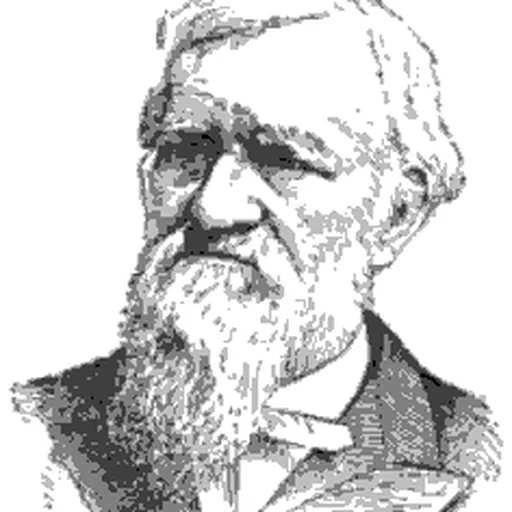
Oliver Dyer
American journalist, author, teacher, lawyer and stenographer
About Oliver Dyer
Lived 1824 – 1907 (aged 82). Oliver Dyer was an American lawyer and journalist, known for John Allen (saloon keeper).
Oliver Dyer (April 26, 1824 – January 13, 1907) was an American journalist, author, teacher, lawyer and stenographer. A pioneer in phonography, he developed his own shorthand system which was the first to be adopted for use in the United States. It was used not only for courtroom testimony but also for recording political events such as the Free Soil Convention in Buffalo, New York, and sessions of the 30th United States Congress in Washington, D.C., in 1848. It was in the latter role that he became the first Congressional shorthand reporter.
Dyer also had a successful career as a columnist for a number of popular publications, such as the Brooklyn Daily Eagle, New York Ledger and The Sun, during the 1850s and 60s. He was prominent among the reformers who campaigned against the various saloons, clubs and other "immoral establishments" of New York's underworld. His 1868 exposé of John Allen caused the saloon keeper to become infamously known as "the wickedest man in New York" and forced to close his dance hall. Dyer was also one of the signatories of the Water Street Revival "street preaching" document, which supported attempts by religious leaders to convince saloon keepers and other criminal figures to abandon crime as a way of life.
Biography Born in Porter, New York on April 26, 1824, Oliver Dyer moved with his parents to Lockport where his father, Jeremiah Dyer, opened a shoemaking shop. Dyer spent most of his early life in the city and became a schoolteacher in 1840. During this time, he became interested in phonography, a popular type of shorthand system then being used in Great Britain, and soon developed his own system. A student of Sir Isaac Pitman, developer of Pitman shorthand, Dyer initially practiced by copying Sunday sermons verbatim and later began teaching phonography classes in which he demonstrated his new system. He began teaching and lecturing in cities across the county. In Philadelphia, he established the first American shorthand periodical, the American Phonographic Journal, as well as the first experimental classes in shorthand at Central High School. After receiving permission from the school, he taught a volunteer after-school class of 250 students free of charge from which would emerge some of the most prominent shorthand writers of the period such as Dennis F. Murphy. These classes were so popular, with the students showing much promise, that shorthand was officially added to the school's curriculum the next year under a regular instructor.
Dyer's system became widely used throughout the decade, and Dyer was eventually considered the leading authority on shorthand in the United States. In 1847, he began supplying the first phonographic reports published by the New York Tribune and for a newspaper in Toronto, the latter being the first published in Canada. He was a strong supporter of the abolitionist movement and often had disagreements with then Congressman Horace Greeley. Dyer studied law while living in Washington, but later chose to pursue a career in journalism instead.
Dyer was an outspoken critic of saloons, clubs and other immoral establishments which typified the New York underworld. In 1868, he was hired by Silas S. Packard shortly after his founding of the magazine Packard's Monthly. That summer, Dyer wrote an exposé on saloon keeper John Allen, a one-time religious student involved in prostitution and murder, for which Allen gained infamy as "The Wickedest Man in New York". He later had "a truthful biography" published about Allen, The Wickedest Man in New York: "Truth Stanger Than Fiction", which became very popular not only in New York but around the country. It also made Packard's Monthly very successful and set the tone for future stories; the magazine's official slogan became "truth is stranger than fiction". Even Allen, despite his notoriety, embraced his new-found publicity by pasting copies of the article in the windows and on the bar mirror of his dance hall, and had business cards printed up using the title "Wickedest Man in New York" as the owner. This led some reformers to criticize Dyer for advertising the red light and vice districts of the Fourth Ward.
Dyer was also associated with the so-called "Water Street Revival", in part due to his writings for Packard's Monthly. He was one of the signatories to the "street preaching" document which gave support to religious leaders' efforts to convince saloon keepers and other criminal figures to abandon crime as a way of life. They persuaded John Allen and others to allow their establishments to be used by missionaries for prayer meetings and other church services. The New York Times eventually exposed the revival movement as a fraud. Dyer's public crusade against Allen resulted in the close of his Water Street dance hall, and Allen died two years later.
In his later years, Dyer became a published author on a wide variety of subjects, ranging from religious writings and political topics, such as the effects of Reconstruction, and the history of The New York Sun. He also wrote biographies on fellow journalist Henry Woodfin Grady, historian George Bancroft, and former U.S. Presidents Andrew Jackson and James A. Garfield. In 1876, his spiritual journey took another turn, and he was ordained as a minister in the Swedenborgian faith
Don’t just read it —
keep it.
Full-length biographies made to live with: read them, listen on the way to work, watch them tonight.
- E-book
- Audio
- Video
Instant download · yours to keep · every purchase keeps this site free
Important facts
People in Oliver Dyer's life
Named in this biography and alive at the same time





Related people
Same field, nearest in time


Contemporaries
People whose lives overlapped Oliver Dyer's




Frequently asked questions
Who was Oliver Dyer?
American journalist, author, teacher, lawyer and stenographer (1824–1907)
When was Oliver Dyer born?
Oliver Dyer was born on 26 April 1824 in Porter.
When did Oliver Dyer die?
Oliver Dyer died on 13 January 1907 in Massachusetts Homeopathic Hospital.
What was Oliver Dyer's occupation?
Oliver Dyer was a lawyer and journalist.
What was Oliver Dyer known for?
Oliver Dyer was known for John Allen (saloon keeper).
What nationality was Oliver Dyer?
Oliver Dyer was American.
Sources & further reading
Cite this page
APA: Biography.guide. (2026). Oliver Dyer. https://biography.guide/oliver-dyer/
MLA: "Oliver Dyer." Biography.guide, https://biography.guide/oliver-dyer/.
Chicago: "Oliver Dyer." Biography.guide. https://biography.guide/oliver-dyer/.
Data last updated: 2026-09-22 · Spot an error? Report a correction.
Portrait: Wikimedia Commons · author & licence
Page generated 2026-09-27 05:03 UTC