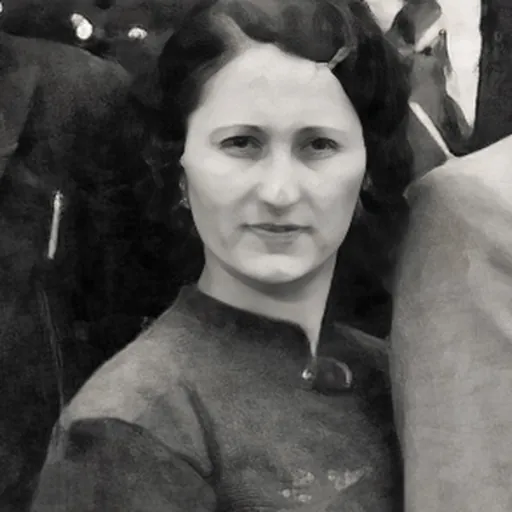
About Olga Bancic
Lived 1912 – 1944 (aged 32). Olga Bancic was a Romanian trade unionist, resistance fighter and laborer.
Olga Bancic (; born Golda Bancic; also known under her French nom de guerre Pierrette; 10 May 1912 – 10 May 1944) was a Jewish Romanian communist activist, known for her role in the French Resistance. A member of the FTP-MOI and Missak Manouchian's Group, she was captured by Nazi German forces in late 1943, and executed about six months later. Bancic was married to the writer and fellow FTP-MOI fighter Alexandru Jar. She was the last person decapitated by axe or similar (and not via guillotine) in Germany, and the last known in Europe.
Biography Bancic was born to a Jewish family in Chișinău, Bessarabia, which was part of the Russian Empire at the time, becoming part of the Romanian Kingdom after World War I. She worked in a mattress factory by the age of 12, and joined the labor movement, taking part in a strike during which she was arrested and allegedly beaten. Bancic, who became a member of the outlawed Romanian Communist Party (PCR), was subsequently arrested several times.
Shortly before the outbreak of World War II, Bancic gave birth to Dolores, her daughter with Alexandru Jar, She left Dolores in the care of a French family following the start of the German occupation, and joined the Paris-based Francs-tireurs et partisans – main-d'œuvre immigrée (FTP-MOI), taking part in about 100 sabotage acts against the Wehrmacht (Armed forces of Nazi Germany), and being personally involved in the manufacture and transport of explosives.
Arrested by the Gestapo on 6 November 1943, she was subject to torture, but refused to give information about her comrades. During her transportation to the place of execution, she composed a letter to her daughter Dolores, who was known under the name Dolores Jacob, on a piece of paper which she threw out a window.
Several streets were named in Bancic's honor, and small monuments were erected in her memory, along with a wall plaque in the PCF plot at Ivry Cemetery in Ivry-sur-Seine. Her name continued to be used as an asset by Communist authorities, but it fell into disuse after the 1989 Revolution. In 2005, writer and journalist Bedros Horasangian objected to the initiatives of Bucharest officials to remove the Polonă Street commemorative plaque making mention of her activities and to rename a street previously bearing her name, arguing that: "It is not proper and insults the memory of a woman who actually died for Allied victory (when Romania was allied to the Germans!). [...] In France, those who have fought in the antifascist resistance enjoy full respect".
Don’t just read it —
keep it.
Full-length biographies made to live with: read them, listen on the way to work, watch them tonight.
- E-book
- Audio
- Video
Instant download · yours to keep · every purchase keeps this site free
Important facts
People in Olga Bancic's life
Named in this biography and alive at the same time


Related people
Same field, nearest in time



Contemporaries
People whose lives overlapped Olga Bancic's





Frequently asked questions
Who was Olga Bancic?
French Resistance fighter (1912-1944)
When was Olga Bancic born?
Olga Bancic was born on 10 May 1912 in Chișinău.
When did Olga Bancic die?
Olga Bancic died on 10 May 1944 in Stuttgart.
What was Olga Bancic's occupation?
Olga Bancic was a trade unionist, resistance fighter and laborer.
What nationality was Olga Bancic?
Olga Bancic was Romanian.
Sources & further reading
Cite this page
APA: Biography.guide. (2026). Olga Bancic. https://biography.guide/olga-bancic/
MLA: "Olga Bancic." Biography.guide, https://biography.guide/olga-bancic/.
Chicago: "Olga Bancic." Biography.guide. https://biography.guide/olga-bancic/.
Data last updated: 2026-09-22 · Spot an error? Report a correction.
Portrait: Wikimedia Commons · author & licence
Page generated 2026-09-27 05:04 UTC