
Olaf the Black
Sea-king of the Isle of Man and parts of the Hebrides
About Olaf the Black
Lived 1173 – 1237 (aged 63–64).
Óláfr Guðrøðarson (died 1237) (Scottish Gaelic: Amhlaibh Dubh; English: Olafr Godredsson), also known as Olaf the Black, was a thirteenth-century King of the Isles, and a member of the Crovan dynasty.#tag:ref|Since the 1990s, academics have accorded Óláfr various personal names in English secondary sources: Amhlaibh, Amhlaíbh, Amlaíb, Olaf, Óláf, Óláfr, Ólafr, Olav, and Olavus. During the same period, Óláfr has been accorded various patronyms in English secondary sources: Amhlaíbh Dubh mac Gofhraidh, Óláf Guðrøðsson, Óláfr Godredsson, Óláfr Godredsson, Ólafr Guðrøðarson, Óláfr Guðrøðarsson, Óláfr Gúðrøðsson, and Óláfr Guðrøðsson. During the same period, he has been accorded various epithets in English secondary sources: Amhlaíbh Dubh mac Gofhraidh, Olaf Dubh, Olaf the Black, Óláfr Dubh, Óláfr the Black, and Olav the Black. and a son of Guðrøðr Óláfsson, King of Dublin and the Isles. Óláfr's mother was Fionnghuala Nic Lochlainn. Guðrøðr had several other children: Affrica, Rǫgnvaldr, and Ívarr. Other possible children include Ruaidhrí, According to the thirteenth-century Chronicle of Mann, Óláfr's mother was Fionnghuala Nic Lochlainn, granddaughter of Muirchertach Mac Lochlainn, High King of Ireland. She was probably a daughter of Muirchertach's son, Niall Mac Lochlainn, King of Cineál Eoghain. Although Óláfr's parentage is known, the maternal ancestry of Rǫgnvaldr is less certain. She may have been Sadbh, an Irishwoman identified as his mother by a contemporary Gaelic praise poem. #tag:ref|The maternal ancestry of Affrica and Ívarr, specifically identified as children of Guðrøðr, are likewise unknown.
The chronicle reveals that the marriage between Guðrøðr and Fionnghuala was formalised in 1176/1177, under the auspices of a visiting papal legate. Before Guðrøðr's death in 1187, the chronicle claims that he left instructions for Óláfr to succeed to the kingship since the latter had been born "in lawful wedlock". This statement could indicate that Óláfr was born just before or immediately after his parents' marriage. The chronicle certainly states that Óláfr was born before the legate formalised his parents' marriage, suggesting that the union existed for some time prior. This source, however, gives conflicting dates for Óláfr's birth: 1173 and 1177. Specifically, in its account of his parents marriage, the chronicle states that Óláfr was three years old; and in its account of his father's death, Óláfr is said to have been only ten.
If the chronicle's account of Óláfr's stake in the kingship is to be believed, it could indicate that Guðrøðr attempted to legitimise the royal succession through his canonical marriage to Fionnghuala. However, this source appears to date to the reign of Óláfr's son, Magnús, and there is reason to suspect that it source was compiled in the context of an attempt to legitimise Óláfr's branch of the Crovan dynasty over that of Rǫgnvaldr. As such, the chronicle appears to be biased towards Óláfr's line, and its account of Guðrøðr's succession may not objective. Whether the chronicle is accurate in its account of the succession is uncertain, as the Islesmen are stated to have chosen Rǫgnvaldr to rule instead, because unlike Óláfr, who was only a child at the time, Rǫgnvaldr was a hardy young man fully capable to reign as king. Furthermore, the fact that Rǫgnvaldr appears to have held power in the Hebrides at the time of Guðrøðr's death could indicate that it was Rǫgnvaldr who had been the acknowledged heir. Another possibility, suggested by the chronicle and latter correspondence between Óláfr and the English Crown, is that Rǫgnvaldr's tenure had been originally intended as temporary wardship until Óláfr was able to reign himself.
Hebridean magnate
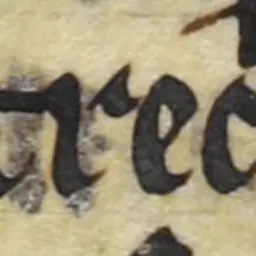
The name of Óláfr's older half-brother, Rǫgnvaldr Guðrøðarson, as it appears on folio 40v of British Library Cotton Julius A VII: "".
Rǫgnvaldr succeeded Guðrøðr as king in 1188. At some point after assuming control of the kingdom, the chronicle reports that Rǫgnvaldr gave Óláfr possession of a certain island called "". The chronicle disparagingly describes the island as being mountainous and rocky, completely unsuitable for cultivation, and declares that its small population lived mostly by hunting and fishing. Although is an early Latin form of the place name of Lewis —the rather flat and boggy northerly half of the Outer Hebridean island of Lewis and Harris—the chronicle's text seems to instead refer to Harris—the somewhat mountainous southerly half. The chronicle claims that, because of the impoverishment of his lands, Óláfr was unable to support himself and his followers, and that in consequence he led "a poor sort of life". There is reason to suspect that the chronicle's otherwise perceptible prejudice against Rǫgnvaldr's branch of the Crovan dynasty, and its apparent bias in favour of Mann over the northernmost reaches of the realm, may also account for its denigrating depiction of Óláfr's allotted lands.
The mediaeval barrel-vaulted nave of the Cathedral of Santiago de Compostela. For over a thousand years the cathedral has been the destination of pilgrims making their way to Santiago de Compostela.
In consequence of this supposed poverty, the chronicle claims that Óláfr went to Rǫgnvaldr, who was also living in the Hebrides, and confronted him for more land. Rǫgnvaldr's stated response was to have Óláfr seized and sent to William I, King of Scotland, who kept him imprisoned for almost seven years. It is possible that, at this stage of his career, Óláfr acted as an under-king to Rǫgnvaldr, and sought to increase his share of power. There is reason to suspect that, following Óláfr's inability to make a deal with Rǫgnvaldr, Óláfr approached Ingi Bárðarson, King of Norway, and offered himself as a more palatable vassal-king in return for Norwegian support in deposing Rǫgnvaldr. In 1210, Rǫgnvaldr himself appears to have travelled to Norway, as evinced by a version of the thirteenth-century Bǫglunga sǫgur, in a journey that could well have been an attempt to further cement his position in the Isles, and counter Óláfr's claims to the throne, by formally submitting to the Norwegian king. In any case, the chronicle states that William died during the seventh year of Óláfr's captivity, and that William had ordered the release of all his political prisoners before his passing. Upon his release, the chronicle reveals that the half-brothers met on Mann, after which Óláfr set off on a pilgrimage with his followers to Santiago de Compostela.
Óláfr's time in the Isles is confirmed by several Icelandic sources—the sagas of Hrafn Sveinbjarnarson (an Icelandic chieftain) and Guðmundr Arason (an Icelandic ecclesiast)—which recount how, in 1202, Guðmundr attempted to sail from Iceland to Norway to become consecrated as the Bishop of Hólar. For example, the thirteenth-century Hrafns saga Sveinbjarnarsonar relates that the wayfaring Icelanders encountered a severe storm and were blown far off course before being forced to make landfall in the Hebrides. The saga identifies the island they landed upon as , which may well refer to Sanday, a tiny tidal island linked to its larger neighbour Canna, the westernmost island of the Small Isles. The sandy flat that joins the islands together forms one of the best natural harbours in the Hebrides.
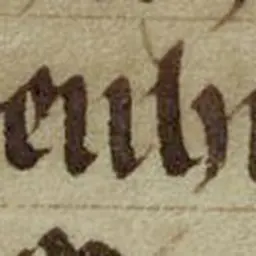
Óláfr's name as appears on folio 163r of AM 47 fol (Eirspennill): "". The Old Norse epithet refers to the colour "black".
According to Hrafns saga Sveinbjarnarsonar, the Icelanders were met by an official of a local king named Óláfr who attempted to collect a landing-tax from them. Afterwards, whilst the Icelanders were at church, the king is said to have personally invited the bishop-elect to dine with him. Guðmundr is then said to have refused the king, after which the latter forbade them to leave. Although the Icelanders are reported to have taken up arms, they eventually caved to the king before being allowed to set sail for Norway. The king encountered by the Icelanders was probably Óláfr himself, although it is not certain that the Crovan dynasty controlled the Small Isles at this point in history. One possibility is that Óláfr, like the Icelanders, may have been temporarily stranded on the tidal island, and that he may have taken advantage of the storm-stricken churchmen to offset the poverty that is assigned to him by the chronicle.
Marriage to Lauon
It is possible that Lochlann's foster son is identical to a similarly named individual, a certain "", who attested a quitclaim between Llywelyn ap Gruffudd and Ralph de Mortimer, in about 1241. It is uncertain what compelled Lochlann to flee his sovereign, and it is uncertain why he chose Wales as his destination. The Crovan dynasty certainly had diplomatic and familial connections with the Welsh. One possibility is that the account of Lochlann's flight reveals that he attempted to replace Óláfr's son, Haraldr, with another son. Haraldr's young age at the time, and the fact that he had a potential rival in the person of his like-named cousin, Haraldr Guðrøðarson, could indicate that Haraldr had been designated as successor during his father's lifetime.
Ancestry
Don’t just read it —
keep it.
Full-length biographies made to live with: read them, listen on the way to work, watch them tonight.
- E-book
- Audio
- Video
Instant download · yours to keep · every purchase keeps this site free
Important facts
People in Olaf the Black's life
Named in this biography and alive at the same time
Contemporaries
People whose lives overlapped Olaf the Black's





Frequently asked questions
Who was Olaf the Black?
Sea-king of the Isle of Man and parts of the Hebrides
When was Olaf the Black born?
Olaf the Black was born in 1173.
When did Olaf the Black die?
Olaf the Black died on 21 May 1237 in St Patrick's Isle.
Sources & further reading
Cite this page
APA: Biography.guide. (2026). Olaf the Black. https://biography.guide/olaf-the-black/
MLA: "Olaf the Black." Biography.guide, https://biography.guide/olaf-the-black/.
Chicago: "Olaf the Black." Biography.guide. https://biography.guide/olaf-the-black/.
Data last updated: 2026-09-20 · Spot an error? Report a correction.
Page generated 2026-09-27 05:05 UTC