
About Oda Olberg
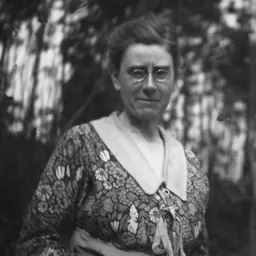
Lived 1872 – 1955 (aged 82). Oda Olberg was a German women's rights activist, journalist, nurse, editor and resistance fighter.
Oda Olberg (1872 – 1955), also known as Oda Olberg-Lerda, was a German-born journalist, socialist and feminist. Her career was cut short by the rise of Fascism in Italy and Germany.
Life Oda Olberg was born in Bremerhaven on 2 October 1872, the daughter of a German naval officer. In 1896 she moved to Italy, and in 1897 married the Italian socialist Giovanni Lerda. She became foreign affairs editor for Avanti!, the newspaper of the Italian Socialist Party, and in 1899 the official foreign correspondent for the Arbeiter-Zeitung.
Living in Rome in the early 1920s, Olberg and Lerda witnessed Fascist violence. In 1923 she published a study of Italian Fascism. The pair faced increasing threats of violence from the mid-1920s, and Lerda died in 1927. Olberg left Italy to join her son Edgardo in Argentina, but returned to Vienna in 1928, where she worked as correspondent for the Vienna Arbeiter-Zeitung (Vienna). She wrote on the effects of the economic depression, and published a short study of Nazism in 1932.
After the socialist failure to resist Nazism in the 1934 Austrian Civil War, Olberg went into exile, rejoining her son Edgardo in Buenos Aires. She wrote in Spanish for several Argentinean journals, including Critica, as well as the German-language Argentinisches Tageblatt. In 1937 she helped found the anti-Nazi exile organization Das Andere Deutschland. However, her health declined due to a cardiac condition. Though she continued to write, she suffered censorship under Juan Perón. She died in Buenos Aires on 11 April 1955.
Works Das Elend in der Hausindustrie der Konfektion [Poverty among Home Workers in Clothes Making] . 1896. Das Weib und der Intellektualismus [Women and Intellectualism]. 1902. Der Fascismus in Italien [Fascism in Italy]. 1923. Die Entartung in ihrer Kulturbedingtheit: Bemerkungen und Anregungen [Degeneracy in Its Relation to Culture: Remarks and Suggestions]. 1926. Nationalsozialismus [National Socialism]. 1932. Der Mensch, sein eigener Feind: Betrachtungen über Gerechtigkeit [Humanity, Its Own Worst Enemy: Reflections on Justice]. 1948.
Don’t just read it —
keep it.
Full-length biographies made to live with: read them, listen on the way to work, watch them tonight.
- E-book
- Audio
- Video
Instant download · yours to keep · every purchase keeps this site free
Important facts
People in Oda Olberg's life
Named in this biography and alive at the same time

Related people
Same field, nearest in time



Contemporaries
People whose lives overlapped Oda Olberg's


Frequently asked questions
Who was Oda Olberg?
journalist and feminist (1872–1955)
When was Oda Olberg born?
Oda Olberg was born on 2 October 1872 in Bremerhaven.
When did Oda Olberg die?
Oda Olberg died on 11 April 1955 in Buenos Aires.
What was Oda Olberg's occupation?
Oda Olberg was a women's rights activist, journalist, nurse, editor and resistance fighter.
What nationality was Oda Olberg?
Oda Olberg was German.
Sources & further reading
Cite this page
APA: Biography.guide. (2026). Oda Olberg. https://biography.guide/oda-olberg/
MLA: "Oda Olberg." Biography.guide, https://biography.guide/oda-olberg/.
Chicago: "Oda Olberg." Biography.guide. https://biography.guide/oda-olberg/.
Data last updated: 2026-09-20 · Spot an error? Report a correction.
Page generated 2026-09-27 05:07 UTC