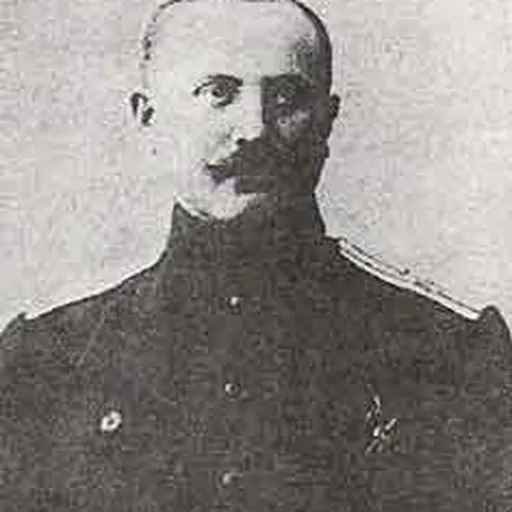
About Nuh-bey Tarkovsky
Lived 1878 – 1951 (aged 72). Nuh-bey Tarkovsky was a Russian military officer.
Nuh-bey Khanovich Tarkovsky ( – 19 January 1951) was a North Caucasian military commander, prince and shamkhal. A descendant of the rulers of the Shamkhalate of Tarki, he was Minister of War of the Mountainous Republic of the Northern Caucasus.
Early life and career Nuh-bey Tarkovsky was born on 15 May 1878, in the village of Torqali, in the Temir-Khan-Shurinsky okrug of the Dagestan Oblast (now Korkmaskala in the Republic of Dagestan). He began his studies at a realschule in Temir-Khan-Shura (now Buynaksk), and in 1889 was sent to the , from which he successfully graduated in 1897. On 31 August 1897 he entered the in Saint Petersburg as an junker private. On 20 June 1899 he was promoted to a non-commissioned officer, and on 8 August, after graduating from college in the first category, he was promoted to cornet with distribution to the as part of the Caucasus Cavalry Division. Then he was transferred to the of the 3rd Caucasus Cossack Division.
For a personal feat during the capture of the village of Dobropole, Ternopil Oblast, the commander of the Caucasian Native Cavalry Division, major general Dmitry Bagration petitioned for Tarkovsky to be awarded with a Golden Weapon for Bravery. In October 1916, as a lieutenant colonel he was sent to the Caucasus to organize replenishment. Between 1917 and 1918 Tarkovsky commanded the Dagestan cavalry regiment of the Caucasian Native Cavalry Division. In April he was elected a delegate to the Mountainous Republic of the Northern Caucasus in Vladikavkaz.
In November 1918, he transferred his powers to the government of the Mountainous Republic. Subsequently, the Mountainous Republic's Prime Minister, Pshemakho Kotsev arrived in Dagestan with Ottoman troops. who were located in Baku at the time, about the presence of White Russian troops in the Mountainous Republic. After the failure of Tarkovsky's protests, he resigned from all positions on 25 March 1919. He subsequently began collaborating with the Armed Forces of South Russia as they faced an . At the end of 1920, he moved to the Ottoman Empire, but following the Turkish War of Independence and the establishment of relations with Soviet Russia, he again migrated to France. Then, with the beginning of World War II, he moved to Switzerland and died in Lausanne in 1951.
Awards Order of St. George 4th class Order of Saint Stanislaus 3rd class (1905), swords and a bow to it (1915) Order of Saint Anna 3rd class (1908) Order of St. Stanislaus 2nd class with swords (1911) Order of St. Anna 2nd class (1913) Order of Saint Vladimir 4th class with swords and bow (1915) Order of St. Anna 4th class with the inscription "For bravery" (1915) Golden Weapon for Bravery (1915)
Don’t just read it —
keep it.
Full-length biographies made to live with: read them, listen on the way to work, watch them tonight.
- E-book
- Audio
- Video
Instant download · yours to keep · every purchase keeps this site free
Important facts
People in Nuh-bey Tarkovsky's life
Named in this biography and alive at the same time
Related people
Same field, nearest in time




Contemporaries
People whose lives overlapped Nuh-bey Tarkovsky's



Frequently asked questions
Who was Nuh-bey Tarkovsky?
Russian military officer
When was Nuh-bey Tarkovsky born?
Nuh-bey Tarkovsky was born on 15 May 1878 in Kumtorkala.
When did Nuh-bey Tarkovsky die?
Nuh-bey Tarkovsky died on 19 January 1951 in Lausanne.
What was Nuh-bey Tarkovsky's occupation?
Nuh-bey Tarkovsky was a military officer.
What nationality was Nuh-bey Tarkovsky?
Nuh-bey Tarkovsky was Russian.
Sources & further reading
· Wikipedia: Nuh-bey Tarkovsky
Cite this page
APA: Biography.guide. (2026). Nuh-bey Tarkovsky. https://biography.guide/nuh-bey-tarkovsky/
MLA: "Nuh-bey Tarkovsky." Biography.guide, https://biography.guide/nuh-bey-tarkovsky/.
Chicago: "Nuh-bey Tarkovsky." Biography.guide. https://biography.guide/nuh-bey-tarkovsky/.
Data last updated: 2026-09-22 · Spot an error? Report a correction.
Portrait: Wikimedia Commons · author & licence
Page generated 2026-09-27 05:04 UTC