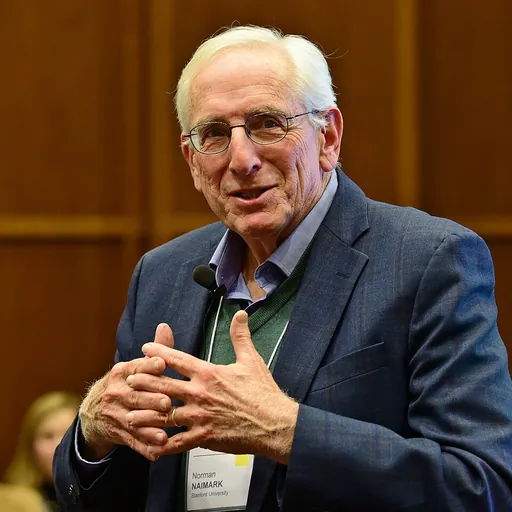
Norman Naimark
Robert and Florence McDonnell Professor in East European Studies, Stanford University
About Norman Naimark
Born 1944. Norman Naimark is an American historian, university teacher and academic.
Career Naimark received all of his degrees at Stanford. He taught at Boston University, and was a fellow at Harvard University's Russian Research Center before returning to Stanford as a member of the faculty in the 1980s. Naimark is of Jewish heritage; his parents were born in Galicia.
He is a member of the editorial boards of a number of professional journals, including The American Historical Review and The Journal of Contemporary History.
He was awarded the Officer's Cross of the Order of Merit by Germany. He wrote in a 2017 essay that genocide is often tied to war, dehumanization, and/or economic resentment. He writes, "if there weren’t other very good reasons to prevent war, the correlation between war and genocide is a good one".
Views on the definition of genocide
Throughout his more recent works, Naimark argues that the "world needs a much broader definition of genocide" than set by the 1948 Genocide Convention to also include "nations killing social classes and political groups." In his 2010 work Stalin’s Genocides, Naimark makes a case that the government of the Soviet Union under Joseph Stalin "killed systematically rather than episodically" and that Dekulakization, Holodomor and Great Purge "shouldn’t be seen as discrete episodes, but seen together", calling it "a horrific case of genocide – the purposeful elimination of all or part of a social group, a political group."
Naimark argues that they constitute genocide due to, among other factors, the intent of extermination that underpinned them: the quotas that sometimes were set on the number of people that needed to be executed or arrested, the dehumanizing language directed at kulaks, slogans promoted by activists openly calling for their extermination, and a "great deal of evidence of government connivance" regarding Holodomor. Naimark writes that early drafts of the UN Genocide Convention had included the killing of social and political groups in the initial definitions of genocide, but were dropped after the Soviet delegation threatened to veto the convention.
In his critique, Joshua Rubenstein agrees with Naimark's characterization that both Hitler and Stalin deserve to be known as "genocidaires" from a contemporary standpoint. However, he also disagrees with Naimark's apparent equating of Hitler and Stalin because the Soviet Union prevented Nazi Germany's attempt to conquer and subjugate all of Europe, suggesting the Soviet system was therefore a lesser evil when seen in a historical context. He also states that, while Stalin imposed his will in some countries like Poland and East Germany, he surprisingly favored restraint and accommodation in others like Denmark, Finland, and Austria. Stalin's ultimate goal remained a Europe susceptible to Soviet influence, showcasing a leader navigating a delicate balance between dominance and diplomacy.
Published works
Books
Don’t just read it —
keep it.
Full-length biographies made to live with: read them, listen on the way to work, watch them tonight.
- E-book
- Audio
- Video
Instant download · yours to keep · every purchase keeps this site free
Important facts
People in Norman Naimark's life
Named in this biography and alive at the same time

Related people
Same field, nearest in time


Contemporaries
People whose lives overlapped Norman Naimark's



Frequently asked questions
Who is Norman Naimark?
Robert and Florence McDonnell Professor in East European Studies, Stanford University
When was Norman Naimark born?
Norman Naimark was born in 1944 in Suffern.
What is Norman Naimark's occupation?
Norman Naimark is a historian, university teacher and academic.
What nationality is Norman Naimark?
Norman Naimark is American.
Sources & further reading
Cite this page
APA: Biography.guide. (2026). Norman Naimark. https://biography.guide/norman-naimark/
MLA: "Norman Naimark." Biography.guide, https://biography.guide/norman-naimark/.
Chicago: "Norman Naimark." Biography.guide. https://biography.guide/norman-naimark/.
Data last updated: 2026-09-20 · Spot an error? Report a correction.
Portrait: Wikimedia Commons · author & licence
Page generated 2026-09-27 04:57 UTC