
About Norman Myers
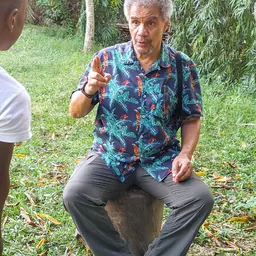
Lived 1934 – 2019 (aged 85). Norman Myers was a British environmentalist, ecologist and conservationist.
Norman Myers (24 August 1934 – 20 October 2019) was a British environmentalist specialising in biodiversity and also noted for his work on environmental refugees.
Biography Myers was born in Whitewell (Lancashire, then Yorkshire) and was raised until the age of 11 on the family farm, without electricity, gas or an internal toilet. He lived in Kenya for over 30 years and later settled in Headington, Oxford, England. He attended Clitheroe Royal Grammar School He is survived by their two daughters, Malindi and Mara, and grandchildren. Mara Yamauchi is a retired marathon runner who was raised in Kenya until the age of 8.
He died in Oxford on 20 October 2019 after a long battle with dementia and Parkinson's.
Career Myers was an advisor to organisations including the United Nations, the World Bank, scientific academies in several countries, and various government administrations worldwide. He was an Honorary Visiting Fellow at Green College, Oxford University, and an adjunct professor at Duke University and the University of Vermont.
Myers's work ranged over diverse critical global issues and includes 18 books and over 250 scientific papers, produced while working as a consultant and in temporary academic posts. In the late 1970s, his work addressed rapidly accelerating decline of tropical forests. His estimates were later verified through satellite imagery. In the early 1980s Myers addressed the issue of deforestation in the context of land conversion for cattle production, a process that he called the "hamburger connection", showing the international linkages between industrial food production and environmental decline.
He did some of the early work on biodiversity, highlighting the critical importance of "biodiversity hotspots" – regions that are home to a disproportionately high number of species. This work was cited when he was named 2007 Time Magazine Hero of the Environment. Myers proposed, (in Nature, an article published in 2000 and cited 19,000 times by 2017) that these hotspots should be the focus of preservation efforts as a way to cut the rates of mass extinction and this strategy has been adopted by global conservation organisations raising hundreds of millions of dollars to date – by some estimates the largest amounts ever assigned to a single conservation strategy.
He wrote an influential book Ultimate Security: The Environmental Basis of Political Stability that was an early contribution to the field of environmental security and how environmental factors influence local and international politics. Together with Jennifer Kent, he wrote Perverse Subsidies (published in 1997 by the International Institute for Sustainable Development; rev. edition, 2001) that highlighted how large-scale government intervention in the form of subsidies, both direct and indirect, can lead to adverse rather than beneficial effects on society and the environment. Also in 1997, he published Environmental Refugees, warning that there might be 50 million environmental refugees by 2010 "if not before."
Criticism Myers's widely cited work on 'climate refugees' has been criticised by social scientists, and migration scholars in particular. Professor Myers himself admitted that his estimates, although calculated from the best available data, required some "heroic extrapolations", In April 2011, the UN was reported to have distanced itself from Myers's forecasts in 2005 that the total number of climate refugees would reach 50 million by 2010. One academic has stated that "my understanding is that Norman Myers looked at a map of the world, and he said which are the hotspots that we think are going to be affected by climate change; then he looked up the projected populations for those areas in 2010 and 2050 and added them up.... That's how he got to such a figure, because he didn't take into account that some people wouldn't move." Populations continue to rise in many regions, with one effect being attempts at migration. Other estimates place the number of climate refugees in the tens of thousands.
Honours Cornell University's Andrew D. White Professor-at-Large, 1990-1996 Blue Planet Prize (1991) Volvo Environment Prize (1992) Pew Fellow in Environment (1994) Foreign Associate, US National Academy of Sciences (1994) UNEP Environment Prize, Sasakawa Award (1995) Companion (CMG), Order of St. Michael and St. George, Queen's Honours (1998) Honorary doctorate, University of Kent (2003) Fellow, American Association for the Advancement of Science Fellow, World Academy of Art and Science Fellow, Linnean Society of London Fellow, Royal Society of Arts, London Global 500 Roll of Honour, United Nations Environment Programme Gold Medal, World Wildlife Fund International Order and Knight of the Golden Ark, Netherlands
Don’t just read it —
keep it.
Full-length biographies made to live with: read them, listen on the way to work, watch them tonight.
- E-book
- Audio
- Video
Instant download · yours to keep · every purchase keeps this site free
Important facts
People in Norman Myers's life
Named in this biography and alive at the same time


Related people
Same field, nearest in time





Contemporaries
People whose lives overlapped Norman Myers's




Frequently asked questions
Who was Norman Myers?
British environmentalist (1934–2019)
When was Norman Myers born?
Norman Myers was born on 24 August 1934 in Clitheroe.
When did Norman Myers die?
Norman Myers died on 20 October 2019 in Oxford.
What was Norman Myers's occupation?
Norman Myers was an environmentalist, ecologist and conservationist.
What nationality was Norman Myers?
Norman Myers was British.
Sources & further reading
Cite this page
APA: Biography.guide. (2026). Norman Myers. https://biography.guide/norman-myers/
MLA: "Norman Myers." Biography.guide, https://biography.guide/norman-myers/.
Chicago: "Norman Myers." Biography.guide. https://biography.guide/norman-myers/.
Data last updated: 2026-09-20 · Spot an error? Report a correction.
Page generated 2026-09-27 05:02 UTC