
About Norman Baillie-Stewart
Lived 1909 – 1966 (aged 57). Norman Baillie-Stewart was a British and German journalist and autobiographer.
Espionage career
In August 1932, the British Security service, MI5, became aware that a man claiming to be a British army officer had attempted to gain an interview at the German War Office in Berlin. The British embassy in Berlin tentatively identified the man as Norman Baillie-Stewart. Major William Hinchley-Cooke of MI5 was assigned to investigate the matter.
In January 1933, it was decided to confront Baillie-Stewart with the gathered evidence, and offer him the chance to quietly resign from the army in exchange for information about his German contact. He refused this and so was charged with offences against the Official Secrets Act. Baillie-Stewart wrote a further letter to "Herr Obst" in Germany, describing his predicament. He gave the letter to his adjutant to post but the adjutant instead gave it to Major Hinchley-Cooke.
On 20 March 1933, Baillie-Stewart was taken to the Tower of London. The authorities believed this was the least-open military establishment in London and holding him there would help keep the matter out of the public eye. The story of an officer from a prestigious regiment, facing the unprecedented charges of espionage and held in the famous Tower of London, quickly became a press sensation.
Baillie-Stewart's court-martial began at Chelsea Barracks on 20 March. He faced ten charges under the Official Secrets Act 1911 for selling military secrets to a foreign power; he pleaded not guilty to all of them.
Using the pretext of studying for Staff College examinations, Baillie-Stewart borrowed from the Aldershot Military Library specifications and photographs of an experimental tank, the Vickers A1E1 Independent, as well as a new automatic rifle and notes on the organisation of tank and armoured car units.
Baillie-Stewart was convicted of seven of the ten charges against him and was sentenced to cashiering and five-years in prison. Soon after, while held in Wormwood Scrubs, he was interviewed again by an MI5 officer and revealed that the Herr Obst he had addressed his letters to had been the cover-name of Major Muller ("Muller" was also likely a cover-name). Marie-Luise had been merely a figment of his controller's imagination. Baillie-Stewart's code-name was Poiret (little pear). That and Marie-Luise (a variety of pear) were names used to conceal the correspondence with Muller. Muller's cover name, Obst, was the German word for "fruit"
Baillie-Stewart was released from Maidstone Prison on 20 January 1937.
German collaboration
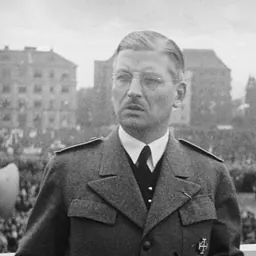
In August 1937, eight months after his release from prison, Baillie-Stewart moved to Vienna, where he applied for Austrian citizenship; however, it was refused since he did not meet the residency qualification. In February 1938, the Austrian government, led by Kurt Schuschnigg, suspected him of being a Nazi agent and gave him three weeks to leave Austria. Officials at the British embassy in Vienna refused to help him once they learned who he was Baillie-Stewart made his first broadcast reading pro-Nazi news on the Germany Calling English-language service a week before the United Kingdom declared war on Germany.
It has been speculated that it was Baillie-Stewart who made the broadcast that led the pseudonymous Daily Express radio critic Jonah Barrington to coin the term "Haw-Haw". The nickname possibly referenced Baillie-Stewart's exaggeratedly aristocratic way of speaking, but Wolf Mittler is usually considered a more likely candidate. When William Joyce later became the most prominent Nazi propaganda broadcaster, Barrington appended the title and named Joyce "Lord Haw-Haw" since the true identity of the broadcaster was then unknown. Another nickname possibly applied to Baillie-Stewart was "Sinister Sam".
By the end of September 1939, it had been clear to the radio authorities that Joyce, originally Baillie-Stewart's backup man, was a more effective broadcaster. Baillie-Stewart had also become gradually disenchanted with the material that he was given to broadcast; his last radio broadcast was in December 1939 and he was dismissed shortly after. He continued to work in Berlin as a translator for the German Foreign Ministry and lectured in English at Berlin University. In early 1940, he acquired German citizenship.
In early 1942, Baillie-Stewart made a brief return to radio under the alias of "Lancer". He made several broadcasts for both the Reichsrundfunk and Radio Luxembourg. He spent much time avoiding the more blatant propaganda material he was asked to present. He translated to English the words of "Lili Marleen", which were sung by Lale Andersen as a form of propaganda towards Allied soldiers but then taken up strongly by the Allies themselves.
In 1944, Baillie-Stewart had himself sent to Vienna for medical treatment, where he was arrested in 1945 in Altaussee, while he was wearing "chamois leather shorts, embroidered braces and a forester's jacket", and was sent back to Britain to face charges of high treason.
Postwar
Baillie-Stewart avoided execution only because the Attorney-General, Hartley Shawcross, did not think he could successfully try him on charges of high treason since he had German citizenship and instead decided to try him on the lesser charge of "committing an act likely to assist the enemy". The Security Service (MI5) reportedly lobbied for him to be sent to the Soviet occupation zone of Germany, where there would be no "namby-pamby legal hair-splitting".
In Ireland, he married and settled in the Dublin suburb of Raheny. He had two children before he died of a heart attack after collapsing at a pub in Harmonstown in June 1966. At the time of his death, he had just completed his autobiography, which he had co-written with John Murdock. This was posthumously published in 1967.
Don’t just read it —
keep it.
Full-length biographies made to live with: read them, listen on the way to work, watch them tonight.
- E-book
- Audio
- Video
Instant download · yours to keep · every purchase keeps this site free
Important facts
People in Norman Baillie-Stewart's life
Named in this biography and alive at the same time





Related people
Same field, nearest in time



Contemporaries
People whose lives overlapped Norman Baillie-Stewart's



Frequently asked questions
Who was Norman Baillie-Stewart?
Soldier and broadcaster (1909-1966)
When was Norman Baillie-Stewart born?
Norman Baillie-Stewart was born on 15 January 1909 in London.
When did Norman Baillie-Stewart die?
Norman Baillie-Stewart died on 7 June 1966 in Dublin.
What was Norman Baillie-Stewart's occupation?
Norman Baillie-Stewart was a journalist and autobiographer.
What nationality was Norman Baillie-Stewart?
Norman Baillie-Stewart was British and German.
Sources & further reading
· Wikipedia: Norman Baillie-Stewart
· DBpedia: Norman Baillie-Stewart
Cite this page
APA: Biography.guide. (2026). Norman Baillie-Stewart. https://biography.guide/norman-baillie-stewart/
MLA: "Norman Baillie-Stewart." Biography.guide, https://biography.guide/norman-baillie-stewart/.
Chicago: "Norman Baillie-Stewart." Biography.guide. https://biography.guide/norman-baillie-stewart/.
Data last updated: 2026-09-20 · Spot an error? Report a correction.
Page generated 2026-09-27 05:24 UTC