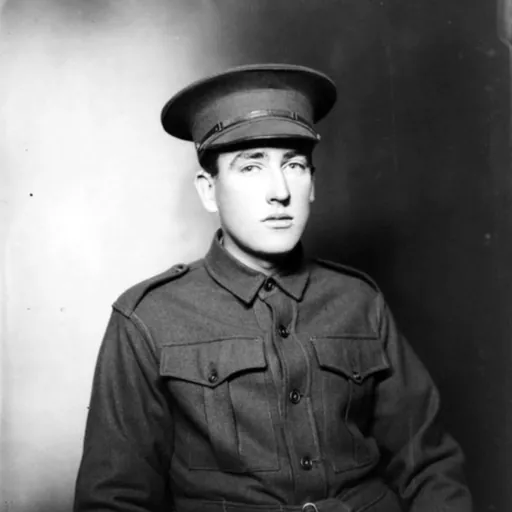
About Norm Lugg
Lived 1898 – 1936 (aged 38). Norm Lugg was an australian rules football player.
Military service Lugg, who came from Ararat, was 17 years of age when he enlisted in June 1915, to serve with the AIF in World War I. Attached to the 4th Reinforcements of the 21st Battalion, Lugg embarked with his unit aboard the HMAT Hororata on 27 September 1915.
He was at one point known to have been recovering at a convalescent camp in Bolougne.
Football career South Melbourne Soon after his return to Australia, Lugg began training with South Melbourne, who were the reigning VFL premiers. He was described by the local newspaper as being a "solid individual who kicks like a champion with either foot", while noting that he "lacks dash a little". His efforts in training were enough to earn selection for the opening round of the season.
He was a regular member of the South Melbourne team throughout the 1919 VFL season, with 17 appearances. In round 12, against St Kilda, Lugg played in a record game for South Melbourne, in which they amassed the league's highest ever fourth quarter score, 17.4 (106), as well as the highest team score, 29.15 (189). The winning margin, 171 points, stood until the 1979 season. He was mentioned in The Argus as one of the South Melbourne players to have excelled in that performance.
His best game however came in South Melbourne's semi final against Richmond. A follower, Lugg had been playing as a defender when not in the ruck, but was picked as a half forward, to fill in for the absent Harold Robertson. He kicked three goals, marked strongly and was dominant in the ruck, a performance described as the "game of his life". It wasn't enough though to prevent a 14-point loss to Richmond, which eliminated South Melbourne from the finals.
Fitzroy Lugg, who was suffering from injuries incurred during his war service, was granted a permit to join Fitzroy early in the 1921 VFL season. He appeared in 12 games for Fitzroy, his year ending in round 17 with a three-week suspension for retaliation against Essendon player Roy Laing, who had struck him.
Frankston Not selected for Fitzroy in 1922, Lugg left for the Nepean Football League in 1923 as the new captain-coach of Frankston. Not long into the season, Lugg had to retire from football due to illness and also resigned as coach.
Yeoman He recovered well enough the following year to be able to accept an appointment to coach Yeoman in Tasmania's North West Football Union, a position he held for only one season.
Death Lugg died at the Caulfield Repatriation Hospital on 12 April 1936, aged 38, due to illness from injuries he had sustained in the war.
Footnotes
Don’t just read it —
keep it.
Full-length biographies made to live with: read them, listen on the way to work, watch them tonight.
- E-book
- Audio
- Video
Instant download · yours to keep · every purchase keeps this site free
Important facts
People in Norm Lugg's life
Named in this biography and alive at the same time


Related people
Same field, nearest in time



Contemporaries
People whose lives overlapped Norm Lugg's



Frequently asked questions
Who was Norm Lugg?
Australian rules footballer (1898-1936)
When was Norm Lugg born?
Norm Lugg was born on 15 March 1898 in Ararat.
When did Norm Lugg die?
Norm Lugg died on 12 April 1936 in Caulfield.
What was Norm Lugg's occupation?
Norm Lugg was an australian rules football player.
Sources & further reading
Cite this page
APA: Biography.guide. (2026). Norm Lugg. https://biography.guide/norm-lugg/
MLA: "Norm Lugg." Biography.guide, https://biography.guide/norm-lugg/.
Chicago: "Norm Lugg." Biography.guide. https://biography.guide/norm-lugg/.
Data last updated: 2026-09-22 · Spot an error? Report a correction.
Portrait: Wikimedia Commons · author & licence
Page generated 2026-09-27 05:02 UTC