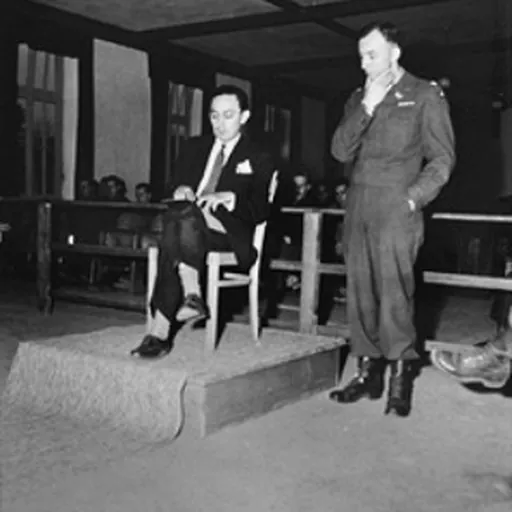
About Norbert Frýd
Lived 1913 – 1976 (aged 62). Norbert Frýd was a Czech writer, diplomat, journalist and dramaturge.
Norbert Frýd (born Norbert Fried) (21 April 1913 – 18 March 1976) was a Czech writer, journalist and diplomat. He is known mainly for his autobiographical novel Krabice živých (A Box of Lives, 1956), in which he describes his experiences in Nazi concentration camps. During World War II, he was imprisoned in the Theresienstadt, Auschwitz and Dachau-Kaufering concentration camps.
Biography Norbert Fried was born in České Budějovice to a family of Jewish merchants. His father was a Czech Jew and his mother came from a German Jewish family. He studied at the German gymnasium in his home town, graduating in 1932. He went on to study the Faculty of Law of the Charles University in Prague. After graduating in 1937 he studied for a doctorate in modern literature at the Faculty of Arts and Philosophy. He submitted his thesis on "The Origins of Czech Surrealism" in 1939 but was not awarded his PhD until 1945. In 1936 he began working as a lyricist, editor and script-writer for Metro–Goldwyn–Mayer and RKO Radiofilm. In 1939, when Jews were excluded from public employment, he was forced to work as a manual laborer not allowed to work for anyone outside Prague's Jewish community. which later he and Karel Reiner rearranged into a set of children's songs and choruses that were successfully performed in the ghetto. He also directed the play Esther (with music by Reiner). In Autumn 1944, he was transported to Auschwitz concentration camp, along with all the other artists imprisoned in Theresienstadt. At Auschwitz, he spent several nights sitting (together with thousands of other people) on a concrete floor in block "E2", located on the site of the former Roma camp. Subsequently, he was transferred to Dachau-Kaufering. "I was in Dachau-Kaufering at the end of 1944", he later remembered, "when the boys from all over Europe – French, Dutch, Germans, Poles, Yugoslavs, Greeks, we Czechs and I don't know who else – began to sing The Internationale in their mother languages, all together. It was a sound like I'd never heard before." In April 1945, as the SS were starting to evacuate the camps, he managed to escape. Frýd's father, brother and wife died in the concentration camps and he appears to have been the only member of his family to survive the Holocaust.
After the war, he worked as a journalist and an official of the Czechoslovak Communist Party. In 1946, he changed his name to Frýd. A year later, in 1947, he became a cultural diplomatic attaché in Mexico and subsequently served in various diplomatic posts in Latin America and the U.S. After a brief period of employment with Czechoslovak Radio from 1951–1953, he embarked on a career as a freelance writer. You know, I remembered him as a cheerful guy who was always playing the guitar and singing. Then he was taken in a transport to the camps. He came back from Dachau, but he was a different person. No guitar, no singing. When I gave him my hand, I realized the terrible change. He had cold moist hands, as if you were touching a corpse. He suffered from depression and anxiety. He had to cope with terrible fear. And yet he wasn't scared and went to the communist Department of the Interior on my behalf", she said.
From 1951 until the early 1970s, he served as a delegate to UNESCO. in 1956. The plot is set in the last months of 1944, in the fictional concentration camp of Gigling. The main character, the young intellectual Zdeněk Roubík, is an assistant in the camp office. One of his jobs is to maintain the card index of the inmates, hence the title of the novel, "A Box of Lives". In the camp, Roubík gradually manages to overcome the apathy and depression caused by the death of his brother and he becomes more actively involved in camp life. The author attempts to depict everyday life, social interactions and relationships in the camp, and the work and hardships of the inmates. The description of the SS guards in the camp is a focus of particular attention. Vzorek bez ceny a pan biskup aneb Začátek posledních sto let (1966), Part 1 Hedvábné starosti aneb Uprostřed posledních sto let (1968) Part 2 Lahvová pošta aneb Konec posledních sto let (1971) Part 3 Císařovna (1972) Almara plná povídaček (1973) Rukama nevinnosti (1974) Květovaný kůň (1975, children's book) Oživení v sále (1976) Tři nepatrní muži (1978) short stories
Scenic Noc kotrmelců (1962)
Other Mexická grafika (1955)
English translations Frýd, Norbert: A Box of Lives. Prague: Artia, 1962
Don’t just read it —
keep it.
Full-length biographies made to live with: read them, listen on the way to work, watch them tonight.
- E-book
- Audio
- Video
Instant download · yours to keep · every purchase keeps this site free
Important facts
People in Norbert Frýd's life
Named in this biography and alive at the same time

Related people
Same field, nearest in time


Contemporaries
People whose lives overlapped Norbert Frýd's





Frequently asked questions
Who was Norbert Frýd?
Czech writer, journalist and diplomat (1913–1976)
When was Norbert Frýd born?
Norbert Frýd was born on 21 April 1913 in České Budějovice.
When did Norbert Frýd die?
Norbert Frýd died on 18 March 1976 in Prague.
What was Norbert Frýd's occupation?
Norbert Frýd was a writer, diplomat, journalist and dramaturge.
What nationality was Norbert Frýd?
Norbert Frýd was Czech.
Sources & further reading
Cite this page
APA: Biography.guide. (2026). Norbert Frýd. https://biography.guide/norbert-fryd/
MLA: "Norbert Frýd." Biography.guide, https://biography.guide/norbert-fryd/.
Chicago: "Norbert Frýd." Biography.guide. https://biography.guide/norbert-fryd/.
Data last updated: 2026-09-23 · Spot an error? Report a correction.
Portrait: Wikimedia Commons · author & licence
Page generated 2026-09-27 05:07 UTC