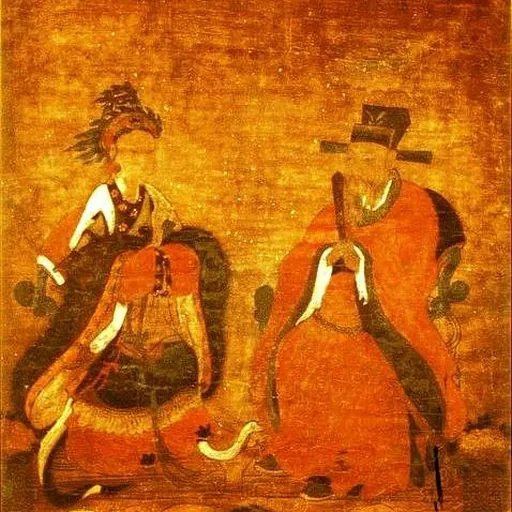
Noguk
Queen; Mongolian princess and Korean Queen
About Noguk
Lived 1350 – 1365 (aged 14–15). Noguk was a queen consort.
Princess Supreme Noguk (; d. 8 March 1365), also known as Queen Indeok and Queen Mother Indeok during her stepson, King U of Goryeo's reign. She was a Yuan dynasty imperial family member as the great-granddaughter of Darmabala, and a niece of Princess Joguk who became a Korean queen consort though her marriage with Gongmin of Goryeo as his primary wife. Her personal name was Borjigin Budashiri (; ). She was the last Mongol to become queen consort of Goryeo.
Biography The future Princess Noguk was born Budashiri, a member of the Yuan dynasty's ruling Borjigin clan and a great-great-great-granddaughter of Kublai Khan. Though her birth year is unknown, she is recorded as having married the reformist monarch Gongmin of Goryeo in the Yuan capital of Khanbaliq in 1349, after which she went to live in Goryeo.
Noguk's marriage followed a practice established by Kublai Khan, where female members of the Yuan imperial clan were married to Goryeo princes in order to maintain Yuan hegemony on the Korean peninsula. By contrast with earlier marriages between the Yuan and Goryeo dynasties, however, Budashiri's marriage to Gongmin was described as happy
After her death, King Gongmin was said to have been deeply saddened and became indifferent to politics with entrusted great tasks to a Buddhist monk, Pyeonjo, who was executed in 1371. King Gongmin was killed in his sleep by Hong Ryun , Choe Man-saeng , and others in 1374.
Legacy King Gongmin began the construction of a tomb near Kaeseong after the queen's death. The queen was interred under the mound Jeongreung, and her husband was later buried under an accompanying mound known as Hyeonreung.
In 1367, she posthumously received the title "princess supreme" (, ) – typically accorded to aunts of emperors (even though she was not).
According to the Veritable Records of the Joseon Dynasty, the tenth king Yeonsan believed that Princess Noguk had looked similar to his mother, the deposed Queen Yun, so he collected the princess' portraits at government offices.
In popular culture Television series Portrayed by Sunwoo Eun-sook in the 1983 KBS TV series Foundation of the Kingdom. Portrayed by Seo Ji-hye in the 2005–2006 MBC TV series Shin Don. Portrayed by Park Se-young in the 2012 SBS TV series Faith. Portrayed by Bae Min-hee in the 2012–2013 SBS TV series The Great Seer.
Film Portrayed by Choi Eun-hee in the 1967 film A Tender Heart.
Novel Portrayed in the 1942 novel A Tender Heart (다정불심; a.k.a. "Tender Heartedness") by Park Jong-hwa.
Don’t just read it —
keep it.
Full-length biographies made to live with: read them, listen on the way to work, watch them tonight.
- E-book
- Audio
- Video
Instant download · yours to keep · every purchase keeps this site free
Important facts
People in Noguk's life
Named in this biography and alive at the same time

Related people
Same field, nearest in time




Frequently asked questions
Who was Noguk?
queen; Mongolian princess and Korean Queen
When was Noguk born?
Noguk was born in 1350 in Yuan dynasty.
When did Noguk die?
Noguk died on 8 March 1365 in Goryeo.
What was Noguk's occupation?
Noguk was a queen consort.
Sources & further reading
Cite this page
APA: Biography.guide. (2026). Noguk. https://biography.guide/noguk/
MLA: "Noguk." Biography.guide, https://biography.guide/noguk/.
Chicago: "Noguk." Biography.guide. https://biography.guide/noguk/.
Data last updated: 2026-09-23 · Spot an error? Report a correction.
Portrait: Wikimedia Commons · author & licence
Page generated 2026-09-27 05:07 UTC