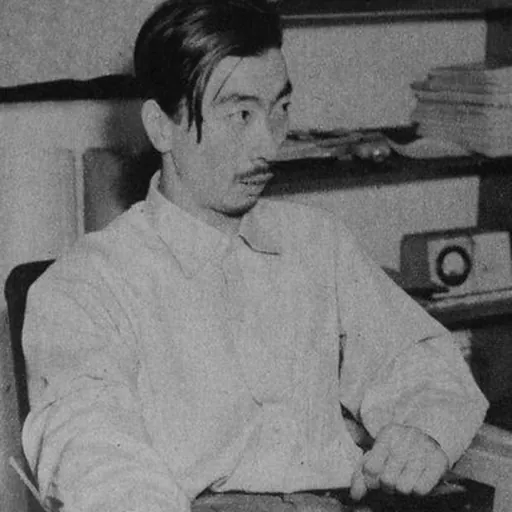
About Noboru Baba
Lived 1927 – 2001 (aged 73). Noboru Baba was a Japanese mangaka, kamikaze, picture book writer, artist, illustrator and comics artist.
was a Japanese manga artist and writer. He is best known for his long-running four-panel newspaper comic Baku-san and for the acclaimed children’s picture book series 11 Piki no Neko (Eleven Cats). Active from the postwar period through the late 20th century, Baba was often referred to as one of the “Three Crows of Children’s Manga,” alongside Osamu Tezuka and Eiichi Fukui.
Life and career Noboru Baba was born in Sannohe in Aomori Prefecture in 1927. The youngest of three siblings, he displayed an early talent for drawing and was particularly inspired by Suihō Tagawa’s manga Norakuro, which would leave a lasting impression on his approach to animal characters. He became friends with children's writer Shigeru Shiraki, who was from the same town as him. After graduating from Aomori Prefectural Aomori High School, Baba enrolled at Tokyo Fine Arts School (now Tokyo University of the Arts). His studies were interrupted when he was drafted into military service during the Second World War.
Following the war, Baba returned to Aomori and took a job at the regional newspaper Tō-Ō Nippō, where he contributed illustrations and comic strips. His debut as a professional manga artist came in the last 1940s with work published in Shin Nihon Manga. In 1950, he relocated to Tokyo to pursue his career full-time, motivated by Shigeru Shiraki. When he started his career as a manga artist, he published popular children's manga like Posto-kun and Būtan. Eventually, he started drawing manga also for other newspapers and weekly magazines.
In 1967, Baba published the first volume of 11 Piki no Neko (Eleven Cats), a humorous picture book about a group of mischievous, scheming cats who work together and occasionally betray each other in pursuit of food, adventure, or survival. The book became a bestseller and led to five sequels, as well as animated adaptations and stage plays. This series, which ran until 1996, solidified Baba’s reputation as one of Japan’s most important creators of children's literature. Though he is less well known internationally than some of his contemporaries, Baba is frequently cited in Japan as a formative figure in both postwar manga and modern picture book publishing. His influence can be traced in the work of later generations of artists. Keiji Nakazawa, known for his series Barefoot Gen, read his work.
Selected works
Manga
Picture books TitleYearNotesRefsKitsune Mori no Yamaotoko (きつね森の山男)1963 11-piki no Neko (11ぴきのねこ)1967–1996Published in 6 vol. Buta Tanuki Kitsune Neko (ぶたたぬききつねねこ)1978 Budōbatake no Ao-san (ぶどう畑のアオさん)2001
Don’t just read it —
keep it.
Full-length biographies made to live with: read them, listen on the way to work, watch them tonight.
- E-book
- Audio
- Video
Instant download · yours to keep · every purchase keeps this site free
Important facts
People in Noboru Baba's life
Named in this biography and alive at the same time



Related people
Same field, nearest in time




Contemporaries
People whose lives overlapped Noboru Baba's

Frequently asked questions
Who was Noboru Baba?
Japanese mangaka (1927-2001)
When was Noboru Baba born?
Noboru Baba was born on 18 October 1927 in Sannohe.
When did Noboru Baba die?
Noboru Baba died on 7 April 2001 in Nerima.
What was Noboru Baba's occupation?
Noboru Baba was a mangaka, kamikaze, picture book writer, artist, illustrator and comics artist.
What nationality was Noboru Baba?
Noboru Baba was Japanese.
Sources & further reading
Cite this page
APA: Biography.guide. (2026). Noboru Baba. https://biography.guide/noboru-baba/
MLA: "Noboru Baba." Biography.guide, https://biography.guide/noboru-baba/.
Chicago: "Noboru Baba." Biography.guide. https://biography.guide/noboru-baba/.
Data last updated: 2026-09-23 · Spot an error? Report a correction.
Portrait: Wikimedia Commons · author & licence
Page generated 2026-09-27 05:06 UTC