
About Nnenna Okore
Born 1975. Nnenna Okore is a Nigerian artist and sculptor.
Nnenna Okore (born 1975 in Canberra, Australia) is an Australian-born Nigerian artist who lives and works in Chicago at North Park University, Chicago. Her largely abstract sculptural forms are inspired by richly textured forms and colours within the natural environment. Okore's work frequently uses flotsam or discarded objects to create intricate sculptures and installations through repetitive and labor-intensive processes. She learnt some of her intricate methods, including weaving, sewing, rolling, twisting and dyeing, by watching local Nigerians perform daily domestic tasks. Her work has been shown in galleries and museums within and outside of the United States. She has won several international awards, including a Fulbright Scholar Award in 2012. and the Australian Creative Victoria Award in 2021.
Okore is currently a Professor of Art at North Park University in Chicago, where she runs the sculpture program. As an environmental artist, researcher, and teacher, Okore uses her eco-centered art practice to engender learning, artistic experience, and ecological awareness through art.
Background
Okore was born in Canberra, Australia to parents from Uturu, Abia State in the southeastern region of Nigeria. After moving from Australia to Nigeria at the age of four, Okore spent most of her childhood in the university town of Nsukka, Enugu State in southeastern Nigeria, where both parents worked as academics at the University of Nigeria, Nsukka (UNN). Okore's art was subsequently influenced by visual characteristics of the Nsukka environs, such as dilapidated mud adobe houses with zinc roofing, piles of firewood accumulated against a broken structure, traditional clothing, concrete blocks, market wares, and rugged terrains. Growing up in a tropical environment where decay and rebirth were integral to the way of life, she also had a strong fascination for lifeless materials in nature, including rocks, tree bark, detritus, and skeletal forms. She was especially enamored by the red-coloured Nsukka soil that characteristically left traces of red dust on most things.
Living on the university campus, Okore was closely connected to the rural Nsukka neighborhoods that bordered the school vicinity. She drew lots of creative inspirations and material sensibilities from their cultural and social landscapes. These cultural experiences have contributed to how she addresses subjects spanning environmental issues to the embodied connectivity to material things, people and natural forces in her works.
Education Okore attended the University of Nigeria Nsukka Primary School, the University of Nigeria Nsukka Secondary School, Her enthusiasm for art grew during her primary school years, when she started knitting, sewing, and crocheting. In her secondary school years, she drew and painted many still-life compositions. During that time, Okore won multiple art awards, including the UNESCO African Child Art Prize in 1993. She credits her artistic growth to her family, whom she notes were incredibly supportive, and enabling of her desire to pursue art.
By the time she graduated from high school in Swaziland, Okore was proficient in printmaking, pottery, modeling, and acrylic painting. A few years later, she won the UNIFEM Women's Empowerment Art Prize (1994) which earned her several roundtrips to local and international destinations in Nigeria, Senegal, and China to represent African youth at women's conferences. which platformed many international female celebrities and leaders from across the globe.
In 1995, Okore enrolled in the Fine and Applied Arts undergraduate program at the University of Nigeria, Nsukka. This enabled her to create unique surface textures that were characterized by buildups with soil, rope, fabric and other found objects. By her final year as an undergraduate student, her focus had widened to include a discourse on the transformative power of material things. Few teachers from the Nsukka school that influenced Okore during her time there, included Chijioke Onuora, Chike Aniakor, and El Anatsui. Okore was also heavily influenced by Arte Povera whose experiential style appeals strongly to her visual narrative. Two years later, Okore relocated to the United States for a masters of fine arts program at the University of Iowa, which she completed in 2005.
Professional accomplishments Fiber art installation After graduating from the University of Iowa, Okore was recruited by North Park University in 2005 to teach and oversee its sculptural program. She is presently a Professor of Art and instructs students in Three-dimensional Designs, Sculptural Practices, Video Art, and Drawing, among other subjects. To balance her career and personal life, she devotes, at least, two days of the week to her studio practice. She has been featured in publications, such as Sculpture Magazine, The New York Times, Financial Times, Art South Africa, Ceramics: Art and Perception, and The Guardian, among others. In 2012, Okore received a Fulbright Scholar Award, which enabled her to travel to Nigeria for a year-long teaching project at the University of Lagos. During her one-year stint, she produced a new body of eco-based artworks and introduced students to environmental art concepts that focused on nature-centered processes, materials, and sites. She returned to the United States after completing her project in 2013.
Okore is also a recipient of the 2021 Australian Creative Victoria Creators Fund Award. Her works have been featured in important exhibitions at the Museum of Art and Design, The Frances Young Tang Teaching Museum and Art Gallery, Museum of Contemporary African Diasporic Art, Spelman College Museum of Fine Art, Museu Afro Brasil, Memphis Brooks Museum of Art, Musée des Civilizations Noires, and Cleveland Museum of Art. Okore's towering installation titled, 'And the World Keeps Turning' was on view at the 2021 Brugge Triënnale, Belgium. She has also featured in the Stoa 169 Columned Hall exhibition in Polling, Germany, the 'Invincible Hands' at the Yemi Shyllon Museum of Art, Lagos, and 2021 Chengdu Biennale in Chengdu, China.
Materials
Fiber art installation Okore's early years in the United States presented her with environmental and cultural differences. While adopting new materials inspired by her surroundings, she incorporated similar objects to those she used in Nigeria, like sticks, leaves, or jute materials. Okore's material choice is also heavily influenced by the philosophy of creating innovative artistic forms by repurposing everyday material. This style of making was adopted, in part out of necessity, due to the high cost of Western-produced art materials. Rather than being stifled by the ephemerality of materials like discarded newspapers or wax, Okore turned her focus to their sculptural potentialities instead.
Okore tends to feature organic, fibrous, malleable, and ethereal qualities of materials in her works. Her works, for instance, capture the visual characteristics of transient, root-like, or dense forms. Paper, in particular, offers a range of possibilities to Okore's process. By following the non-traditional route, she creates rich, bodily handmade paper textures by pulping and layering together materials including found paper, jute fiber, dye, coffee, and lint.
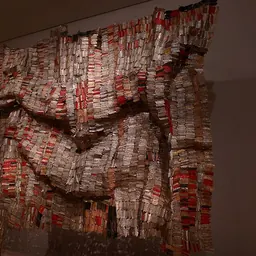
Work and concept bioplastic Installation Themes of aging, death, and decay are recurrent in Okore's work and highlight the vulnerability and fragility of Earth. She captures the diverse and tactile aspects of the physical world through weathered, dilapidated and lifeless forms. Through manually repetitive processes, Okore's works reveal the complex and distinct properties of fabric, trees, topography, and architecture. Her works are also inspired by traditional women's crafts in Africa such as textiles. Okore engages in a slow, arduous process of weaving, dyeing, winding, and teasing materials like burlap, wire, and paper, sometimes sourced from West Africa, to create dramatic textile installations.
More recently, Okore's environmental practice has expanded to include the creation of bioplastic artworks made from food waste, such as mushrooms, onion, orange, and banana peels.
Being an Igbo woman, Okore also draws on elements of Igbo culture and history, specifically the lasting effects of colonialism. Okore regularly takes trips home to Nigeria, as a way of staying connected to her Nigerian memories of the environment and culture that inspires much of her work.
Gallery representation October Gallery, London, United States. Jenkins Johnson Gallery, San Francisco, United States. David Krut Gallery, New York City, United States. Kuaba Gallery, Indianapolis, United States.
Select collections Krannert Art Museum, University of Urbana Champaign, USA. Jorge M. Pérez Collection, Miami, USA. EbonyLife Place, Victoria Island, Nigeria. Four Seasons Hotels and Resorts, California, USA. North Park University, Chicago, USA. World Bank, Washington DC, USA. Brooklyn Academy of Music, NY, USA. United States Embassy, Abuja, Nigeria. Eko Hotel and Suites, Lagos, Nigeria. Halls Winery, Napa, CA, USA. The Newark Museum of Art, New Jersey, USA. Jean Paul Blachère Fondation, France. Royal Collections, Abu Dhabi, UEA. Art House Contemporary Limited, Nigeria. Channel 4, London, UK. Renaissance Capital, Moscow, Russia. Daraja Art Foundation, London, UK.
Don’t just read it —
keep it.
Full-length biographies made to live with: read them, listen on the way to work, watch them tonight.
- E-book
- Audio
- Video
Instant download · yours to keep · every purchase keeps this site free
Important facts
People in Nnenna Okore's life
Named in this biography and alive at the same time



Related people
Same field, nearest in time


Contemporaries
People whose lives overlapped Nnenna Okore's

Frequently asked questions
Who is Nnenna Okore?
Nigerian artist
When was Nnenna Okore born?
Nnenna Okore was born in 1975 in Australia.
What is Nnenna Okore's occupation?
Nnenna Okore is an artist and sculptor.
What nationality is Nnenna Okore?
Nnenna Okore is Nigerian.
Sources & further reading
Cite this page
APA: Biography.guide. (2026). Nnenna Okore. https://biography.guide/nnenna-okore/
MLA: "Nnenna Okore." Biography.guide, https://biography.guide/nnenna-okore/.
Chicago: "Nnenna Okore." Biography.guide. https://biography.guide/nnenna-okore/.
Data last updated: 2026-09-25 · Spot an error? Report a correction.
Page generated 2026-09-27 05:11 UTC