
About Niña Pastori
Born 1978. Niña Pastori is a Spanish singer.
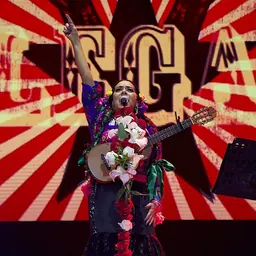
María Rosa García García (born 15 January 1978 in San Fernando, Cádiz), better known as Niña Pastori, is a Spanish flamenco singer (cantaora).
Biography María Rosa García was born in 1978 in the town of San Fernando in Cádiz. The youngest of five siblings and the only daughter of a military man (José García) and flamenco singer "La Pastori" García.
Her stage name is "Niña Pastori" because among her five older brothers, she was the only woman, and she was referred to as "la niña"; she was also "la única hija de la Pastori" (the only daughter of la Pastori), and when she went on stage, people remarked, “va a cantar la niña de la Pastori” (la Pastori's girl is going to sing). Her initial name was "La niña de la Pastori", but she later changed it to "Niña Pastori".
She went to junior school at the Vicente Tofiño school in San Fernando (Cádiz).
She started her artistic career at a young age singing in Andalusia. At the age of six, she accompanied her mother in the flamenco tablaos of "Barrio de la Pastora", and a year later won a singing contest at the "El Chato" club in San Fernando, where she sang bulerías (a flamenco style) and won first prize. Following this performance, she gained recognition for her vocal ability at a young age. Part of this was due to the single Tú me camelas, which was a hit in Spain in summer 1996. The trio also collaborated with Santana on the track Una Noche en Nápoles for the 2014 album Corazón.
In 2018, she was awarded the Medalla de Andalucía, where she performed the Andalusian hymn. She also received the Honorary Award for her National and International Career at the Premios Flamenco En La Piel awards at the International Salon of Flamenco Fashion (SIMOF) 2018.
She sang a version of Schubert's Ave Maria during Pope John Paul II's last visit to Madrid in May 2003 for 3 million people. Later, this version was included in a new edition of her album María released in 2006.
Discography
-Entre dos puertos. 1996
Produced by Paco Ortega and Alejandro Sanz, it was her first studio album, which she recorded aged just 17. The album went platinum (150,000 copies sold), and her single "Tú me camelas" managed to be among the top of the music charts for months. As for its content, the album offers a mix of pop along with rumbas, fandangos, bulerías and tanguillos.
-Eres Luz. 1998
Eres Luz is the second studio album by Niña Pastori, produced by Paco Ortega and Alejandro Sanz, published by Sony BMG, and recorded and released in 1998. The album includes songs with Alejandro Sanz, Parrita, Paco Ortega and her brother, Paco. This album offers a fresh touch of flamenco.
-Canaílla. 2000
It is her record of consecration and was produced by Alejandro Sanz. It offers collaborations with various artists such as José Miguel and Antonio Carmona, Vicente Amigo, Moraito, etc. It is a disc of varied content, catering to all audiences.
-María. 2002
This album was again designed and planned by Niña Pastori and her partner Julio Jiménez Borja, alias Chaboli. Thus, the latter was the one that produced all the songs on the album except two, "Amor de San Juan" and "De boca en boca", which were produced by his author, José Manuel Ruiz, known as Queco.
-No hay quinto malo. 2004
“No hay quinto malo” is the fifth album of Niña Pastori. It offers both CD and DVD versions, and was shot by director Juan Estelrich. Niña Pastori participated in the composition of all the songs of this album along with her husband, Chaboli, and Jeros. It is her riskiest album, but also the purest and most intimate.
-Joyas prestadas. 2006
On this album, the artist covers her favourite songs for the first time, which are special for her and have helped her in her life. It includes songs by Joan Manuel Serrat, Alejandro Sanz, Maná, Juan Luis Guerra, Antonio Machín, Manolo García, Luz Casal, Armando Manzanero and Marifé de Triana.
-Esperando verte. 2009
She recorded it together with her husband, Chaboli, whilst being pregnant with her first daughter, to which she refers in many of her songs. The album includes very varied styles from tangos to bulerías and fandangos.
The title track of the album, "Esperando verte", is a song dedicated entirely to her daughter. Thus, this album is considered for her as one of the most special due to her pregnancy.
-La orilla de mi pelo. 2011
This album won the Latin Grammy for the Best Flamenco Album. In this album, pop predominates over flamenco. Thus, there is a change in the accompaniment of her songs, leaving aside the flamenco guitar and replacing it with the acoustic and electric guitar.
Pastori described the themes of the album as centring on passion, romance, and artistic purity.
-Raíz. 2014.
On this album, Pastori worked with the Mexican singer-songwriter Lila Downs and the Argentinian folk singer Soledad Pastorutti. The album was produced by Aneiro Taño and J. Jiménez, also known as "Chaboli." Through their songs, they share particular features of their folklore and their nations.
-Ámame como soy. 2015
This repertory arose from the collaborations of Niña Pastori with Ruben Blades, Juan Luis Guerra, Pancho Céspedes and Sara Baras for the first time.
-Bajo tus alas. 2018
This album was produced by Chaboli and mixed in Los Angeles by Rafa Sardina. In `Bajo tus alas`, Niña Pastori offers songs accompanied by great musical artists such as Manuel Carrasco, Guaco, Vanesa Martín and Pablo Alborán.
It's another step in her personal style, which is influenced by flamenco, and the album also highlights the depth of her voice.
The starting point of her presentation tour of Bajo tus Alas was in Campanario.
Collaborations La Roja Baila: Sergio Ramos, RedOne. Entre dos puertos: Antonio Reyes (bailaor); Ricardo Miño, Moraíto Chico, Juan Manuel Cañizares, Rafael Riqueni and Ramón Trujillo (guitarrista). Eres luz: Moraíto, Juan Carlos Romero, Machuka, Alejandro Sanz, José Antonio Rodríguez and Juan Manuel Cañizares (guitarists); Manuel Soler, El Bandolero and Chaboli (percussionista). Cañaílla: Guadiana (cantaor), Antonio Carmona (cantador); José Miguel Carmona, Diego Carrasco, Diego del Morao, Moraíto Chico and Vicente Amigo (guitarista); Alejandro Sanz (compositante); El Bandolero and Chaboli (percussionista). María: Farruquito (bailaor); José Carlos Gómez, Moraíto Chico, Diego del Morao and José Antonio Rodríguez (guitarists); El Bandolero, Chaboli and Tino di Geraldo (percussionists). No hay quinto malo: Paquete, Diego del Morao, Juan Carmona and José Miguel Carmona (guitarists); Luis Dulzaides, Tino di Geraldo and Chaboli (percussionists); Carles Benavent (bass); Victor Merlo (double bass). Joyas prestadas: José Miguel Carmona and Diego Moreno (guitarists); Chaboli and Angie Bao (percussionist); Antonio Serrano (harmonica); Nacho Mañó and Antonio Ramos "Maca" (bass); José María Cortina and Santi Navalón (keyboards). Raíz: Lila Downs and Soledad Pastorutti.
Don’t just read it —
keep it.
Full-length biographies made to live with: read them, listen on the way to work, watch them tonight.
- E-book
- Audio
- Video
Instant download · yours to keep · every purchase keeps this site free
Important facts
People in Niña Pastori's life
Named in this biography and alive at the same time







Related people
Same field, nearest in time





Contemporaries
People whose lives overlapped Niña Pastori's


Frequently asked questions
Who is Niña Pastori?
Spanish recording artist; singer
When was Niña Pastori born?
Niña Pastori was born on 15 January 1978 in San Fernando.
What is Niña Pastori's occupation?
Niña Pastori is a singer.
What nationality is Niña Pastori?
Niña Pastori is Spanish.
Sources & further reading
Cite this page
APA: Biography.guide. (2026). Niña Pastori. https://biography.guide/nina-pastori/
MLA: "Niña Pastori." Biography.guide, https://biography.guide/nina-pastori/.
Chicago: "Niña Pastori." Biography.guide. https://biography.guide/nina-pastori/.
Data last updated: 2026-09-20 · Spot an error? Report a correction.
Page generated 2026-09-27 05:09 UTC