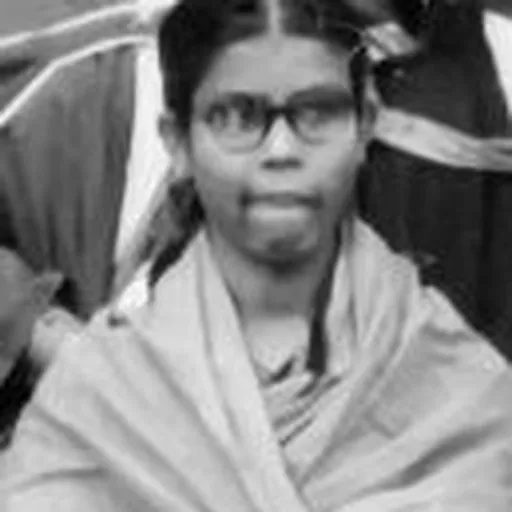
About Nilima Ibrahim
Lived 1921 – 2002 (aged 80). Nilima Ibrahim was a Bangladeshi, Indian and Pakistani writer and academic.
Neelima Ibrahim (11 October 1921 – 18 June 2002) was a Bangladeshi educationist, littérateur and social worker. She is well known for her scholarship on Bengali literature but even more so for her depiction of raped and tortured women in the 1971 Bangladesh Liberation War in her book Ami Birangana Bolchi. She was awarded Bangla Academy Literary Award in 1969, Begum Rokeya Padak in 1996 and Ekushey Padak in 2000 by the Government of Bangladesh for her contributions to Bangla literature.
Early life and education Neelima was born on 11 October 1921 in Bagerhat, Khulna to Zamindar Prafulla Roy Chowdhury and Kusum Kumari Devi. Ibrahim passed her school leaving examination and entrance level examinations from the Khulna Coronation Girls' School in 1937 and from the Victoria Institution in Calcutta in 1939. Such women were accorded the title Birangona (war heroine) by the Government of Bangladesh, but this did not prevent them from being stigmatized. Appalled by newspaper accounts that some victims of sexual violence preferred to be sent to prisoner of war camps in India with their Pakistani rapists, rather than endure familial rejection and social scorn in Bangladesh, Ibrahim was moved to interview them.
She published a collection of seven of these first-person narratives in her two-volume Ami Birangona Bolchi (The Voices of War Heroines) in 1994 and 1995. Social anthropologist Nayanika Mookherjee writes that, "The text suggests that ... 'traditional, backward Islamic norms' cause the rejection of raped women and contribute to their trauma." Bangladeshi academic Firdous Azim describes the book as "path-breaking" and "an integral part of a feminist historicizing of the war of liberation in Bangladesh."
Works
Non-fiction Sharat-Pratibha (The Creative Faculty of Sharatchanda), 1960, Banglar Kavi Madhusudan (Madhushudan, the Poet of Bengal), 1961, Unabingsha Shatabdir Bangali Samaj o Bangla Natak (Bengali Society and Bengali Drama in the 19th century), 1964, Bangla Natak: Utsa o Dhara (Bengali Drama: Origin and Development), 1972, Begum Rokeya, 1974, Bangalimanas o Bangla Sahitya (Bengali Mentality and Bengali Literature), 1987, Sahitya-Sangskrtir Nana Prasanga (Various Aspects of Literature and Culture), 1991
Fiction Bish Shataker Meye (Girl of the Twentieth Century), 1958, Ek Path Dui Bank (The Forked Road), 1958, Keyabana Sancharini (Traveller of Keya Forest), 1958, Banhi Balay (The Bangle of Fire), 1985
Plays Due Due Char (Two and Two Make Four), 1964, Je Aranye Alo Nei (The Dark Forest), 1974, Rodjwala Bikel (The Sunburnt Afternoon), 1974, Suryaster Par (After Sunset), 1974
Short stories Ramna Parke (At Ramna Park), 1964
Translations Eleanor Roosevelt, 1955, Kathashilpi James Fenimor Cooper (Storyteller James Fenimore Cooper), 1968, Bostoner Pathe Pathe (On the Streets of Boston), 1969
Travelogue Shahi Elakar Pathe Pathe (Along the Royal Streets), 1963
Autobiography Bindu-Bisarga (Dot and Ghost), 1991
Narratives/Ethnography Ami Birangana Bolchhi (I, the Heroine, Speaks), 1996
Awards Bangla Academy Literary Award (1969) Michael Madhusudan Award (1987) Lekhika Sangha Award (1989) Anannya Literature Award (1996) Begum Rokeya Padak (1996) Bangabandhu Award (1997) Ekushey Padak (2000) The Independence Award (Swadhinata Puroshkar) (2011)
Don’t just read it —
keep it.
Full-length biographies made to live with: read them, listen on the way to work, watch them tonight.
- E-book
- Audio
- Video
Instant download · yours to keep · every purchase keeps this site free
Important facts
Family & relationships
People in Nilima Ibrahim's life
Named in this biography and alive at the same time


Related people
Same field, nearest in time


Contemporaries
People whose lives overlapped Nilima Ibrahim's




Frequently asked questions
Who was Nilima Ibrahim?
Bangladeshi writer (1921-2002)
When was Nilima Ibrahim born?
Nilima Ibrahim was born on 11 October 1921 in Bagerhat Sadar Upazila.
When did Nilima Ibrahim die?
Nilima Ibrahim died on 18 June 2002 in Dhaka.
What was Nilima Ibrahim's occupation?
Nilima Ibrahim was a writer and academic.
What nationality was Nilima Ibrahim?
Nilima Ibrahim was Bangladeshi, Indian and Pakistani.
Sources & further reading
Cite this page
APA: Biography.guide. (2026). Nilima Ibrahim. https://biography.guide/nilima-ibrahim/
MLA: "Nilima Ibrahim." Biography.guide, https://biography.guide/nilima-ibrahim/.
Chicago: "Nilima Ibrahim." Biography.guide. https://biography.guide/nilima-ibrahim/.
Data last updated: 2026-09-22 · Spot an error? Report a correction.
Portrait: Wikimedia Commons · author & licence
Page generated 2026-09-27 05:02 UTC