
About Nikolay Voronov
Lived 1899 – 1968 (aged 68). Nikolay Voronov was a Russian military officer, politician, marshal and artillery.
Nikolai Nikolayevich Voronov (; – 28 February 1968) was a Soviet general, Chief Marshal of Artillery, and Hero of the Soviet Union (7 May 1965). He was commander of artillery forces of the Red Army from 1941 until 1950. Voronov commanded the Soviet artillery during the Battle of Stalingrad and was the Stavka representative to various fronts during the Siege of Leningrad and the Battle of Kursk. He also fought in the Russian Civil War, the Polish-Soviet War and the Battle of Khalkhin Gol, as well as serving as an advisor to the Spanish Republican Army during the Spanish Civil War.
Early life Nikolai Voronov was born on 5 May 1899 in Saint Petersburg to Nikolai Terentyvich Voronov, a clerk, and Valentina Voronov. After the Revolution of 1905, Voronov's father became unemployed due to his Russian Social Democratic Labour Party sympathies. On 30 November 1908, his poverty-stricken mother committed suicide by taking cyanide. Voronov dropped out of a private school in 1914 due to financial problems and in 1915 got a job working as a secretary for an attorney. In the fall of 1916, his father was drafted. In 1917, Voronov passed an external degree examination. after which he was a platoon commander in a howitzer battalion in the Petrograd 2nd Battery. As part of the 15th Army, he fought in battles against Nikolai Yudenich's forces near Pskov. His battery was armed with the 76 mm divisional gun M1902 instead of the 122 mm howitzer M1910. On 17 August, Voronov received a severe concussion during a battle in the village of Józefów nad Wisłą. When he regained consciousness, he found that Polish troops had captured the village. The injured Voronov attempted to escape on a horse, but was captured. During his eight months of captivity, Voronov suffered from typhus and twice came close to having his leg amputated. He was repatriated at the end of the war in April 1921.
Interwar period In the summer of 1922, Voronov was appointed commander of the howitzer battery of the 27th Rifle Division. In fall 1923 he attended the school of higher artillery commanders and after graduation continued to serve with the 27th Rifle Division. During the 1926 maneuvers, Voronov distinguished himself commanding the artillery of the Belorussian Military District. As a reward, he was granted permission to take the entrance examination for the Frunze Military Academy.
In 1930, Voronov graduated from the academy. He became the commander of the artillery regiment of the 1st Moscow Rifle Division. In April 1934, he was appointed chief military Commissar of the 1st Artillery School. where he worked on the training of artillery units on the Madrid Front. During his tour in Spain, Voronov was awarded the Order of Lenin and the Order of the Red Banner. In June 1937, Voronov returned to Moscow. In November, Voronov inspected the troops of the Leningrad Military District, in readiness for the Winter War. During the war, he led artillery units, mainly those of the 7th Army, and fought in the offensive against the Mannerheim Line. of the artillery after the introduction of Red Army general officers ranks. On 20 July, he was ordered organized antitank artillery during the Yelnya Offensive. After returning to Moscow, Voronov, together with Leonid Govorov, developed detailed instructions on antitank tactics, which was soon sent to the troops as a Stavka directive. As part of the State Defense Committee, Voronov went to Leningrad to organized antitank defence and the artillery. Through the efforts of Voronov, the GRAU became subordinate to the Chief of the Artillery. Voronov also set up an artillery headquarters, led by Ivan Susloparov.
After his return in mid-September to Moscow, Voronov at the request of the Leningrad Front's military council was sent to Leningrad, where he assisted in the carrying out of counterattacks. After returning to Moscow in October, Voronov reviewed the readiness of the Moscow Reserve Front and also worked on the formation of antitank and artillery regiments intended for the defence of Moscow. In late October, Voronov was sent back to Leningrad to organized the front's artillery during the Sinyavino Offensive in the area of the Nevsky Pyatachok. He also met his father, who continued to stay in the city.
Voronov worked on the supply, acquisition and coordination of artillery units in the areas of the Winter Campaign of 1941–42. In his report to Stalin of 28 February, Voronov raised the question of military air defence, which since November 1941 had remained without leadership. On 2 June, by order of the People's Commissariat for Defence, all air defence units were subordinated to the front artillery commanders and the chief of the artillery. In early June, Voronov took part in the planning and conducting of operations on the left flank of the Western Front. In July, he went to Stalingrad to assist the retreating 62nd Army and 64th Army. During the Moscow Conference, Shaposhnikov, Voroshilov and Voronov represented the Soviet Union during talks with the British military delegation. In September, Voronov accompanied Aleksandr Vasilevsky on a tour of the Southwestern Front, Stalingrad Front and Don Front. Voronov began to plan the artillery barrage in Operation Uranus. After the approval of the plan for Operation Uranus, Voronov worked with the chiefs of artillery of the fronts and supervised the training of units to conduct the offensive. During the beginning of the operation, Voronov was in the command post of the 21st Army. On 31 October, Voronov issued a decree on the establishment of artillery divisions in the Reserve of the Supreme High Command (Stavka Reserve). In late November, Voronov, Vasilevsky and Alexander Novikov visited the area of Operation Little Saturn.
From 16 to 19 December, Voronov coordinated the artillery of the Southwestern and Voronezh Fronts. On 19 December, he was sent to the Don Front to aid in the planning and implementation of operations for the elimination of the surrounded German troops in Stalingrad.
On 10 January 1943, after an artillery barrage, Operation Koltso was launched. For the operation, Voronov was awarded the Order of Suvorov 1st class. On 18 January, he was promoted to Marshal of the Artillery. In early February, Voronov was sent to the Northwestern Front to assist with the planning and operation of the Demyansk Offensive. In April, the Katyusha rocket launcher units were handed over to the chief of the artillery, but self-propelled artillery units were placed under command of tank units, despite Voronov's protests. From May to June, Voronov oversaw the formation of the first five breakthrough artillery corps, and on 5 July served as the representative for the commander of the Bryansk Front, as well as checking the preparation of the artillery bombardment in the Battle of Kursk. On 3 August, he was sent to the Western Front to monitor the planning and conduct of the Battle of Smolensk.
On 30 August, Voronov was sent to the Kalinin Front. On 20 October, he coordinated the actions of the 1st Baltic Front, 2nd Baltic Front and Western Front. In early 1944, he had to resign from his position as a Stavka representative and return to Moscow for treatment of health issues. Voronov then helped redeploy ammunition and artillery to the Far Eastern Front.
Postwar In May 1946, Voronov began the establishment of the Academy of Artillery Sciences. He was also elected a deputy of the Soviet of the Union. On 23 February 1968, a tumor was discovered and Voronov was operated on. On 28 February he died without regaining consciousness. He married Nina and had a son, Vladimir.
Honours and awards Voronov received the following Soviet awards: Hero of the Soviet Union Order of Lenin, six times Order of the October Revolution Order of the Red Banner, four times Order of Suvorov, 1st Class, three times Order of the Red Star Medal "For the Defence of Leningrad" Medal "For the Defence of Stalingrad" Medal "For the Defence of Moscow" Medal "For the Victory over Germany in the Great Patriotic War 1941–1945" Jubilee Medal "Twenty Years of Victory in the Great Patriotic War 1941–1945" Medal "For the Victory over Japan" Jubilee Medal "XX Years of the Workers' and Peasants' Red Army" Jubilee Medal "30 Years of the Soviet Army and Navy" Jubilee Medal "40 Years of the Armed Forces of the USSR" Jubilee Medal "50 Years of the Armed Forces of the USSR" Medal "In Commemoration of the 800th Anniversary of Moscow" Medal "In Commemoration of the 250th Anniversary of Leningrad" Honorary weapons
He also received the following foreign awards: Order of Sukhbaatar (Mongolia) Order of the Red Banner (Mongolia) Order of the Partisan Star, 1st class (Yugoslavia) Order of National Liberation (Yugoslavia) Cross of Grunwald, 1st class (Poland) Commander of the Order of Polonia Restituta (Poland)
Nikolai Voronov is interred in the Kremlin Wall Necropolis at the Red Square.
Dates of rank Voronov's promotion dates were as follows: Kombrig: 26 November 1935 Komkor: 20 June 1937 Colonel General: 7 May 1940 Marshal of the Artillery: 18 January 1943 (equivalent to NATO four star rank) Chief Marshal of Artillery: 21 February 1944
Don’t just read it —
keep it.
Full-length biographies made to live with: read them, listen on the way to work, watch them tonight.
- E-book
- Audio
- Video
Instant download · yours to keep · every purchase keeps this site free
Important facts
People in Nikolay Voronov's life
Named in this biography and alive at the same time

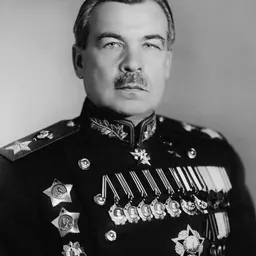

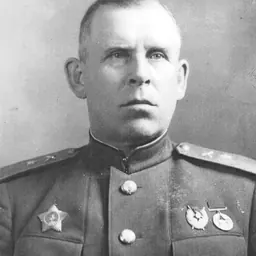
Related people
Same field, nearest in time


Contemporaries
People whose lives overlapped Nikolay Voronov's




Frequently asked questions
Who was Nikolay Voronov?
Soviet marshal (1899–1968)
When was Nikolay Voronov born?
Nikolay Voronov was born on 23 April 1899 in Saint Petersburg.
When did Nikolay Voronov die?
Nikolay Voronov died on 28 February 1968 in Moscow.
What was Nikolay Voronov's occupation?
Nikolay Voronov was a military officer, politician, marshal and artillery.
What nationality was Nikolay Voronov?
Nikolay Voronov was Russian.
Sources & further reading
Cite this page
APA: Biography.guide. (2026). Nikolay Voronov. https://biography.guide/nikolay-voronov/
MLA: "Nikolay Voronov." Biography.guide, https://biography.guide/nikolay-voronov/.
Chicago: "Nikolay Voronov." Biography.guide. https://biography.guide/nikolay-voronov/.
Data last updated: 2026-09-20 · Spot an error? Report a correction.
Page generated 2026-09-27 05:33 UTC