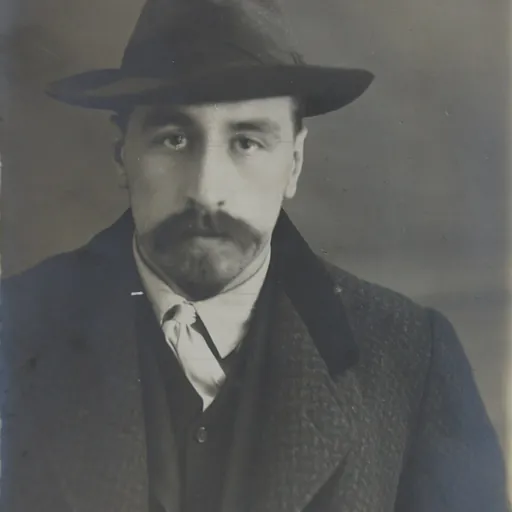
About Nikolay Ustryalov
Lived 1890 – 1937 (aged 46). Nikolay Ustryalov was a Russian politician.
Nikolai Vasilyevich Ustryalov (; November 25, 1890 – September 14, 1937) was a Russian politician, philosopher and a leader of a group known as Smenovekhovtsy. His great-uncle was Nikolay Gerasimovich Ustryalov. Ustryalov and many of his followers were later executed during the Great Purge.
Early years Ustryalov was born in Saint Petersburg. He graduated in law from Moscow University in 1913. Ustryalov belonged to a tendency of Slavophile intellectuals, although from early on he departed from his contemporaries by being less enthusiastic about the Eastern Orthodox Church than the likes of Sergei Bulgakov and Peter Berngardovich Struve. He started out as a supporter of the "Whites" in the Russian Civil War and saw service under the command of Aleksandr Kolchak.
Ideology
Amongst Ustryalov's written works were contributions to "The Problems of Great Russia" and "Morning of Russia", two pre-Bolshevik journals in which he called for unity amongst the Slavs and rejoiced in the overthrow of Tsarist rule. In exile he founded the journal "Okno" (Window) with other dissidents and in 1921 published his seminal collection of articles "Smena vekh" ("Change of Landmarks"), in which he expounded his theories of nationalism and that gave rise to a weekly magazine, Smena vekh. The main ideologue for the Smenovekhovtsy as his followers became known, Ustryalov used written works such as In the Struggle for Russia (1920) and Under the Sign of Revolution (1925) to argue against the views of Struve. With the introduction of the New Economic Policy Ustryalov saw a process of "normalisation" beginning in the Soviet Union and argued that increasingly the USSR was "like a radish" in that it was red on the outside but white on the inside. and lived in exile in Harbin, Manchuria. Here he worked as an advisor at the China Far East Railway, (KVZhD). He was Dean of the Faculty of Law at Harbin from 1920 until 1924. Trotsky regarded the forces that gathered around Ustryalov as not wanting Russia to return to a state of semi-colonial dependence on Western capitalism and therefore anticapitalist without being the least bit socialist. According to Trotsky, Ustryalov and his followers foresaw the conversion of the Soviet state into a normal bourgeois state, and believed that this state should be supported. Ustryalov's past as a White counted against him, however, and he struggled to find employment or even acceptance as a Soviet citizen in Moscow. Eventually he was sent to a gulag.
In 1937, during the Great Purge, he was arrested on charges of espionage and "anti-Soviet agitation". On September 14, 1937, he was sentenced to death and executed on the same day.
Don’t just read it —
keep it.
Full-length biographies made to live with: read them, listen on the way to work, watch them tonight.
- E-book
- Audio
- Video
Instant download · yours to keep · every purchase keeps this site free
Important facts
People in Nikolay Ustryalov's life
Named in this biography and alive at the same time
Related people
Same field, nearest in time





Contemporaries
People whose lives overlapped Nikolay Ustryalov's




Frequently asked questions
Who was Nikolay Ustryalov?
Russian politician (1890-1937)
When was Nikolay Ustryalov born?
Nikolay Ustryalov was born on 25 November 1890 in Saint Petersburg.
When did Nikolay Ustryalov die?
Nikolay Ustryalov died on 14 September 1937 in Moscow.
What was Nikolay Ustryalov's occupation?
Nikolay Ustryalov was a politician.
What nationality was Nikolay Ustryalov?
Nikolay Ustryalov was Russian.
Sources & further reading
· Wikipedia: Nikolay Ustryalov
Cite this page
APA: Biography.guide. (2026). Nikolay Ustryalov. https://biography.guide/nikolay-ustryalov/
MLA: "Nikolay Ustryalov." Biography.guide, https://biography.guide/nikolay-ustryalov/.
Chicago: "Nikolay Ustryalov." Biography.guide. https://biography.guide/nikolay-ustryalov/.
Data last updated: 2026-09-20 · Spot an error? Report a correction.
Page generated 2026-09-27 05:09 UTC