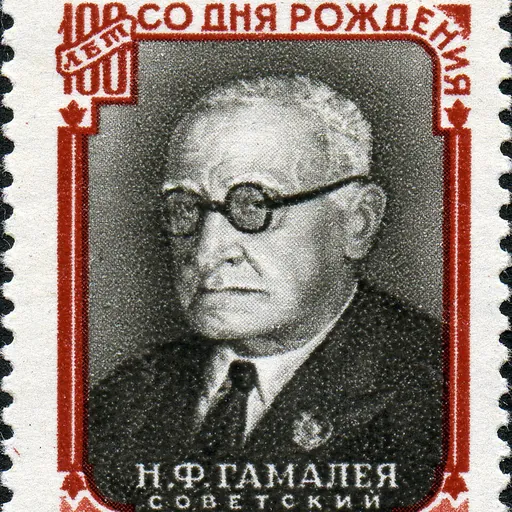
About Nikolay Gamaleya
Lived 1859 – 1949 (aged 90). Nikolay Gamaleya was a Russian physician, biologist, virologist and epidemiologist.
Nikolay Fyodorovich Gamaleya (; – 29 March 1949 ) was a Russian, Ukrainian and Soviet physician and scientist of Zaporozhian Cossack origin who played a pioneering role in microbiology and vaccine research.
Biography
Gamaleya was born in Odessa, then part of the Russian Empire, into the family of a retired officer who participated in the Battle of Borodino. He became a respected hospital physician in his native Odessa afterward.
Gamaleya worked in Louis Pasteur's laboratory in France in 1886. Following Pasteur's model after his return, he joined Ilya Mechnikov in organizing an Odessa bacteriological station for rabies vaccination studies and research on combating cattle plague and cholera, diagnosing sputum for tuberculosis, and preparing anthrax vaccines. The Odessa Bacteriological Institute became Russia's first-ever bacteriological observation station.
Despite the poor facilities and the small staff, the scientists were able to succeed in figuring out the conditions under which the rabies vaccination was most effective.
After defending his 1892 dissertation on the etiology of cholera (published in 1893), Gamaleya served as director of the Odessa Bacteriological Institute in 1896–1908. Reporting of the lysis of Bacillus anthracis bacteria by a transmissible "ferment" in 1898, Gamaleya was the discoverer of the bacteria-destroying antibodies known as bacteriolysins.
Gamaleya initiated a public health campaign of exterminating rats to fight the plague in Odessa and southern Russia and pointed to the louse as the carrier of typhus. In 1910–1913, Gamaleya edited the journal Gigiena i sanitariya (Hygiene and Sanitation).
Gamaleya's later work, including organizing the supply and distribution of smallpox vaccines for the Red Army, made strides toward the eventual eradication of smallpox in the USSR.
The author of more than 300 academic publications on bacteriology, Gamaleya was a member of the Academy of Sciences of the USSR and the USSR Academy of Medical Sciences. He also served as head of the All-Union Society of Microbiologists, Epidemiologists and Infectionists.
The highly regarded Gamaleya's state honors included two Lenin Orders, the Order of the Red Banner of Labour, and the 1943 State Stalin Prize.
Gamaleya died in Moscow.
In Odesa, a memorial plaque is installed on the building of the bacteriological station (2 Pasteur Street) bearing the inscription: “Nikolai Fyodorovich Gamaleya worked at the Odesa Bacteriological Station from 1886 to 1888.”
Don’t just read it —
keep it.
Full-length biographies made to live with: read them, listen on the way to work, watch them tonight.
- E-book
- Audio
- Video
Instant download · yours to keep · every purchase keeps this site free
Important facts
People in Nikolay Gamaleya's life
Named in this biography and alive at the same time
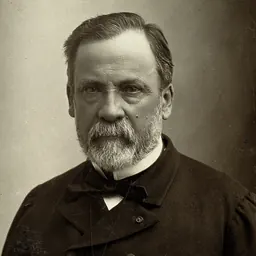
Related people
Same field, nearest in time



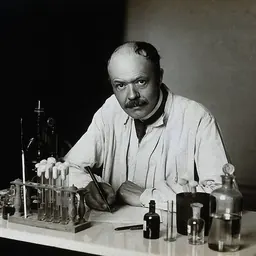


Contemporaries
People whose lives overlapped Nikolay Gamaleya's


Frequently asked questions
Who was Nikolay Gamaleya?
Russian and Soviet physician and scientist who played a pioneering role in microbiology and vaccine research (1859-1949)
When was Nikolay Gamaleya born?
Nikolay Gamaleya was born on 5 February 1859 in Odesa.
When did Nikolay Gamaleya die?
Nikolay Gamaleya died on 29 March 1949 in Moscow.
What was Nikolay Gamaleya's occupation?
Nikolay Gamaleya was a physician, biologist, virologist and epidemiologist.
What nationality was Nikolay Gamaleya?
Nikolay Gamaleya was Russian.
Sources & further reading
Cite this page
APA: Biography.guide. (2026). Nikolay Gamaleya. https://biography.guide/nikolay-gamaleya/
MLA: "Nikolay Gamaleya." Biography.guide, https://biography.guide/nikolay-gamaleya/.
Chicago: "Nikolay Gamaleya." Biography.guide. https://biography.guide/nikolay-gamaleya/.
Data last updated: 2026-09-21 · Spot an error? Report a correction.
Portrait: Wikimedia Commons · author & licence
Page generated 2026-09-27 05:01 UTC