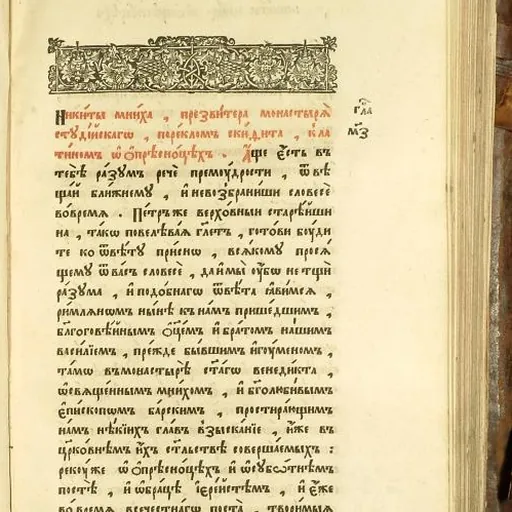
About Niketas Stethatos
Lived 1000 – 1090. Niketas Stethatos was a Byzantine monk, historian, philosopher, writer, mystic and orthodox theologian.
Niketas Stethatos (, ; c. 1005 – c. 1090) was a Byzantine mystic and theologian who is considered a saint by the Eastern Orthodox Church. He was a follower of Symeon the New Theologian and wrote the most complete biography of Symeon, Life of Symeon.
Life Niketas Stethatos was born c. 1005 and entered the Monastery of Stoudios in Constantinople at the age of fourteen. He became a close disciple of Symeon the New Theologian, eventually writing the most complete biography of his teacher, the Life of Symeon. Niketas later became abbot of the Monastery of Stoudios. The sobriquet "Stethatos", meaning "courageous," was given to Niketas due to his speaking out against Constantine IX Monomachos having an illicit mistress. Niketas later supported Michael Cerularius in 1054, taking part in the conflict that became the East-West Schism, writing anti-Latin treatises criticizing the use of unleavened bread, Sabbath fasting, and the celibacy of priests. Niketas' personal works include polemical writings and treatises on the soul, on paradise, on the meaning of hierarchy, and on the limits of human life. He wrote an unpublished hypotyposis on the private spiritual life expected of the Stoudios monks.
Another widely read work is his treatise on ascetic practices which are contained in the fourth volume of the English editions of the Philokalia, the three Centuries on Practical, Physical and Gnostic Chapters. The titles describe three main stages on the spiritual path: praktiki (practice of the commandments); physiki (meditation on the essence of creation); gnosis (the direct knowledge of God). Niketas wrote about many of the same themes as his teacher, Symeon, including: the experience of God as divine light; the importance of having a spiritual father; love for others being more important than prayer; the responsibility of those who have direct experience of God's grace to share it with others. He also wrote that a spiritual life is possible no matter one's outer circumstances—that one doesn't have to physically withdraw from the world, and that true renunciation is an inner practice. Niketas' attitude to the spiritual life is fundamentally positive, and that true sanctity is only a return, through grace, to man's natural condition.
Quotes
"The rays of primordial Light that illumine purified souls with spiritual knowledge not only fill them with benediction and luminosity; they also, by means of the contemplation of the inner essences of created things, lead them up to the noetic heavens. The effects of the divine energy, however, do not stop here; they continue until through wisdom and through knowledge of indescribable things they unite purified souls with the One, bringing them out of a state of multiplicity into a state of oneness in Him." — From the Philokalia. On Spiritual Knowledge, Love and the Perfection of Living, #21.
"The Spirit is light, life and peace. If consequently you are illumined by the Spirit your own life is imbued with peace and serenity. Because of this you are filled with the spiritual knowledge of created beings and the wisdom of the Logos; you are granted the intellect of Christ (cf. 1 Cor. 2:16); and you come to know the mysteries of God's kingdom (cf. Luke 8:10). Thus you penetrate into the depths of the Divine and daily from an untroubled and illumined heart you utter words of life for the benefit of others; for you yourself are full of benediction, since you have within you Goodness itself that utters things new and old (cf. Matt. 13:52)." — From the Philokalia. On Spiritual Knowledge, Love and the Perfection of Living, #46.
Don’t just read it —
keep it.
Full-length biographies made to live with: read them, listen on the way to work, watch them tonight.
- E-book
- Audio
- Video
Instant download · yours to keep · every purchase keeps this site free
Important facts
People in Niketas Stethatos's life
Named in this biography and alive at the same time

Related people
Same field, nearest in time


Contemporaries
People whose lives overlapped Niketas Stethatos's




Frequently asked questions
Who was Niketas Stethatos?
Byzantine theologian
When was Niketas Stethatos born?
Niketas Stethatos was born in 1000 in Constantinople.
When did Niketas Stethatos die?
Niketas Stethatos died in 1090 in Constantinople.
What was Niketas Stethatos's occupation?
Niketas Stethatos was a monk, historian, philosopher, writer, mystic and orthodox theologian.
What nationality was Niketas Stethatos?
Niketas Stethatos was Byzantine.
Sources & further reading
· Wikipedia: Niketas Stethatos
Cite this page
APA: Biography.guide. (2026). Niketas Stethatos. https://biography.guide/niketas-stethatos/
MLA: "Niketas Stethatos." Biography.guide, https://biography.guide/niketas-stethatos/.
Chicago: "Niketas Stethatos." Biography.guide. https://biography.guide/niketas-stethatos/.
Data last updated: 2026-09-23 · Spot an error? Report a correction.
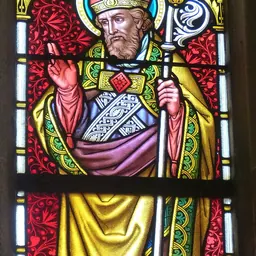
Portrait: Wikimedia Commons · author & licence
Page generated 2026-09-27 05:06 UTC