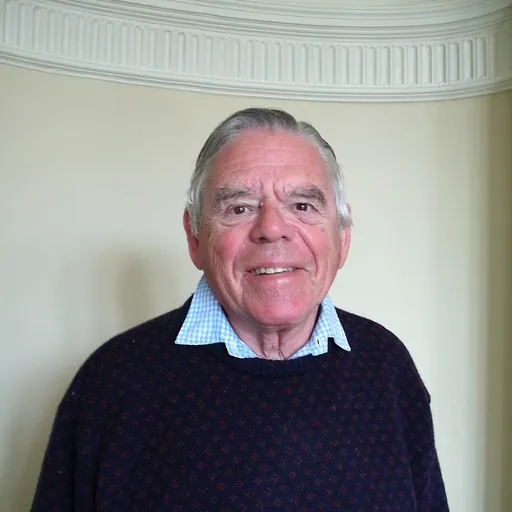
Nicolas Stacey
British sprinter, priest of the Church of England and social activist
About Nicolas Stacey
Lived 1927 – 2017 (aged 89). Nicolas Stacey was a British autobiographer, sprinter, anglican priest, athlete and priest.
Reverend Nicolas David Stacey (27 November 1927 – 8 May 2017) was a priest of the Church of England and social activist. He was Rector of Woolwich in the 1960s, and Director of Social Services for Kent County Council from 1974 to 1985.
Early life Nick Stacey was born 27 November 1927. He was educated at the Royal Naval College, Dartmouth, and saw service on HMS Anson in the last months of the Second World War. He participated in the liberation of Hong Kong, and witnessed the devastation of Hiroshima shortly after VJ Day. and the 1952 Olympic Games. He was a semi-finalist in the 200 metres and a finalist in the 4×400 metres relay.
Ordained in 1953 he served his title at St Mark's, Portsea, Portsmouth, under Christopher Pepys, later Bishop of Buckingham. In 1958 he moved to become Domestic Chaplain (personal assistant) to the Bishop of Birmingham, Dr Leonard Wilson. During his time in Birmingham,he began to receive national attention, after founding and editing a tabloid church newspaper, the Birmingham Christian News, which gained a reputation for comparatively lively journalism and a more sensationalist approach to church news. This was a deliberate policy on Stacey's part, and became characteristic of his ministry. He said "We want to be a platform for the prophetic voices of the country. We want to show that the Christian faith is relevant to twentieth-century living and that the Church is concerned with all the activities of man".
The "Woolwich Project" In 1960 he was invited by Mervyn Stockwood, Bishop of Southwark, to become rector of Woolwich, where he served for eight years. Contemporary accounts describe the parish at that time as comprising three Church of England churches with relatively small congregations. The area faced challenges associated with social housing, and the level of religious observance in Woolwich were reported to be declining more rapidly than the national average.
During his tenure, Stacey introduced a range of reforms. He assembled a team of ministers drawn from different denominations, and closed one of the three churches. He altered the eighteenth-century parish church of St Mary Magdalen, including the enclosure of galleries and side aisles to create offices, meeting rooms, and counselling spaces. A discothèque was built in the crypt, and the youth club operated at the church reportedly attracted significant local participation, including referrals from probation officers. A coffee bar was also opened in the gallery. It was reported that within four years 1500 people a week were passing through the church facilities.
But Stacey didn't neglect the traditional model of parochial ministry. An intensive parish visiting programme was begun, with the large clergy team visiting or attempting to visit every household in the parish systematically. An adaptation of the Prayer Book baptism service was devised in an attempt to be more welcoming. Stacey fostered links with the civic bodies of the area, and encouraged links with the Royal Arsenal.
Despite all this effort, after four years Stacey judged the project to have been a failure. Regular worshippers had increased from fifty to one hundred, but most of these did not live in the parish. Eric Mascall called Stacey a "gimmick manqué".
Undeterred, Stacey restructured his ministry team. Most of the clergy sought secular employment, working in the parish in their spare time and at weekends. Stacey himself earned most of his income through journalism. However, after another three years he realised that he was ready for a change from Woolwich parish, and, realising that the Church was unlikely to offer him another post, he began to seek secular employment.
Oxfam and Social Services In 1968 Stacey was appointed Deputy Director of Oxfam, a job he stayed in for only 2 years. He felt that Oxfam was well placed to do what Bob Geldof attempted 30 years later - lead a national campaign to Make Poverty History. This would have involved educating the public on the enormity and complexity of relieving poverty in the Third World which could only be done by massive British government aid. Oxfam's trustees were afraid it would lose its charitable status and Stacey resigned.
Kendall House In 2006 Stacey was interviewed as part of the British Library's oral history series, National Life Stories, under the title "Pioneers of Charity and Social Welfare". In the interview about his role in the development of Social Care in Britain, Stacey revealed that during his time as Director of Social Services he did not uncover abuse that warranted referral to the police. A few weeks after Stacey died in 2017 the BBC's Religious Affairs correspondent, Callum May, wrote an article on the BBC website that linked those remarks with Kendall House, a Church of England-run children's home in Gravesend where vulnerable girls were routinely medicated, restrained and abused. Among the residents was campaigner Teresa Cooper, whose persistence across three decades led to the Kendall House review, which finally brought the full story of abuse to light. The independent review's 2016 report found the institution to have inadequate governance and oversight, made 19 recommendations for the Dioceses of Canterbury and Rochester, and concluded that they should apologise to the women who had suffered abuse. The BBC article implied that Stacey, a Church of England parish priest in the 1960s, oversaw Kendall House and must have known of the abuse and failed to report it.
A complaint to the BBC was upheld and the BBC accepted that as a Church of England home Kendall House was not overseen by Stacey, that he was not responsible for Kendall House and that it was not "unavoidable that Stacey would have known what was going on but failed to report it". The Church Times, which also ran the story, published letters clarifying the mistake. The revelations of abuse at Kendall House served to underline the importance of Stacey's pioneering role in the introduction of Professional Fostering. Professional Fostering removed vulnerable children from institutions such as Kendall House and placed them in family homes. The initiative was subsequently introduced by Social Services throughout the UK.
Documents held on Kendall House show Rev. Stacey was directly involved there and had direct contact with the acting GP and social workers involved with Kendall House.
Personal life Stacey's daughter Dame Mary Stacey was appointed a High Court judge in 2020.
Don’t just read it —
keep it.
Full-length biographies made to live with: read them, listen on the way to work, watch them tonight.
- E-book
- Audio
- Video
Instant download · yours to keep · every purchase keeps this site free
Important facts
People in Nicolas Stacey's life
Named in this biography and alive at the same time





Related people
Same field, nearest in time


Contemporaries
People whose lives overlapped Nicolas Stacey's


Frequently asked questions
Who was Nicolas Stacey?
British sprinter, priest of the Church of England and social activist (1927-2017)
When was Nicolas Stacey born?
Nicolas Stacey was born on 27 November 1927 in London.
When did Nicolas Stacey die?
Nicolas Stacey died on 8 May 2017.
What was Nicolas Stacey's occupation?
Nicolas Stacey was an autobiographer, sprinter, anglican priest, athlete and priest.
What nationality was Nicolas Stacey?
Nicolas Stacey was British.
Sources & further reading
Cite this page
APA: Biography.guide. (2026). Nicolas Stacey. https://biography.guide/nicolas-stacey/
MLA: "Nicolas Stacey." Biography.guide, https://biography.guide/nicolas-stacey/.
Chicago: "Nicolas Stacey." Biography.guide. https://biography.guide/nicolas-stacey/.
Data last updated: 2026-09-23 · Spot an error? Report a correction.
Portrait: Wikimedia Commons · author & licence
Page generated 2026-09-27 05:05 UTC