
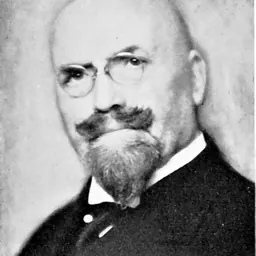
Nicolás Guillén
Cuban poet, journalist, political activist, and writer
About Nicolás Guillén
Lived 1902 – 1989 (aged 87). Nicolás Guillén was a Cuban poet, journalist and writer.
Literary works Guillén drew from his mixed African and Spanish ancestry and education to combine his knowledge of traditional literary form with firsthand experience of the speech, legends, songs, and songs of Afro-Cubans in his first volume of poetry, Motivos de son. It was soon acclaimed as a masterpiece and widely imitated. In the 1920s, when Afro-Cuban sounds and instruments were changing the world of Cuban music, Afro-Cuban culture began to be expressed in art and literature as well. Initially, Afro-Cuban poetry, or "negrista" poetry, was mainly published by European Cubans such as Emilio Ballagas, Alejo Carpentier, and José Tallet. It was not until the 1930s that Guillén would appeal in literary terms by expressing a personal account of the struggles, dreams, and mannerisms of Afro-Cubans.
Guillén became outspoken politically, and dissatisfied with picturesque portrayal of the daily life of the poor. He began to decry their oppression in his poetry volumes Sóngoro cosongo and West Indies Ltd. Guillen also wrote Cantos para soldados y sones para turistas, which reflected his growing political commitment. Characteristic for his poems is the use of onomatopoetic words ("Sóngoro Cosongo", "Mayombe-bombe") that try to imitate the sound of drums or the rhythm of the son. Silvestre Revueltas's symphonic composition Sensemayá was based on Guillén's poem of the same name, and became that composer's best-known work, followed by José Limantour's suite from his film score for La noche de los mayas.
Guillén later became acknowledged by many critics as the most influential of those Latin American poets who dealt with African themes and re-created African song and dance rhythms in literary form.
In Man-Making Words: Selected Poems of Nicolás Guillén, Angel Aguier, in reference to Motivos de son, wrote that "the 'son,' a passionate dance born of the Negro-white encounter under Caribbean skies in which the words and music of the people culminate in song, is the basic substance of the elemental poetry which Guillen intuitively felt as the expression of the Cuban spirit.... He specifically chose the son as the mixed artistic creation of the two races that make up the Cuban population; for the son, in form and content, runs the full gamut of every aspect of our national character." This quote establishes how the son, such a profound musical genre of that time, initiated the fusion of black and white Cuban culture. Guillén's incorporation of the genre into his writings, symbolized and created a pathway for the same cultural fusion in Cuban literature.
Guillén's unique approach of using the son in his poetry is expressed in his book Sóngoro consongo (1931). In this work, he included poems that depicted the lives of Cubans and emphasized the importance of Afro-Cuban culture in Cuban history. Sóngoro consongo captures the essence of the Afro-Cuban culture and ways that the people deal with their personal situations.
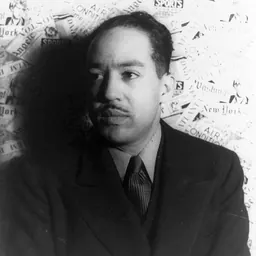
Langston Hughes and Nicolás Guillén In 1930, José Antonio Fernández de Castro, publisher of the Havana daily paper, Diario de la Marina, and the first to translate American Langston Hughes’s poetry to Spanish, arranged for the two poets to meet. He was a white Cuban from an aristocratic family who loved black Cuba. He was a newspaperman, a diplomat, and a friend to Cuba’s artists.
In February 1930, Langston Hughes traveled to Cuba for the second time, on a two-week mission to find a black composer to collaborate on a folk opera. He had been given a letter of introduction to José Antonio Fernández de Castro, his door to Cuba’s artistic world. At this time Hughes’ poetry was better known to Cubans than that of Guillén, so the American's arrival created a stir in the artistic community. The next month, on 9 March 1930, Guillén published “Conversación con Langston Hughes”, an article describing his experience of meeting Hughes in Havana. The Cubans expected a nearly white, tall and heavyset man in his forties with thin lips and an even thinner English-style mustache. Instead they saw a twenty-seven-year-old, slight brown man without a mustache. Guillén wrote that Mr. Hughes "parece justamente un mulatico cubano” – looks just like a Cuban mulatto.
Guillén was especially taken with Hughes' warm personality and enthusiasm for the "son" music, which he heard on the nightly forays into Cuba's Marinao district organized by Fernandez de Castro. Hughes was said to be a hit with the soneros. His enthusiasm for Cuban music inspired Guillén. Hughes immediately saw the similarities between son and the blues, as folk music traditions whose form was based on the call-and-response structure of African music. Additionally, he was excited about its possibilities as an organic base for formal poetry. According to biographer Arnold Rampersad, Hughes suggested to Guillén that he make the rhythms of the son central to his poetry, as the American had used elements of blues and jazz.
Hughes drew not only rhythmic innovation from these folk music traditions, but used them as a means to express his protest against racial inequality. Both poets shared anger against racism, but Hughes impressed Guillén with his particular kind of racial consciousness. Although the Cuban poet had expressed outrage against racism and economic imperialism, he had not yet done so in language inspired by Afro-Cuban speech, song, and dance. He had been more concerned with protest than with celebrating the power and beauty of Afro Cubans.
Within weeks of meeting Hughes, Guillén quickly wrote eight poems that were markedly different from his previous work. His new poems generated controversy and established Guillén's fame as one of the premier poets of the Négritude movement, which spanned the Americas. On 21 April 1930, Guillén sent Hughes the result of his inspiration, his book of poetry Motivos de Son. The author wrote on the inside cover, “Al poeta Langston Hughes, querido amigo mío. Afectuosamente, Nicolás Guillén”. Although Hughes did not find an Afro-Cuban composer to work with, he created a lasting friendship with Guillén; it was based on their mutual respect and convictions about racial inequality.
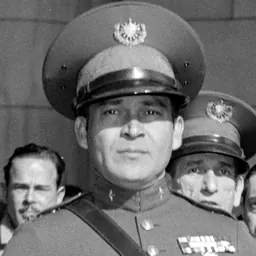
Poetry and politics Cuba's dictatorial Gerardo Machado regime was overthrown in 1933, but political repression in the following years intensified. In 1936, with other editors of Mediodía, Guillén was arrested on trumped-up charges, and spent some time in jail. In 1937 he joined the Communist Party During his travels in the country, he covered Spain's Civil War as a magazine reporter. In 1953, he was prevented by the Fulgencio Batista government from re-entering Cuba after a trip to Chile and had to spend five years in exile. 1976, he was awarded the International Botev Prize. In 1983, he was the inaugural winner of Cuba's National Prize for Literature. His nephew was experimental Cuban filmmaker Nicolás Guillén Landrián (1938–2003).
Major works Motivos de son (1930) Sóngoro cosongo (1931) West Indies Ltd. (1934) España: poema en cuatro angustias y una esperanza (1937) Cantos para soldados y sones para turistas (1937) El son entero (1947) Cuba libré (1948), in English, poetry collection, tr. Langston Hughes, Ben Frederic Carruthers Elegías (1948–1958) Tengo (1964) Poemas de amor (1964) El gran zoo (1967) La rueda dentada (1972) El diario que a diario (1972) Man-making words (1972) Selected poems of Nicolás Guillén. Translated, annotated ... by Robert Márquez and David Arthur McMurray. Por el mar de las Antillas anda un barco de papel. Poemas para niños y mayores de edad (1977) Yoruba from Cuba: Selected Poems of Nicolas Guillen (trans. Salvador Ortiz-Carboneres; Peepal Tree Press, 2005) Libre estoy, vine de lejos, soy un negro. Antología poética (2019) (selección y prólogo de Nicolás Guillén Hernández).
Discography Antologia Oral: Poesia Hispanoamericana del Siglo XX / Oral Anthology: Spanish-American Poetry of the 20th Century (Folkways Records, 1960) Nicolás Guillén: Poet Laureate of Revolutionary Cuba (Folkways, 1982)
Don’t just read it —
keep it.
Full-length biographies made to live with: read them, listen on the way to work, watch them tonight.
- E-book
- Audio
- Video
Instant download · yours to keep · every purchase keeps this site free
Important facts
People in Nicolás Guillén's life
Named in this biography and alive at the same time



Related people
Same field, nearest in time
Contemporaries
People whose lives overlapped Nicolás Guillén's



Frequently asked questions
Who was Nicolás Guillén?
Cuban poet, journalist, political activist, and writer (1902–1989)
When was Nicolás Guillén born?
Nicolás Guillén was born on 10 July 1902 in Camagüey.
When did Nicolás Guillén die?
Nicolás Guillén died on 16 July 1989 in Havana.
What was Nicolás Guillén's occupation?
Nicolás Guillén was a poet, journalist and writer.
What nationality was Nicolás Guillén?
Nicolás Guillén was Cuban.
Sources & further reading
Cite this page
APA: Biography.guide. (2026). Nicolás Guillén. https://biography.guide/nicolas-guillen/
MLA: "Nicolás Guillén." Biography.guide, https://biography.guide/nicolas-guillen/.
Chicago: "Nicolás Guillén." Biography.guide. https://biography.guide/nicolas-guillen/.
Data last updated: 2026-09-20 · Spot an error? Report a correction.
Page generated 2026-09-27 05:24 UTC