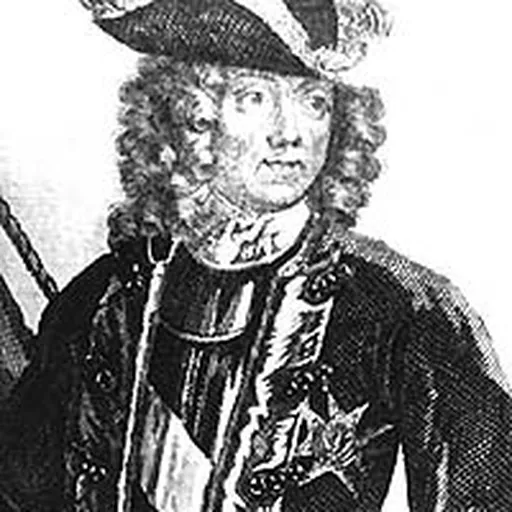
About Nicolas Chalon du Blé
Lived 1652 – 1730 (aged 78). Nicolas Chalon du Blé was a French diplomat and politician.
Nicolas Chalon du Blé, marquis d'Uxelles and Cormatin (24 January 1652 – 10 April 1730) was a French general and Foreign Minister. He was also created a knight and Marshal of France by Louis XIV, and was a diplomat for Louis XIV and Philippe II, Duke of Orléans.
Biography
Early years du Blé was born at Chalon-sur-Saône.
His appearance was described as tall and ruddy, with a huge wig and a hat pulled down over his eyes. He tended to hide his military orders and decorations under a plain, tightly buttoned coat.
Second son of Louis Chalon du Blé, marquis of Uxelles (who died in 1658 at the siege of Gravelines), and of Marie Le Bailleul (1626–1712), Nicolas Chalon du Blé became marquis d'Uxelles on the death of his elder brother in 1669. He was a protégé of Camille le Tellier de Louvois.
Military career
Map of the Siege of Mayence, in 1689. Engraving, Paris, 1756 He was granted military leadership in 1688, during the Nine Years' War; he served as lieutenant general at the siege of Philippsburg, and was charged with holding the Place de Mayence fortress in Mainz, when the French army was forced to retreat.
He initially defended during the Siege of Mainz against the Grand Alliance, from 1 June to 8 September 1689, but had to surrender, and was publicly booed upon his return to Paris. He retained the favor of François-Michel le Tellier, Marquis de Louvois and King Louis XIV, and was rewarded with the fief of Rougemont-le-Château (1696), and he received the baton of Marshal, in 1703.
Diplomatic career He took part as a diplomat at the preliminary conferences of Geertruidenberg on 9 March 1710, but the peace negotiations were broken by Louis XIV at the end of the following June. Chalon du Blé again represented the king during the negotiation for the Peace of Utrecht in 1713.
He was one of the aristocratic architects of the polysynody system of government, and obtained the first presidency of the Council of Foreign Affairs, (1715–1718) when the regency of Philippe II began. This appointment was made against the better judgement of the Regent, who held different foreign policy aims than Blé, and who had been the target of scorn from Blé's social circle. The Regent made the decision primarily to keep his enemy in plain view rather than in subterfuge against the government.
As president of the Council of Foreign Affairs, Blé tended to the popular, traditional French view of favoring Catholic Spain over Protestant Great Britain. This was in contradiction to the Regent, who admired Britain's parliamentary system and open economy. When the Cellamare Conspiracy came to light in 1718, however, Blé gave up antagonizing the Regent and "became polite, agreeable, and ate from his hand" in the words of Saint-Simon. According to one source, the Regent even made Blé kiss the Treaty of the Triple Alliance, which allied France with Britain and the Dutch Republic against Spain. He died in Paris in 1730.
Don’t just read it —
keep it.
Full-length biographies made to live with: read them, listen on the way to work, watch them tonight.
- E-book
- Audio
- Video
Instant download · yours to keep · every purchase keeps this site free
Important facts
Related people
Same field, nearest in time



Contemporaries
People whose lives overlapped Nicolas Chalon du Blé's





Frequently asked questions
Who was Nicolas Chalon du Blé?
French diplomat (1652-1730)
When was Nicolas Chalon du Blé born?
Nicolas Chalon du Blé was born on 24 January 1652 in Chalon-sur-Saône.
When did Nicolas Chalon du Blé die?
Nicolas Chalon du Blé died on 10 April 1730 in Paris.
What was Nicolas Chalon du Blé's occupation?
Nicolas Chalon du Blé was a diplomat and politician.
What nationality was Nicolas Chalon du Blé?
Nicolas Chalon du Blé was French.
Sources & further reading
· Wikipedia: Nicolas Chalon du Blé
· DBpedia: Nicolas Chalon du Blé
Cite this page
APA: Biography.guide. (2026). Nicolas Chalon du Blé. https://biography.guide/nicolas-chalon-du-ble/
MLA: "Nicolas Chalon du Blé." Biography.guide, https://biography.guide/nicolas-chalon-du-ble/.
Chicago: "Nicolas Chalon du Blé." Biography.guide. https://biography.guide/nicolas-chalon-du-ble/.
Data last updated: 2026-09-22 · Spot an error? Report a correction.
Portrait: Wikimedia Commons · author & licence
Page generated 2026-09-27 05:03 UTC