
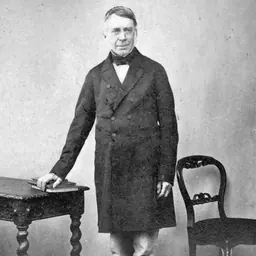
Nicolae Gane
Moldavian-born Romanian prose writer, poet and politician
About Nicolae Gane
Lived 1838 – 1916 (aged 78). Nicolae Gane was a Romanian judge, translator, politician, poet and writer.
Nicolae Gane (February 1, 1838 – April 16, 1916) was a Moldavian, later Romanian prose writer, poet, and politician.
Born in Fălticeni, his family were boyars of small and medium importance; his parents were postelnic Matei Gane and his wife Ruxandra (née Văsescu). He began his education at the primary school founded in his native town by Neofit Scriban, followed by Louis Jourdan's French boarding school in Iași. Gane intended to study fine arts in Paris, but encountering opposition from his family, opted instead for a government career. Thanks to his connections, he obtained a position in Iași as secretary and translator for Moldavia's director of prisons. He resigned after a day and returned to Fălticeni, where he was named a member of the Suceava County tribunal. He was dismissed during demonstrations backing the union of the Principalities in 1857, and restored in 1860, following the union, as president of the same tribunal.
His appeals court colleague Vasile Pogor and the brothers Iacob and Leon C. Negruzzi introduced Gane to the recently founded Junimea society, of which he remained a leading member, even though in 1883 he joined its political rival, the National Liberal Party (PNL). His lengthy political career included two stints as prefect of Iași County (1870, 1901), five terms as mayor of Iași (1872-1876; 1881; 1887-1888; 1896-1899; 1907-1911), a seat in the Assembly of Deputies in nearly every PNL-controlled legislature, In March 1888, when PNL leader Ion C. Brătianu reshuffled the cabinet in a moment of crisis, he named two new ministers. One of them was Gane, who received the Agriculture, Industry, Commerce and Domains portfolio; the government went on to serve for three weeks. During Gane's time as mayor, his city acquired paved roads and gas lighting, as well as a new building for the Iași National Theatre in 1896. After 1906, he preferred to publish in Viața Românească. Elected a corresponding member of the Romanian Academy in 1882, he rose to titular member in 1908, was president of its literary section in 1912, and vice president of the Academy from 1912 to 1913. In 1906, he published a translation of Dante Alighieri's Inferno, written in imperfect tercets.
His wife Sofia was the daughter of Pavel Stoianovici, a Serb who had arrived from Bessarabia around 1827, and of Pavel's wife, the daughter of a Greek and Bulgarian rakia-maker at Bucharest's Curtea Veche. The couple had five daughters and three sons; two became magistrates and one a cavalry officer, and all the children who married took spouses from among the Moldavian boyar families. Three Gane-related sites in Iași are listed as historic monuments by Romania's Ministry of Culture and Religious Affairs: his early 19th-century house, now a museum; his 1943 bust, located in Copou Park; and his grave in Eternitatea cemetery. Nicu Gane National College in Fălticeni bore his name from 1923 to 1948, and has again done so since 1970.
Don’t just read it —
keep it.
Full-length biographies made to live with: read them, listen on the way to work, watch them tonight.
- E-book
- Audio
- Video
Instant download · yours to keep · every purchase keeps this site free
Important facts
People in Nicolae Gane's life
Named in this biography and alive at the same time
Related people
Same field, nearest in time

Contemporaries
People whose lives overlapped Nicolae Gane's



Frequently asked questions
Who was Nicolae Gane?
Moldavian-born Romanian prose writer, poet and politician (1838-1916)
When was Nicolae Gane born?
Nicolae Gane was born on 1 February 1838 in Fălticeni.
When did Nicolae Gane die?
Nicolae Gane died on 16 April 1916 in Iași.
What was Nicolae Gane's occupation?
Nicolae Gane was a judge, translator, politician, poet and writer.
What nationality was Nicolae Gane?
Nicolae Gane was Romanian.
Sources & further reading
Cite this page
APA: Biography.guide. (2026). Nicolae Gane. https://biography.guide/nicolae-gane/
MLA: "Nicolae Gane." Biography.guide, https://biography.guide/nicolae-gane/.
Chicago: "Nicolae Gane." Biography.guide. https://biography.guide/nicolae-gane/.
Data last updated: 2026-09-20 · Spot an error? Report a correction.
Page generated 2026-09-27 05:26 UTC