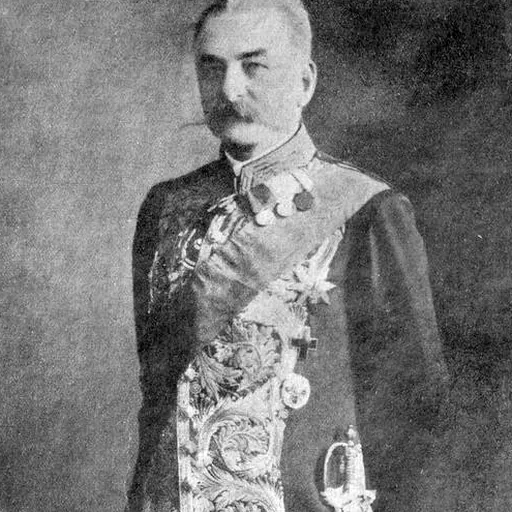
About Nicholas Golitsyn
Lived 1850 – 1925 (aged 75). Nicholas Golitsyn was a Russian politician, statesperson and head of government.
Prince Nikolai Dmitriyevich Golitsyn (; 12 April 1850 – 2 July 1925) was a Russian aristocrat, monarchist and the last prime minister of the Russian Empire. He was in office from 29 December 1916 (O.S.) or 9 January 1917 (N.S.) until his government resigned after the outbreak of the February Revolution.
Biography Golitsyn was born in Porechye, a village in the Moscow Governorate near Mozhaisk, into the noble Golitsyn family. His father was Dmitry Borisovich Golitsyn (1803–1864) who came from Bolshiye Vyazyomy, the family estate. Nikolai passed his childhood in the Dorogobuzhsky District. He graduated from the Imperial Alexander Lyceum in 1871 and entered the Ministry of the Interior, where he was appointed to the Łomża Governorate (Congress Poland). He became vice-governor of Archangelsk (1879); vice-director of the Economics Department of the Ministry of Internal Affairs (1884); Governor of the guberniyas of Arkhangelsk (1885), Kaluga (1893), and Tver (1897). He was appointed senator in 1903. As a plenipotentiary of the Red Cross in Turgay and Uralskaya Oblasts and Saratov Governorate he organized aid for famine-stricken areas (1907–1908). He was a member of the State Council (1912) and chairman of the commission to render assistance to the Russian prisoners of war abroad (1915). He was a deputy chairman of one of Empress Alexandra's charity commissions.
Prime minister On 25 December he was invited by Empress Alexandra for an interview, but received by the tsar. A hesitating Prince Golitsyn did not want to succeed prime minister Alexander Trepov, insisted on the resignation of the Minister of Internal Affairs Alexander Protopopov and begged Nicholas II to cancel his appointment, citing his lack of preparation for the role of prime minister. The tsar refused, but Pavel Ignatieff, Alexander Makarov and Dmitry Shuvayev were replaced; Nikolai Dobrovolsky was appointed. The Council of Ministers officially met once or twice a week (seven meetings in January, six in February). The main concern of the government was "food and transport." The most important thing, according to Prince Golitsyn, was the convocation of the Duma and the desire to work together with it and somehow make this work possible. The government discussed the timeframe for resuming the Duma sessions: it was originally scheduled to open on 12 January, then - on 31 January, but in the end, it was postponed until 14 February. Protopopov, who excused himself many times and did not attend the meetings, suggested dissolution or postponing the Duma even further.
Despite being the oldest member of the council (Golitsyn was 66, while the others were 36 to 63 years old), he was not a leader. (His advanced years led him to regularly fall asleep during State Council meetings.) In January 1917 two rival institutions, the Duma and the Petrograd Soviet, competed for power. On 8 February, at the wish of the tsar, Nikolay Maklakov, together with Protopopov drafted the text of the manifesto on the dissolution of the Duma (cancelled and scheduled to resume on 14 February 1917). On 14 February mass demonstrations broke out. On 15 February Alexander Kerensky made a speech in the Duma that almost called for the assassination of the emperor. A week later the demonstrations on Nevsky Prospekt became more serious. On 25th members of the government gathered at Golitsyn's apartment at Konnogvardeyskiy Bul'var, 13. Belyaev suggested his colleagues remove Protopopov from his post, as he saw in him the main cause of unrest.
On 26 February, the tsar ordered the army to suppress the rioting by force, but troops began to mutiny, joined the protesters, and demanded a new constitutional government. In the evening the meeting of the Duma was prorogued, although Golitsyn and Nikolai Pokrovsky opposed its dissolution. Golitsyn used a (signed, but not yet dated ukaze which had been given to Trepov) declaring that his majesty had decided to interrupt the Imperial Duma until 1 April, leaving it with no legal authority to act. The deputies refused to leave and a private committee of Duma members was formed to help restore order.
Downfall and execution The Council of Ministers met the evening of 27 February 1917 and submitted its resignation to the emperor, asking Grand Duke Michael Alexandrovich to temporarily act as regent, which he refused. Following Nicholas's decision to abdicate, the Provisional Committee of the State Duma ordered former ministers and senior officials arrested. Golitsyn was arrested by police and transferred to the Peter and Paul Fortress for interrogation, where he was starved and tortured, then released on 13 March.
On 21 April 1917 he was again arrested by police and interrogated by the Extraordinary Commission of Inquiry of the Provisional Government. After the assumption of power by the Bolsheviks, Golitsyn was allowed to leave but decided to stay in Russia, earning his living by repairing shoes in Moscow or Petrograd and guarding vegetable gardens in Rybinsk. During the period from 1920 to 1924 he was twice arrested by the OGPU, on the suspicion of connection with counterrevolutionaries. After his third arrest (on 12 February 1925), he was executed on 2 July 1925 in Leningrad on the charge of participating in a "counter-revolutionary monarchist organization".
Family Prince Nikolai Golitsyn married in Saint Petersburg on 7 April 1881 Evgenia Andrejevna von Grünberg (Saint-Petersburg, 18 April 1864 - Nice, 18 July 1934). The couple had six children:
Prince Dimitri Nikolayevich (Archangelsk, 1882 - Nice, 1928), married Frances Simpson Stevens Prince Nikolai Nikolayevich (Archangelsk, 1883 - executed at Solovki, 1931) Prince Alexander Nikolayevich (St. Petersburg, 1885 - Toulon, 1974), in exile married the Imperial Princess Marina Petrovna of Russia, daughter of Grand Duke Peter Nikolaevich of Russia. Prince Evgeni Nikolayevich (Archangelsk, 1888 - Paris, 1928) Princess Sofia Nikolayevna (1886 - 1891) Princess Olga Nikolayevna (1891 - 1892)
Don’t just read it —
keep it.
Full-length biographies made to live with: read them, listen on the way to work, watch them tonight.
- E-book
- Audio
- Video
Instant download · yours to keep · every purchase keeps this site free
Important facts
People in Nicholas Golitsyn's life
Named in this biography and alive at the same time




Related people
Same field, nearest in time





Contemporaries
People whose lives overlapped Nicholas Golitsyn's


Frequently asked questions
Who was Nicholas Golitsyn?
Russian noble (1850-1925)
When was Nicholas Golitsyn born?
Nicholas Golitsyn was born on 12 April 1850 in Moscow Governorate.
When did Nicholas Golitsyn die?
Nicholas Golitsyn died on 2 July 1925 in Saint Petersburg.
What was Nicholas Golitsyn's occupation?
Nicholas Golitsyn was a politician, statesperson and head of government.
What nationality was Nicholas Golitsyn?
Nicholas Golitsyn was Russian.
Sources & further reading
· Wikipedia: Nicholas Golitsyn
Cite this page
APA: Biography.guide. (2026). Nicholas Golitsyn. https://biography.guide/nicholas-golitsyn/
MLA: "Nicholas Golitsyn." Biography.guide, https://biography.guide/nicholas-golitsyn/.
Chicago: "Nicholas Golitsyn." Biography.guide. https://biography.guide/nicholas-golitsyn/.
Data last updated: 2026-09-22 · Spot an error? Report a correction.
Portrait: Wikimedia Commons · author & licence
Page generated 2026-09-27 05:04 UTC