
About Nicetius
Lived 513 – 566 (aged 52–53). Nicetius was a latin Catholic priest and writer.
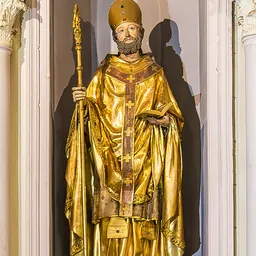
Saint Nicetius (c. 525 - c. 566) was a bishop of Trier, born in the latter part of the sixth century, exact date unknown; died in 563 or more probably 566.
Nicetius was the most important bishop of the ancient see of Trier, in the era when, after the disorders of the Migrations, Frankish supremacy began in what had been Roman Gaul. Considerable detail of the life of this zealous bishop is known from various sources, from letters written either by or to him, from two poems of Venantius Fortunatus and above all from the statements of his pupil Aredius, later Abbot of Limoges, which have been preserved by Gregory of Tours.
Life Pastoral work Nicetius came from a Gallo-Roman family; he was a native of Aquitaine. From his youth he devoted himself to religious life and entered a monastery. Theuderic I (511-34) had encouraged clerics from Acquitaine to work in the Rhineland. The king came to esteem Nicetius despite his often remonstrating with him on his wrongdoing without, however, any loss of favour. After the death of Bishop Aprunculus of Trier, an embassy of the clergy and citizens of Trier came to the royal court to elect a new bishop. They desired Saint Gallus, but the king refused his consent. It was through Theuderic's patronage that Nicetius was confirmed as bishop. About 527 Nicetius set out as the new bishop for Trier, accompanied by an escort sent by the king, and while on the journey had opportunity to make known his firmness in the administration of his office.
The general interests of the Church did not escape his watchful care. He wrote an urgent letter to Emperor Justinian of Constantinople in regard to the emperor's position in the controversies arising from Monophysitism. Another letter that has been preserved is to Chlodoswinda, wife of the Lombard King Alboin, in which he exhorts this princess to do everything possible to bring her husband over to the Catholic faith.
In his personal life Nicetius was very ascetic and self-mortifying; he fasted frequently, and while the priests and clerics who lived with him were at their evening meal he would go, concealed by a hooded cloak, to pray in the churches of the city. He founded a school of his own for the training of the clergy. The best known of his pupils is the later Abbot of Limoges, Aredius, who was the authority of Gregory of Tours for the latter's biographical account of Nicetius. Gregory of Tours, wrote the oldest Nicetius Vita, and praised the fearless advocacy of the Bishop.
Veneration Nicetius was buried in the church of St. Maximin at Trier. In the diocese of Trier, he is revered as a saint. His feast day is celebrated at Trier on 1 October; in the Roman Martyrology his name is placed under 5 December.
The genuineness of two treatises ascribed to him is doubtful: "De Vigiliis servorum Dei" and "De Psalmodiæ Bono".
Don’t just read it —
keep it.
Full-length biographies made to live with: read them, listen on the way to work, watch them tonight.
- E-book
- Audio
- Video
Instant download · yours to keep · every purchase keeps this site free
Important facts
People in Nicetius's life
Named in this biography and alive at the same time

Related people
Same field, nearest in time


Contemporaries
People whose lives overlapped Nicetius's


Frequently asked questions
Who was Nicetius?
Bishop of Trier
When was Nicetius born?
Nicetius was born in 513 in Aquitania prima.
When did Nicetius die?
Nicetius died in 566 in Trier.
What was Nicetius's occupation?
Nicetius was a latin Catholic priest and writer.
What nationality was Nicetius?
Nicetius's recorded nationality: Francia.
Sources & further reading
Cite this page
APA: Biography.guide. (2026). Nicetius. https://biography.guide/nicetius/
MLA: "Nicetius." Biography.guide, https://biography.guide/nicetius/.
Chicago: "Nicetius." Biography.guide. https://biography.guide/nicetius/.
Data last updated: 2026-09-20 · Spot an error? Report a correction.
Page generated 2026-09-27 05:27 UTC