Nguyen Van Nhung
South Vietnamese military officer; executed Ngô Đình Diệm and Ngô Đình Nhu
About Nguyen Van Nhung
Lived 1919 – 1964 (aged 44–45). Nguyen Van Nhung was a Vietnamese military personnel, aide-de-camp and dương Văn Minh.
Nguyễn Văn Nhung (1919 or 1920 – 31 January 1964) was an officer in the Army of the Republic of Vietnam (ARVN). After joining the French Army in 1944 during the colonial era of Vietnam, he soon met and became the aide-de-camp and bodyguard of Dương Văn Minh, and spent the rest of his career in this role as Minh rose up the ranks to become a general. Nhung and Minh later transferred to the French-backed Vietnamese National Army (VNA) during the First Indochina War and he became an officer; the VNA then became the ARVN after the creation of the Republic of Vietnam (South Vietnam). A soft-spoken man, Nhung was a professional military assassin best known for his role in the November 1963 coup d'état led by Minh that ousted President Ngô Đình Diệm from office.
At the end of the coup, Nhung - having shot Colonel Lê Quang Tung, the loyalist commander of the Army of the Republic of Vietnam Special Forces at a grave at Tân Sơn Nhứt Air Base the day before - executed President Diệm and his brother Ngô Đình Nhu. An investigation led by General Trần Văn Đôn, another coup plotter, determined that Nhung had repeatedly stabbed and shot the Ngô brothers while escorting them back to military headquarters after having arrested them. It was widely believed that Minh had ordered Nhung to execute the Ngô brothers. Following Nguyễn Khánh's successful January 1964 coup against Minh's military junta, Nhung died in mysterious circumstances, the only fatality in the otherwise bloodless regime change.
Career Nhung was born in either 1919 or early 1920.
1963 coup Tung assassination alt=A portrait of a middle-aged man, looking to the left in a half-portrait/profile. He has chubby cheeks, parts his hair to the side and wears a suit and tie.
On 1 November 1963, a group of ARVN generals, led by Minh, orchestrated a coup against President Ngô Đình Diệm. The plotters summoned a group of ARVN officers to the Joint General Staff headquarters at Tân Sơn Nhứt Air Base, on the pretext that they were going to attend a lunch meeting. Among those invited was the loyalist commander of the Army of the Republic of Vietnam Special Forces, Colonel Lê Quang Tung. At 13:30 (UTC 06:30), General Trần Văn Đôn announced that a coup was taking place. Most of the officers rose to applaud, but Tung did not, refusing to join the coup. He was taken away by Nhung, all the while shouting, "Remember who gave you your stars!" The generals were well aware of the threat that Tung posed; they had discussed his elimination during their planning, having contemplated waging an offensive against his special forces. At nightfall, Nhung took Tung, and his brother and deputy, Major Lê Quang Triệu, with their hands tied, to a jeep and drove them to the edge of the air base. Forced to kneel over two freshly dug holes, the brothers were shot into their graves and buried.
Diệm and Nhu assassination
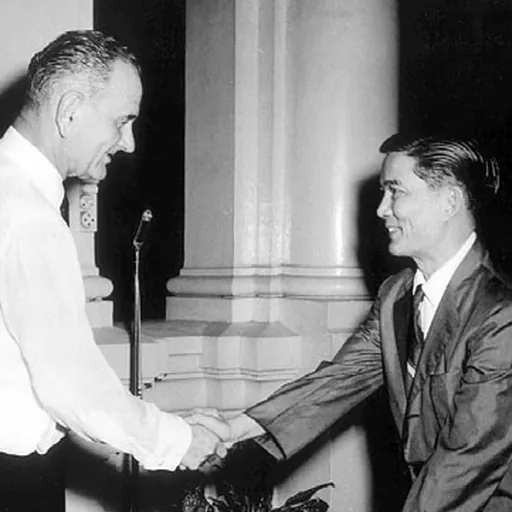
Ngô Đình Nhu (pictured) shaking hands with United States Vice President Lyndon B. Johnson. alt=Tall European man standing in profile at left in a white suit and tie shakes hands with a smaller black-haired Asian man in a white shirt, dark suit and tie.
By the next morning, the loyalist forces had collapsed. Diệm and his younger brother and chief adviser, Ngô Đình Nhu, agreed to surrender, and coup plotter Đôn promised them safe passage out of the country. In the meantime, Minh left Joint General Staff (JGS) headquarters and travelled to Gia Long Palace in a sedan, accompanied by Nhung. He arrived at the palace at 08:00 in full military uniform to supervise the arrest of Diệm and Nhu for the surrender ceremony. Diệm and Nhu had communicated with the generals via a direct phone link from the safehouse to the palace, giving the false impression that they were still besieged.
alt=Middle-aged black-haired man lies face half-down on the floor, covered on his face and dark suit and trousers with blood. His hands are behind his back.
The soldiers arrived at the church and promptly arrested the brothers, tying them with their hands behind their backs. After the arrest, Nhung and Major Dương Hiếu Nghĩa sat with Diệm and Nhu inside the APC, and the convoy departed for Tân Sơn Nhứt. They stopped at a railroad crossing on the return trip where, by all accounts, the brothers were assassinated. An investigation by Đôn later determined that Nghĩa had shot the brothers at point-blank range with a semi-automatic firearm and that Nhung sprayed them with bullets before repeatedly stabbing their bodies with a knife.
During the journey back, Nghĩa gave his account of the assassinations to military headquarters: "As we rode back to the Joint General Staff headquarters, Diệm sat silently, but Nhu and the captain [Nhung] began to insult each other. I don't know who started it. The name-calling grew passionate. The captain had hated Nhu before. Now he was charged with emotion."
Đôn and other officers were stunned when the corpses arrived at JGS headquarters. Đôn confronted Minh in his office, and while they were remonstrating, Xuân entered the room. Unaware of Đôn's presence, Xuân snapped to attention and stated in French, “Mission accomplie”. Despite Đôn's investigation,
Death
Following the coup, Nhung's commanding officer, General Minh, became the President of South Vietnam, ruling through a military junta known as the Military Revolutionary Council. After three months of rule, which was criticised for its lack of direction, General Nguyễn Khánh deposed Minh in a bloodless coup before dawn on 30 January 1964. Minh was briefly put under house arrest, Other reports at the time said that Nhung was found dead as a result of strangulation at the Joint General Staff headquarters. According to variations of this line, Nhung either hanged himself in custody or was murdered by an unknown hand.
More recently, historians have come to believe that Khánh ordered that Nhung be liquidated and that the earlier reports were deliberately false material disseminated by Khánh through his subordinates. According to this account, one of Khánh's men took Nhung to the garden of a Saigon villa and forced him to kneel, before executing him with a single gunshot to the back of the head. Nhung's death led to protests among the Saigon public, who took the killing to be a signal that the remaining members of Diệm's regime would be reinstated to positions of authority.
Nhung was buried on 1 February, the day after his death, in the presence of family and friends, at Gia Đính cemetery. Nhung's death was never formally investigated by an independent body and the official line of suicide continued to be propagated.
Minh was said to have been deeply affected by the loss of his long-time aide, and it was reported that the general erected an altar dedicated to Nhung's memory in his office, with the major's portrait on it. Shortly after the coup, Khánh made Minh the figurehead head of state under American advice, hoping that the presence of the popular general would help to unify the armed forces, but Minh made little attempt to help Khánh, partly because of resentment over the loss of his aide.
Don’t just read it —
keep it.
Full-length biographies made to live with: read them, listen on the way to work, watch them tonight.
- E-book
- Audio
- Video
Instant download · yours to keep · every purchase keeps this site free
Important facts
People in Nguyen Van Nhung's life
Named in this biography and alive at the same time


Related people
Same field, nearest in time



Contemporaries
People whose lives overlapped Nguyen Van Nhung's



Frequently asked questions
Who was Nguyen Van Nhung?
South Vietnamese military officer; executed Ngô Đình Diệm and Ngô Đình Nhu
When was Nguyen Van Nhung born?
Nguyen Van Nhung was born in 1919 in French Indochina.
When did Nguyen Van Nhung die?
Nguyen Van Nhung died on 31 January 1964 in Ho Chi Minh City.
What was Nguyen Van Nhung's occupation?
Nguyen Van Nhung was a military personnel, aide-de-camp and dương Văn Minh.
What nationality was Nguyen Van Nhung?
Nguyen Van Nhung was Vietnamese.
Sources & further reading
Cite this page
APA: Biography.guide. (2026). Nguyen Van Nhung. https://biography.guide/nguyen-van-nhung/
MLA: "Nguyen Van Nhung." Biography.guide, https://biography.guide/nguyen-van-nhung/.
Chicago: "Nguyen Van Nhung." Biography.guide. https://biography.guide/nguyen-van-nhung/.
Data last updated: 2026-09-23 · Spot an error? Report a correction.
Portrait: Wikimedia Commons · author & licence
Page generated 2026-09-27 05:06 UTC