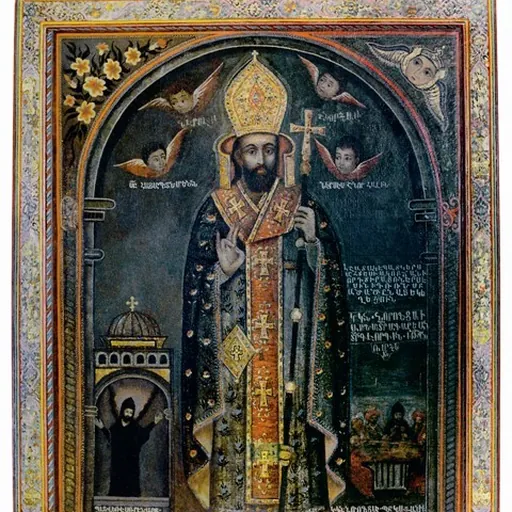
About Nerses IV the Gracious
Lived 1102 – 1173 (aged 71). Nerses IV the Gracious was a poet, matenagir, composer, musician and politician.
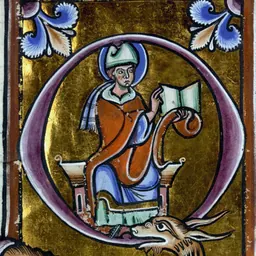
Nerses IV the Gracious (; also Nerses Shnorhali, Nerses of Kla or Saint Nerses the Graceful; 1102 – 13 August 1173) was Catholicos of Armenia from 1166 to 1173.
During his time as a bishop and, later, as Catholicos of the Armenian Church, Nerses worked to bring about reconciliation with the Eastern Orthodox Church and convened a council with emissaries selected by the Byzantine emperor himself to discuss how they might be able to reunite the two churches. The terms the emperor offered were, however, unacceptable to both Nerses and the Armenian Church, and the negotiations collapsed.
Nerses is remembered as a theologian, poet, writer and hymn composer. He has been called "the Fénelon of Armenia" for his efforts to draw the Armenian church out of isolation, and has been recognized as a saint by the Roman Rite of the Catholic Church, which holds his feast on August 13, and by the Armenian Apostolic Church and Armenian Catholic Church, who celebrate him in mid-October on the Saturday of the Fourth Week of the Holy Cross.
Biography
Early life Nerses was born in approximately 1100 into the noble Pahlavuni family. Nerses was the name he adopted upon ordination as a priest; his birth name is unknown. According to some sources, he was born in the castle of Dzovk in the province of Tluk in Cilicia, However, other sources claim that Nerses was born in his family's fortress, also called Dzovk, in the historical province of Sophene in Armenia, Nerses moved to Dzovk in Cilicia, named after their original home, with his brother, the future Catholicos Gregory III, after the death of their father in 1111. (a cousin of Nerses) placed them under the tutelage of the monk Stepanos Manouk, a highly regarded scholar and theologian. Nerses' epithet , which may be translated as 'graceful' appears to have been an honorary title given to the graduates of Karmir Vank, although others have suggested that he received this title for the grace of his person, speech and written works
The writings and theological vocabulary of Nerses Shnorhali align with the tradition of the Church Fathers, whose goal was to articulate and defend the "true faith." In various manuscripts and memorial texts, he is described with the phrase "gracious mouth," emphasizing his role as both a teacher and interpreter.
Nerses Shnorhali is also credited with efforts toward reconciling long-standing doctrinal differences between the Armenian and Greek churches, acting as a peacemaker in theological and diplomatic dialogue.
The epithet Shnorhali was later adopted more broadly as a title of honor for both governors and spiritual leaders, highlighting their eloquence, wisdom, and educational contributions.
In 1165, hostilities broke out between Thoros II, Prince of Armenia and Oshin of Lampron, the two strongest Armenian princes of Cilicia. and one prayer in particular, (I Confess with Faith), is currently available in 36 languages. In James R. Russell's view, Nerses' poetry emphasizes "the imagery of fire and light in a manner at once redolent of Hesychasm and consonant with the Zoroastrian substrate of Armenian Christian culture."
Don’t just read it —
keep it.
Full-length biographies made to live with: read them, listen on the way to work, watch them tonight.
- E-book
- Audio
- Video
Instant download · yours to keep · every purchase keeps this site free
Important facts
Related people
Same field, nearest in time




Contemporaries
People whose lives overlapped Nerses IV the Gracious's


Frequently asked questions
Who was Nerses IV the Gracious?
Armenian bishop and writer
When was Nerses IV the Gracious born?
Nerses IV the Gracious was born on 4 June 1102.
When did Nerses IV the Gracious die?
Nerses IV the Gracious died on 13 August 1173 in Rumkale.
What was Nerses IV the Gracious's occupation?
Nerses IV the Gracious was a poet, matenagir, composer, musician and politician.
Sources & further reading
· Wikipedia: Nerses IV the Gracious
· DBpedia: Nerses IV the Gracious
Cite this page
APA: Biography.guide. (2026). Nerses IV the Gracious. https://biography.guide/nerses-iv-the-gracious/
MLA: "Nerses IV the Gracious." Biography.guide, https://biography.guide/nerses-iv-the-gracious/.
Chicago: "Nerses IV the Gracious." Biography.guide. https://biography.guide/nerses-iv-the-gracious/.
Data last updated: 2026-09-22 · Spot an error? Report a correction.
Portrait: Wikimedia Commons · author & licence
Page generated 2026-09-27 05:03 UTC