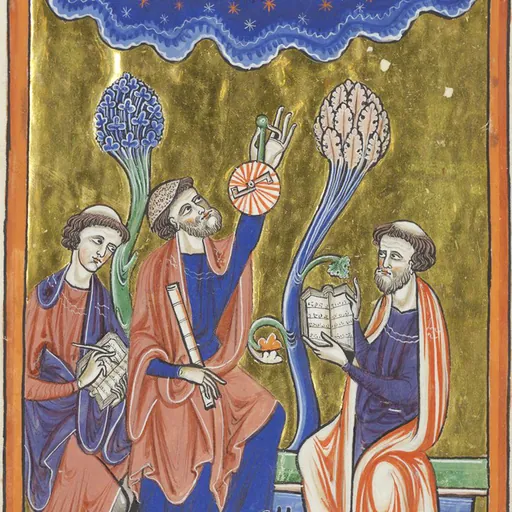
About Abraham ibn Ezra
Lived 1089 – 1167 (aged 77–78). Abraham ibn Ezra was a poet, rabbi, writer, translator, philosopher and astrologer.
Abraham ben Meir Ibn Ezra (, often abbreviated as ; Ibrāhim al-Mājid ibn Ezra; also known as Abenezra or simply ibn Ezra, 1089 / 1092 – 27 January 1164 / 23 January 1167) was one of the most distinguished Jewish biblical commentators and philosophers of the Middle Ages. He was born in Tudela, Taifa of Zaragoza (now Navarre). Ibn Ezra is especially well-known to readers outside of the Jewish tradition as a major source of inspiration for Spinoza's early modern source-criticism on the authorship of the Law of Moses, appearing in theTheologico-Political Treatise.
From outside sources, little is known of ibn Ezra's family; however, he wrote of a marriage to a wife who produced five children. While it is believed four died early, the last-born, Isaac, became an influential poet and a later convert to Islam in 1140. His son's conversion was deeply troubling for ibn Ezra, leading him to pen many poems reacting to the event for years afterward.
Ibn Ezra was a close friend of Judah Halevi, who was approximately 14 years older. When ibn Ezra moved to Córdoba as a young man, Halevi followed him. This trend continued when the two began their lives as wanderers in 1137. Halevi died in 1141, but Ibn Ezra continued travelling for three decades, reaching as far as Baghdad. During his travels, he composed secular poetry of the lands he traveled through and rationalist Torah commentaries (for which he would be best remembered). Although many claim "Ibn Ezra" was a family name allowing for several scholars over the generations to have that name. He wandered all over Europe lamenting that he could not find a patron. The rabbinical post that he held in Vienna was not extended becaue of his straight-forward approach to Talmudic scholarship as opposed to the "pilpul" method then in vogue. Ironically one of the foremost of the latter, Rabeinu Tam, was a very good friend and they corresponded in verse. While in England he wrote the "second" version of his biblical exegesis.
Works
In Spain, Ibn Ezra had already gained the reputation of a distinguished poet and thinker. However, apart from his poems, the vast majority of his work was composed after 1140. Written in Hebrew, as opposed to earlier thinkers' use of Judeo-Arabic, these works covering Hebrew grammar, Biblical exegesis, and scientific theory were tinged with the work of Arab scholars he had studied in Spain.
Beginning many of his writings in Italy, Ibn Ezra also worked extensively to translate the works of grammarian and biblical exegetist Judah ben David Hayyuj from their original Judeo-Arabic to Hebrew. Published as early as 1140, these translations became some of the first expositions of Hebrew grammar to be written in Hebrew. He exercised an independent criticism that, according to some writers, exhibits a marked tendency toward rationalism. In addition, he sharply criticized those who blended the simplistic and logical explanation with Midrash, maintaining that such interpretations were never intended to supplant the plain understanding.
Indeed, Ibn Ezra is claimed by proponents of higher biblical criticism of the Torah as one of its earliest pioneers. Baruch Spinoza, in concluding that Moses did not author the Torah and that the Torah and other protocanonical books were written or redacted by somebody else, cites Ibn Ezra's commentary on Deuteronomy. In his commentary, ibn Ezra examines Deuteronomy 1:1 and expresses concern over the unusual phrasing that describes Moses as being "beyond the Jordan." This wording suggests that the writer was situated in the land of Canaan, which is located west of the Jordan River, even though Moses and the Children of Israel had not yet crossed the Jordan at that point in the Biblical narrative. Relating this inconsistency to others in the Torah, Ibn Ezra stated, "If you can grasp the mystery behind the following problematic passages: 1) The final twelve verses of this book [i.e., Deuteronomy 34:1–12, describing the death of Moses], 2) 'Moshe wrote [this song on the same day, and taught it to the children of Israel]' [Deuteronomy 31:22]; 3) 'At that time, the Canaanites dwelt in the land' [Genesis 12:6]; 4) '... In the mountain of God, He will appear' [Genesis 22:14]; 5) 'behold, his [Og king of Bashan] bed is a bed of iron [is it not in Rabbah of the children of Ammon?]' you will understand the truth." as "a clear indication that it was not Moses who wrote the Pentateuch but someone else who lived long after him, and that it was a different book that Moses wrote".
On the other hand, Orthodox writers have stated that Ibn Ezra's commentary can be interpreted as consistent with Jewish tradition, stating that the Torah was divinely dictated to Moses.
Ibn Ezra is also among the first scholars to have published a text about dividing the Book of Isaiah into at least two distinct parts. In his commentary to Isaiah, he remarked that chapters 1-39 dealt with a different historical period (second half of the 8th century BCE) than chapters 40-66 (later than the last third of the 6th century BCE). This division of the book into First Isaiah and Deutero-Isaiah has been accepted nowadays by all but the most conservative Jews and Christians.
Ibn Ezra's commentaries, especially some of the longer excursuses, contain numerous contributions to the philosophy of religion. One work in particular that belongs to this province, Yesod Mora ("Foundation of Awe"), on the division and the reasons for the Biblical commandments, he wrote in 1158 for a London-based friend, Joseph ben Jacob. In his philosophical thought, Neoplatonic ideas prevail, and astrology also had a place in his view of the world. He also wrote various works on mathematical and astronomical subjects.
He believed that Greek science had been "pillaged" from Hebrew science which predated it.
Don’t just read it —
keep it.
Full-length biographies made to live with: read them, listen on the way to work, watch them tonight.
- E-book
- Audio
- Video
Instant download · yours to keep · every purchase keeps this site free
Important facts
People in Abraham ibn Ezra's life
Named in this biography and alive at the same time
Related people
Same field, nearest in time



Contemporaries
People whose lives overlapped Abraham ibn Ezra's


Frequently asked questions
Who was Abraham ibn Ezra?
12th-century Sephardic rabbi and astrologer
When was Abraham ibn Ezra born?
Abraham ibn Ezra was born in 1089 in Tudela.
When did Abraham ibn Ezra die?
Abraham ibn Ezra died on 23 January 1167 in Calahorra.
What was Abraham ibn Ezra's occupation?
Abraham ibn Ezra was a poet, rabbi, writer, translator, philosopher and astrologer.
Sources & further reading
Cite this page
APA: Biography.guide. (2026). Abraham ibn Ezra. https://biography.guide/abraham-ibn-ezra/
MLA: "Abraham ibn Ezra." Biography.guide, https://biography.guide/abraham-ibn-ezra/.
Chicago: "Abraham ibn Ezra." Biography.guide. https://biography.guide/abraham-ibn-ezra/.
Data last updated: 2026-09-23 · Spot an error? Report a correction.
Portrait: Wikimedia Commons · author & licence
Page generated 2026-09-27 05:06 UTC