
About Nell Tenhaaf
Born 1951. Nell Tenhaaf is a Canadian visual artist and videographer.
Nell Tenhaaf (born in 1951 in Oshawa, Ontario) is a Canadian artist, teacher, writer and feminist.
Nell received a B.F.A. in 1974 and a M.F.A. in 1989 both from Concordia University, Montreal, Quebec.
The bulk of Tenhaaf’s art was produced during the time that she lived in Montreal, Quebec (since 1969); however, her work has been exhibited not only in Canada, but also in the United States and Europe.
Today, Nell Tenhaaf lives in Trent Hills, Ontario and is Professor Emeritus in the Visual Arts and Computational Arts departments of York University.
Practice Tenhaaf writes and makes art on subjects related to science, biotechnology and artificial life. Her practice also focuses on gender issues regarding electronic media and computer technologies as well as science exploration through art practice, keeping even the feminist works within the scientific realm in order to incorporate female origin stories while agitating the rational locus of science. Tenhaaf includes in her work aspects that may contradict each other such as mythology, genetics, biotechnology and even religious iconography, believing that the power of art lies in the interaction between the artist, who is present in a work, and an individual viewer. In order to help the viewer identify with the work, Tenhaaf often includes the material presence of a body in her pieces. In addition to this, Tenhaaf makes sure to keep the notion of agency present in her practice while also addressing ethics.
Notable works The key connection between the artist’s current practice and her early database work is information. Despite originally being trained in painting, in the early 1980s Tenhaaf was determined to get permission from Canadian Department of Communications (DOC) to take part in the Telidon Vista field trials supported by Bell, in Toronto and Montreal. Artists were experimenting with the new "videotex" technology for creating computer graphics in the form of image and text, making content for testing the videotex protocol and the telecommunication networks that gave public access to the databases. It interested Tenhaaf to create alternative content for an emerging technology that was hoped to have a wide commercial appreciation. Given the opportunity, she created the database Us and/or Them (1983) which was a digital collection of text, maps, graphic design as well as images of Cold War found in various information sources such as magazines, newspapers and even United Nations reports, all of which were presented with manipulated digital graphics. This project introduced a correlation between Boolean concept of “and/or” and the harsh us vs them Cold War attitude. By combining information from both the United States and the Soviet Union origins, the controversial aspect of blame was opened. Later, Tenhaaf recreated the project as an independent show; however, until then initial Us and/or Them (1983) was accessible exclusively online at publicly available videotex terminals. This DOC-sponsored artist project was so significant due to its status as the first example of art about data realm.
The commercial project Telidon failed in mid-eighties, and at the same time Tenhaaf decided to redirect her practice closer to her starting medium (painting). She was still extremely interested in technological innovations, but at the time exploring only that in the artistic sphere seemed quite limited. The artist continued to include electronic technologies in her work integrating them with more traditional media such as painting and charcoal drawing. The exhibition ...believable, if not always true (1987) explored a concept of galleries and museums as archives of politically-focused information about economics of both liberalism and capitalism. The installation combined aspects of Egyptian art with popular culture innuendos in a form of bright pinks and greys. In addition to this, Tenhaaf played with the idea of placing contradictory cliches on computer screens within the space that both engaged the viewers and left them wondering about the lack of epistemological certainty. The mixture of information, technology, graphics, conundrums and mock architecture erased the conventional detachment of faith and truth, mythology and science. The artist herself explained the installation as “an interactive encounter with received ideas intended to seduce through a sense of the familiar, and yet introduce a conceptual space for resistance to acquired knowledge.” She elaborated that in this era of technological advancements that allow us to store unlimited amounts of information, the concept of knowledge become controversial. Ironically, despite our tremendous attraction to online databases and digitally-enhanced images, we are still drawn to a familiar past, hence why she choose to include sacred cow and Egyptian-esque architecture exhibiting that beliefs are a foundation to all modern innovations. Consequently, Tenhaaf explored scientific technological discourse and the absence of female form in it by familiarizing viewers to the matriarchal presence in Egyptian culture. In that database, the artist explained the importance of the Cycladic goddess, information on which was taken from the Ramses exhibition conveniently that was taking place in Montreal, Quebec at the time.
Species Life (1989) characterized the shift from information technology to biological technology in Tenhaaf’s practice. She played with the binary objections on gender by presenting digitally rectangular light boxes depicting conventions of gender roles through digitally enhanced images (T frame capture and manipulation): a man and a woman looking at a picturesque sunset with a pink and blue strings of DNA spinning around them; texts from the writings of Friedrich Nietzsche and Luce Irigaray (hand-printed yet still computer-processed) climbing up the fine threads of the double helix where Irigaray’s portion was positioned to identify female position, and consequently, accentuate the role of the mother in reproduction and modern society in general while Nietzsche’s piece took place of a male position of power. By intermingling the traditional aspect of heterosexual coupling with iconic texts of influential philosophers, Tenhaaf presented a conceptual way of describing the DNA double helix exploring the connection between romantic trope of mating and procreation and scientific discovery and its control over the reproduction. Tenhaaf’s work on biotechnology reminds us that biology itself has its history, suggesting that our contemporary concepts of biological destiny in both religious and scientific senses depends majorly on beliefs that include displacement of women from a liable position. By including images of Virgin Mary and Christ in Vitro (1991) and references to the myth of Oedipus in horror autotoxicus (1992) and combining the religious ideas with scientific notions, Tenhaaf urged the viewers to realize that science doesn’t banish patriarchal ways of thinking, but on the contrary can reinforces their power and authority.
Publications With Melanie Baljko, "Sensory, sonic and symbolic features of a collaborative media art practice" in Canadian Journal of Communication, Vol. 37, No. 1, 2012, pp. 109–119. With Melanie Baljko, "The Aesthetics of Emergence: Co-constructed Interactions" in ACM Transactions on Human-Computer Interaction (TOCHI – Special Double Issue on the Aesthetics of Interaction), Vol. 15, Issue 3, November 2008, pp. 11: 1–27. "Art Embodies A-Life: The VIDA Competition" in Leonardo, Vol. 41, No. 1, 2008, pp. 6–15. "Where Surfaces Meet: Interviews with Stuart Kauffman, Claus Emmeche and Arantza Etxeberria" in Leonardo, Vol. 34, No. 2, 2001, pp. 115–120. "As Art is Lifelike: Evolution, Art, and The Readymade" in Leonardo, Vol. 31, No. 5, 1998, pp. 397–404. "Pandora Re-visited: Art and New Technologies" in Journal of Architectural Education, Washington, D.C., Summer, 1987, pp. 18–23.
Don’t just read it —
keep it.
Full-length biographies made to live with: read them, listen on the way to work, watch them tonight.
- E-book
- Audio
- Video
Instant download · yours to keep · every purchase keeps this site free
Important facts
People in Nell Tenhaaf's life
Named in this biography and alive at the same time

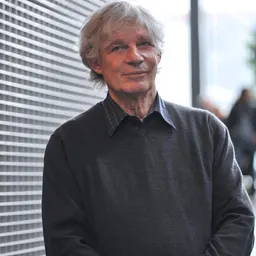
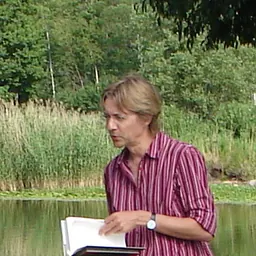

Related people
Same field, nearest in time
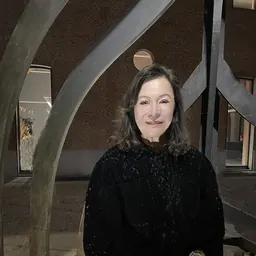




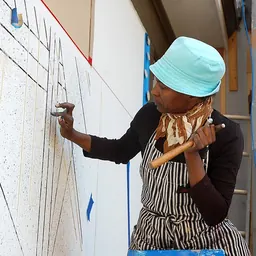
Contemporaries
People whose lives overlapped Nell Tenhaaf's


Frequently asked questions
Who is Nell Tenhaaf?
Canadian artist, teacher, and writer (born 1951)
When was Nell Tenhaaf born?
Nell Tenhaaf was born in 1951 in Oshawa.
What is Nell Tenhaaf's occupation?
Nell Tenhaaf is a visual artist and videographer.
What nationality is Nell Tenhaaf?
Nell Tenhaaf is Canadian.
Sources & further reading
Cite this page
APA: Biography.guide. (2026). Nell Tenhaaf. https://biography.guide/nell-tenhaaf/
MLA: "Nell Tenhaaf." Biography.guide, https://biography.guide/nell-tenhaaf/.
Chicago: "Nell Tenhaaf." Biography.guide. https://biography.guide/nell-tenhaaf/.
Data last updated: 2026-09-20 · Spot an error? Report a correction.
Page generated 2026-09-27 05:03 UTC