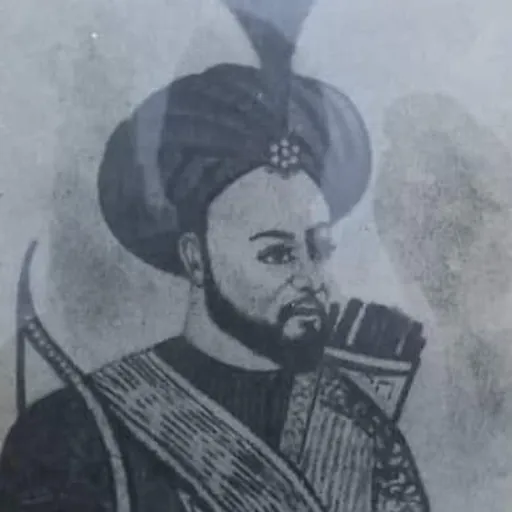
Nawab Sayyid Hussain Ali Khan Barha
Nawab of Aurangabad
About Nawab Sayyid Hussain Ali Khan Barha
Lived 1668 – 1720 (aged 51–52).
Nawab Sayyid Hussain Ali Khan Barha (1666 – 8 October 1720), officially Itisham-ul-Mulk, was a kingmaker of the later Mughal Period. He is best known for ordering the death of Emperor Farrukhsiyar, largely in an attempt to halt the numerous assassination attempts that the latter had ordered against him and his brother Abdullah Khan Barha. Hussain Ali Khan rose as a kingmaker in early 18th century India, when he was concurrently the Mughal governor of Ajmer and Aurangabad in the Deccan.
Both Hussain Ali Khan and his brother, Abdullah Khan, had a hand in the installation or deposition (or both) of several emperors to the throne at Delhi, including: Bahadur Shah I, Jahandar Shah, Farrukhsiyar, Rafi ud Darajat, Shah Jahan II, Ibrahim and Muhammad Shah. The brothers eventually became de facto rulers of the sub-continent by the early 18th century, at a time when India's economy was the largest in the world.
Early life and family Barha was the second son of the Nawab of Ajmer, Mian Abdullah Khan I. Barha dynasty, to which Hussain Ali Khan belonged, was of peasant origins, and his ancestors had moved at an uncertain date from their homeland in Punjab to a barren region in Muzaffarnagar district of Uttar Pradesh. Although Barhas claimed to be descendants of Muhammad, or Sayyids, this claim was always dubious. Emperor Jahangir, although noting that people questioned their lineage, considered their bravery as a proof of their claims. They took much pride in their Indian ancestry, and according to the American historian Richard M. Eaton, were "as native to India as were Jats, Rajputs or Marathas." By the time of Emperor Aurangzeb, the dynasty was firmly regarded as "Old Nobility" and held realms of Ajmer and Dakhin. The Sadaat-e-Bara tribe, due to their reputation, acquired a hereditary right to lead the vanguard of imperial Mughal armies in every battle. The Mughal emperor Jahangir remarked that the Sadaat-e-Bara were "averters of calamity from this dominion".
Hussain Ali Khan started his early career as a Faujdar during Aurangzeb's reign and eventually gained higher positions after backing Bahadur Shah I in the succession war ensuing Aurangzeb's death.
Biography Hussain Ali Khan served as the Commander-in-chief and Mir Bakhshi of the Mughal Empire, the Sipahsalar, and the Amir al-umara (Chief of all nobles), and personally oversaw the end of Ajit Singh's rebellion. He was appointed the Viceroy of the six provinces of the Deccan, after which he broke the peace agreements with the Marathas and engaged in open warfare with all the Maratha chieftains without discrimination. Intoxicated with power, with passing through the territory of Jai Singh, he pillaged the wayside villages of Jaipur and its innocent peasantry, and refused to accept presents from a high-ranking officer. He was inclined to use exaggerated and insolent language, and flatterers in the camp of Hussain Ali Khan used to recite the verses, even in the Emperor's presence "The whole world and all creation seeks the shelter of your umbrella, Kings of the world earn crowns through your emprize." He is noted by William Irvine to have been "Really friendly to the poor and non-oppressive in disposition." During his time as the administrator of Aurangabad, Barha began a reservoir, a bridge and other works for the public.
Death He was eventually assassinated by Turkish nobles also known as the Turani faction. On the pretext of presenting a petition concerning his malnourished troops, Haider Beg Dughlat fatally stabbed Hussain Ali Khan as his attention was diverted to reading the petition. Haider Beg Dughlat was immediately killed by Hussain Ali Khan's fourteen year old nephew Sayyid Nurallah Khan (Sayyid Nur Ali) who was himself immediately killed by Mughal troops. According to the historian Khizr Khan, Hussain Ali Khan was buried in his fathers tomb at Ajmer.
Titles Upon helping the Emperor Farrukhsiyar to the throne of Delhi, Hussain Ali Khan Barha was awarded with the position of Mir Bakhshi and granted the following titles and appellations: Umdat-ul-mulk, Amir-ul-Umara, Bahadur, Feroze Jung, Sipah Sardar.
Depictions
Don’t just read it —
keep it.
Full-length biographies made to live with: read them, listen on the way to work, watch them tonight.
- E-book
- Audio
- Video
Instant download · yours to keep · every purchase keeps this site free
Important facts
People in Nawab Sayyid Hussain Ali Khan Barha's life
Named in this biography and alive at the same time


Contemporaries
People whose lives overlapped Nawab Sayyid Hussain Ali Khan Barha's




Frequently asked questions
Who was Nawab Sayyid Hussain Ali Khan Barha?
nawab of Aurangabad
When was Nawab Sayyid Hussain Ali Khan Barha born?
Nawab Sayyid Hussain Ali Khan Barha was born in 1668.
When did Nawab Sayyid Hussain Ali Khan Barha die?
Nawab Sayyid Hussain Ali Khan Barha died on 8 October 1720.
Sources & further reading
· Wikipedia: Nawab Sayyid Hussain Ali Khan Barha
· DBpedia: Hussain Ali Khan Barha
Cite this page
APA: Biography.guide. (2026). Nawab Sayyid Hussain Ali Khan Barha. https://biography.guide/nawab-sayyid-hussain-ali-khan-barha/
MLA: "Nawab Sayyid Hussain Ali Khan Barha." Biography.guide, https://biography.guide/nawab-sayyid-hussain-ali-khan-barha/.
Chicago: "Nawab Sayyid Hussain Ali Khan Barha." Biography.guide. https://biography.guide/nawab-sayyid-hussain-ali-khan-barha/.
Data last updated: 2026-09-23 · Spot an error? Report a correction.
Portrait: Wikimedia Commons · author & licence
Page generated 2026-09-27 05:07 UTC