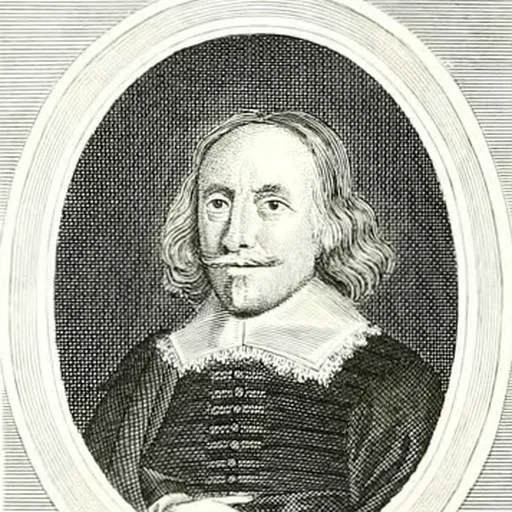
About Nathaniel Barnardiston
Lived 1588 – 1653 (aged 64–65). Nathaniel Barnardiston was a politician.
Sir Nathaniel Barnardiston (1588 – 25 July 1653) of Kedington, alias Ketton, Suffolk, was an English (East Anglian) landowner, magistrate and senior representative of a long-established knightly family, one of the wealthiest in Suffolk, who sat in the House of Commons for Sudbury twice and for the Shire three times between 1625 and 1648. Of Parliamentarian sympathies, he was known for his Christian piety both personally and in managing his household and the parishes under his patronage.
John Burke remarked that he was "esteemed the greatest ornament of his family", and cited Samuel Fairclough, who called him "one of the most eminent patriots of his time, and the twenty-third knight of his family". J.P. Ferris observed, "As a strong parliamentarian and a Presbyterian elder he was the dominant figure in Civil War Suffolk".
Barnardiston family of Ketton
The Barnardiston family took its name from the village of Barnardiston in the south-west corner of Suffolk, nearby to Kedington, and claimed a very remote establishment there, possibly from the time of the Norman Conquest. Kedington was formerly held by the de Novo Mercato or Newmarch family, with whom the Barnardistons intermarried during the 13th and 14th centuries. By 1327 the manor of Great Coates, North Lincolnshire, was held by John de Barnardiston, and also remained an important seat of the family.
In 1553, during the reign of Edward VI, Thomas Barnardiston the grandfather of Nathaniel became a ward of the King's tutor Sir John Cheke, who sent him to study with John Calvin in Geneva. "If the Grandfather failed to live according to that education in some part of his life, yet his Grandson endeavoured to live it for him."
Early life Nathaniel was the eldest surviving son of Sir Thomas Barnardiston of Witham, Essex (son of the Thomas above), and his wife Mary Knightley, daughter of Sir Richard Knightley of Fawsley, Northamptonshire by his first marriage to Mary Fermor. He had younger brothers Arthur and Thomas, and a sister Elizabeth, who reached adulthood. though he was there in November 1605 as he recalled seeing a group of men walking in the Temple garden, whispering together and looking and acting concerned, whom he afterwards recognized to have been the Gunpowder Plot conspirators. He left his term of years in the capital messuage at Witham to his widow, and his possession of the parsonage there to her and to his sons while its term endured. Nathaniel therefore did not succeed to the older family estates until the death of his grandfather, Sir Thomas Barnardiston of Clare, Suffolk, in 1619. His stepmother, his father's sole executrix, remarried, and lived until March 1632/33. Their eldest child was born before 1617. In that year, 1617, he received a commission for sewers (for Suffolk and Essex).
1620s He received a commission for the peace for Suffolk in 1622 which he held more or less continuously for the rest of his life. By 1623 he was also Deputy lieutenant for the county, and for the year of 1623-24 was Sheriff of Suffolk. He was then returned to parliament in 1628 to represent Suffolk. and where Barnardiston often heard him and admired his teaching.
Fairclough, meanwhile, lectured for the town of King's Lynn, but fell foul of local interests there, and, returning to Clare, married Richard Blackerby's eldest daughter. Sir Nathaniel was determined to recruit him, and in 1623 Fairclough accepted the small rectorate of Barnardiston parish, his patron promising him Kedington when it should become vacant. Sir Nathaniel had a family pew specially built at Barnardiston church so that they could all go to hear Fairclough as well as Gibson. Fairclough was, however, summoned before a High Commission for irregularities of teaching, from which he was not discharged for two years. As at Barnardiston, his institution at Kedington in 1629 took place without his having to take the oath of canonical obedience, or to subscribe to Whitgift's Three Articles.
To this period belong the descriptions of his domestic life and devout parental care. There was said to be a blessed conjunction in him: he had "an admirable faculty and easinesse to be intreated, with a great yeildingness of spirit, even to Inferiours, when any good might be done thereby, yet also a strong, resolute unmoveablenesse and stedfastness of mind in opposing all evil in whomsoever." Nathaniel's eldest son, Thomas (born before 1620) matriculated as a fellow-commoner from St Catharine's College at Michaelmas 1633, and on 1 May 1635 he was admitted to Gray's Inn together with his cousin Nathaniel Parker, son of Dame Jane's sister Marcy Soame and Sir Calthrop Parker of Erwarton, Suffolk. In her will Dame Katherine had also given £200 to Stephen Marshall, the puritan vicar of Finchingfield in Essex, for him to bestow as he thought fitting. Marshall was a graduate of Emmanuel College, Cambridge, and had been resident in Clare before becoming curate at Wethersfield, Essex in March 1620, and going to Finchingfield in 1625: the Anglican vicar general of London considered that Marshall governed "the consciences of all the rich puritans in these parts and in many places far remote." He was considered a dangerous man, involved with John Stoughton, Samuel Hartlib and others in the distribution of puritan funds: this bequest was probably intended to support godly ministers either in England or in New England.
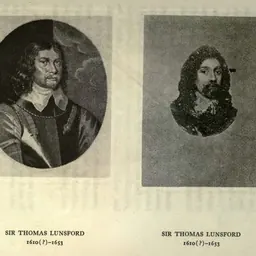
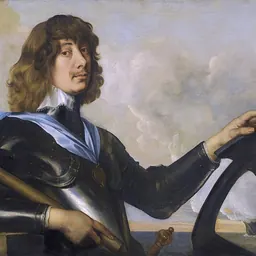
1640s In April 1640 Sir Nathaniel was re-elected as Knight of the Shire for Suffolk, for the Short Parliament, and again in November 1640 for the Long Parliament. Long circumstantial accounts of the election at Ipswich in autumn 1640 were published within an essay by Thomas Carlyle. His eldest son, Thomas Barnardiston, who was knighted by Charles I in 1641, nonetheless shared his father's parliamentary sympathies. His third son, Samuel Barnardiston, was (according to the historian Rapin, or his editor) in a crowd of crop-haired apprentices protesting in Westminster in December 1641 against the Bishops and against Colonel Thomas Lunsford's repressive methods, when the Queen, looking out from her window, remarked of Samuel, "See what a handsome young Roundhead is there", from which the use of this name for the Parliamentarians arose. Yet Sir Nathaniel himself, both in his portrait and his funeral monument, is shown with flowing hair.
Receiving a commission for the subsidy in Suffolk in 1641, in the following year he was again a Deputy Lieutenant for the county. He subscribed £700, and loaned a further £500, to the Parliament towards the costs of bringing the Irish rebels under control. It was agreed that this should be repaid at 8% out of the first payments of the Parliamentary subsidy of 1642, but remained partly unpaid in 1645. Barnardiston took the Covenant in 1643, became Party assessor for Suffolk, and joined the Eastern Counties Association. His position in the Committee, which brought him dealings with his staunch friend Sir William Spring, and in which his son Sir Thomas Barnardiston (who became a Parliamentary soldier) participated, reflected his status as a leading figure among the gentry and magistracy.
The Commons gave approval for the payment of the balance of his loan to them in May 1645. In that year his son Sir Thomas was returned as Member of Parliament for Bury St Edmunds, which he continued to represent until 1653. Sir Nathaniel, who received commissions relating to the Liberty of St Edmund in 1644 and to the Liberty of St Etheldreda in 1645, also had oyer and terminer and gaol delivery in Essex in the latter year, and was a commissioner for sewers in Middlesex. He was, with Henry North of Mildenhall, an elder of the Clare classis of the Presbyterian organization. He also held commissions in 1646 for Exclusions from the Sacrament and in 1648 for Scandalous offences. He is not recorded as sitting in parliament after Pride's Purge in 1648, but in 1649 held a commission for drainage of the Fens.
After writing his will it was observed that "he seemed to have little to do, than to be gone to the better world", though he lived for two years after. He was at Hackney when a swelling appeared on his neck which was the harbinger of death. He summoned Samuel Fairclough from Suffolk to walk and confer with him on the worth and immortality of the soul, and of how it should subsist and act, when separated from the body; and of the joys of the other world, and of the vanity and emptiness of everything in this. At their parting he said to Fairclough, "Sir, I now much wonder that any man who fully believes these things to be realities, and not meer notions (being in my condition) should be unwilling to dye; for my owne parte, I will not be so flattered with any carnal content[ment], as to be desirous to live longer in this World, where there is little hope left that the Lord hath any more work or service for me to do, except it be to suffer for keeping a good Conscience, in witnessing against the Apostacys and impieties of the Times; and now it is a great favour of God to be sent for speedily." and his funeral at Kedington on 26 August 1653 was attended, it is said, by thousands. and from this portrait of his character was derived the Life of him which was included in Samuel Clarke's Lives of Eminent Persons. A volume of elegies and acrostic poems, entitled Suffolk's Tears, was also printed in honour of Sir Nathaniel in 1653. The full title of Suffolk's Tears refers to his "large and extraordinary bounty towards the advancing of Religion and Learning, both at home, and in Forreign Plantations among the Heathen."
Additional biographical information is found in the Life of the elder Fairclough, also printed by Clarke. There are four Barnardiston vaults under Kedington church, all approached through a single subterraneous vestibule. When opened in 1915, the well-preserved lead coffins of Sir Nathaniel and Lady Jane Barnardiston were found in the southern or south-eastern chambers. His bore the inscription, "Sir Nathaniel Barnardiston, Knight, died 25th July, 1653", and hers read "The most pious and prudent the Lady Jane, wife to the religious Knight, Sir Nathaniel Barnardiston, who died ye 17th August, 1669, in ye 78 yeare of her age."
Monument In the church of St Peter and St Paul, Kedington there is a fine wall monument to Sir Nathaniel and Dame Jane Barnardiston, set between two windows of the north aisle. Framed at either side by upright hanging festoons of sculpted fruit and flowers, the central panels show (below), supported on a pair of dark consoles, a black-framed white marble panel carrying the memorial inscription, as if forming the inscribed frontage of a tomb-chest.
Above this is a recessed upper frame containing half-length figures in the round of Sir Nathaniel and Dame Jane, as in life, shown frontally but in an informal pose, he resting on his elbow with his head cupped in his hand, leaning towards the outer side of the frame, and she similarly on the sinister side. At the centre, his left hand rests over her right hand, which rests upon a skull. Above them, beneath a horizontal entablature, three cherubim look out from suspended white swags of sculpted cloth applied to the dark backing-stone.
Free-standing above the upper moulding are a pair of sculpted urns, and some small skulls, set either side of an oval escutcheon in a foliate surround showing the impalement of Barnardiston (dexter: Azure, a fess indented ermine, between six cross-crosslets argent) with Soame (sinister: Gules, a chevron between three mallets or). Beneath the lower table, forming the tailpiece of the monument, is a series of 8 polychrome shield-shaped escutcheons bearing impalements for Barnardiston: with a single skull beneath.
Family Sir Nathaniel married Jane Soame, daughter of Sir Stephen Soame of Little Thurlow, Suffolk, and died at the age of 65. Dame Jane lived until 1669, when she left, among other things, her two silver tobacco boxes and her silver tobacco-tongs to her daughters Rolt and Bloyse. Their children were: Sir Thomas Barnardiston (died 1669), MP and baronet, married Anne, daughter of Sir William Armine, 1st Baronet of Osgodby, Lincolnshire. unnamed daughter, died in infancy. Stephen Barnardiston, died in infancy. John Barnardiston Pelethiah Barnardiston of Hackney, buried at Ketton 1679: married Martha, daughter of Richard Turnor of Totteridge, Hertfordshire. Martha remarried to William Bird of Hackney, and died in 1707. William Barnardiston of London, merchant, died at Aleppo. Jane Barnardiston (as recorded in the Blois MSS) married first John Brooke (died 1653), son of Sir Robert Brooke (1572-1646) of Cockfield Hall, Yoxford, and secondly to Sir William Blois (the younger), who had previously been married to John Brooke's sister Martha Brooke (who died in childbirth in 1657 leaving Sir William with his heir (Sir) Charles Blois). Jane, therefore, having already been the daughter-in-law of the dowager of Cockfield, the religious writer Elizabeth Brooke (who lived on there until 1683), became stepmother to the future (1693) Blois heir to Cockfield Hall. She is called "my daughter Brooke" in her father's will of 1653 and "my daughter Bloyse" in her mother's, of 1669.
All ten of these children are shown by name in the engraved illustration of Sir Nathaniel's arms which forms the frontispiece to the fourth book of Sylvanus Morgan's Sphere of Gentry, entitled Insignia Dignissimi Dom: D: Nathanaelis Barnardiston, Equitis Aurati.
Don’t just read it —
keep it.
Full-length biographies made to live with: read them, listen on the way to work, watch them tonight.
- E-book
- Audio
- Video
Instant download · yours to keep · every purchase keeps this site free
Important facts
People in Nathaniel Barnardiston's life
Named in this biography and alive at the same time




Related people
Same field, nearest in time

Contemporaries
People whose lives overlapped Nathaniel Barnardiston's



Frequently asked questions
Who was Nathaniel Barnardiston?
English politician; (1588-1653)
When was Nathaniel Barnardiston born?
Nathaniel Barnardiston was born in 1588 in Kedington.
When did Nathaniel Barnardiston die?
Nathaniel Barnardiston died on 25 July 1653 in Hackney.
What was Nathaniel Barnardiston's occupation?
Nathaniel Barnardiston was a politician.
Sources & further reading
· Wikipedia: Nathaniel Barnardiston
· DBpedia: Nathaniel Barnardiston
Cite this page
APA: Biography.guide. (2026). Nathaniel Barnardiston. https://biography.guide/nathaniel-barnardiston/
MLA: "Nathaniel Barnardiston." Biography.guide, https://biography.guide/nathaniel-barnardiston/.
Chicago: "Nathaniel Barnardiston." Biography.guide. https://biography.guide/nathaniel-barnardiston/.
Data last updated: 2026-09-22 · Spot an error? Report a correction.
Portrait: Wikimedia Commons · author & licence
Page generated 2026-09-27 05:02 UTC