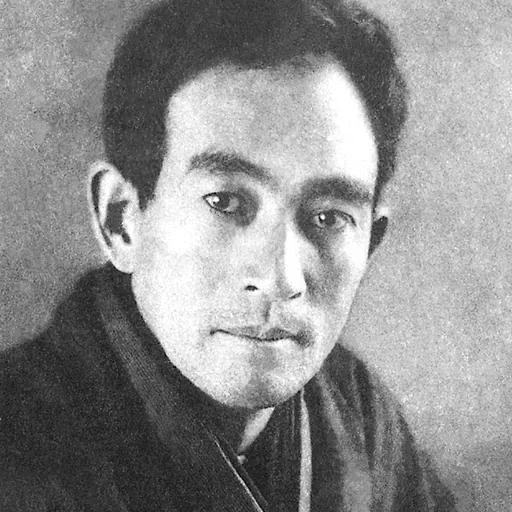
About Naoya Shiga
Lived 1883 – 1971 (aged 88). Naoya Shiga was a Japanese writer, novelist and dramaturge.
was a Japanese writer active during the Taishō and Shōwa periods of Japan, whose work was distinguished by its lucid, straightforward style and strong autobiographical overtones.
Early life Shiga was born in Ishinomaki, Miyagi Prefecture, as the son of a banker and descendant of an aristocratic samurai family. In 1885, the family moved to Tokyo and Shiga was placed in his grandparents' custody. an experience that marked the beginning of an obsession with and fear of death both on an individual and a collective level, and which stayed with him until his early thirties.
Shiga's imagination was inspired by nature, and he was an avid reader of Thomas Carlyle and Ralph Waldo Emerson, as well as of Lafcadio Hearn's stories of the supernatural. but struggled with his new religion due to his own homosexual tendencies. Other co-founders included Saneatsu Mushanokōji and Rigen Kinoshita, who Shiga had befriended at Gakushuin Peer's School, and Takeo Arishima and Ton Satomi. The novel's protagonist, young struggling writer Kensaku, has often been associated with its author.
Shiga's work influenced many later writers, Jun'ichirō Tanizaki praised the "practicality" (jitsuyō) of Shiga's style, in which he discovered, with reference to At Kinosaki, a "tightening up" (higishimeta) of the sentences: "[…] any word that is not absolutely necessary has been left out".
Shiga was also known for being a harsh moral critic of the literary establishment, blaming Tōson Shimazaki for having written his debut novel The Broken Commandment under such precarious financial hardship that Shimazaki's three young daughters died of malnutrition.
Later life
Shiga published very few new works in his later years. and was awarded the Order of Culture in 1949. His grave is at Aoyama Cemetery in Tokyo. His house in Nara, where he lived from 1929 to 1938, has been preserved and is open to the public as a memorial museum.
Selected works 1910: (Abashiri made) 1910: The Razor (Kamisori) 1911: Nigotta atama 1912: Ōtsu Junkichi 1913: Han's Crime (Han no hanzai) 1913: Seibei and his Gourds (Seibei to hyotan) 1917: At Kinosaki (Kinosaki ni te) 1917: The Case of Sasaki (Sasaki no baai) 1917: Reconciliation (Wakai) 1917: Kōjinbutsu no fūfu 1920: The Shopboy's God (Kozō no kamisama) 1920: Manazuru 1920: Bonfire (Takibi) 1921–1937: A Dark Night's Passing (An'ya koro) 1926: A Memory of Yamashina (Yamashina no kioku) 1926: Infatuation (Chijo) 1927: Kuniko 1946: A Gray Moon (Haiiro no tsuki)
Translations (selected)
Don’t just read it —
keep it.
Full-length biographies made to live with: read them, listen on the way to work, watch them tonight.
- E-book
- Audio
- Video
Instant download · yours to keep · every purchase keeps this site free
Important facts
People in Naoya Shiga's life
Named in this biography and alive at the same time



Related people
Same field, nearest in time




Contemporaries
People whose lives overlapped Naoya Shiga's

Frequently asked questions
Who was Naoya Shiga?
Japanese writer (1883–1971)
When was Naoya Shiga born?
Naoya Shiga was born on 20 February 1883 in Ishinomaki.
When did Naoya Shiga die?
Naoya Shiga died on 21 October 1971 in Kanto Central Hospital for Public School Teachers.
What was Naoya Shiga's occupation?
Naoya Shiga was a writer, novelist and dramaturge.
What nationality was Naoya Shiga?
Naoya Shiga was Japanese.
Sources & further reading
Cite this page
APA: Biography.guide. (2026). Naoya Shiga. https://biography.guide/naoya-shiga/
MLA: "Naoya Shiga." Biography.guide, https://biography.guide/naoya-shiga/.
Chicago: "Naoya Shiga." Biography.guide. https://biography.guide/naoya-shiga/.
Data last updated: 2026-09-23 · Spot an error? Report a correction.
Portrait: Wikimedia Commons · author & licence
Page generated 2026-09-27 05:07 UTC