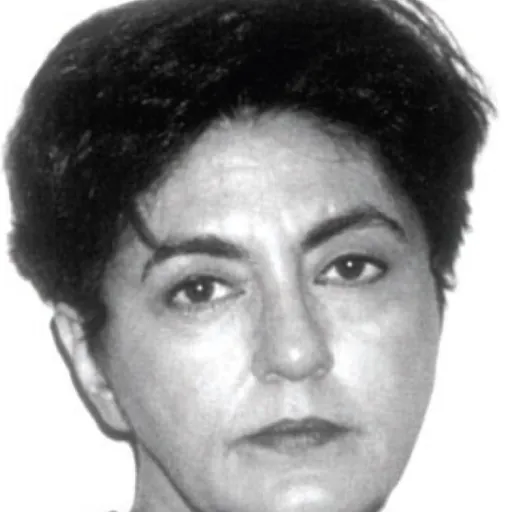
About Nalini Malani
Born 1946. Nalini Malani is an Indian printmaker, painter, artist and video artist.
Nalini Malani (born 19 February 1946) is an Indian artist, among the country's first generation of video artists.
She works with several mediums which include theater, videos, installations along with mixed media paintings and drawings. The subjects of her creations are influenced by her experience of migration in the aftermath of the partition of India. Pressing feminist issues have become a part of her creative output. Malani uses a visual language that moves from stop motion, erasure animations, reverse paintings and to digital animations, where she draws directly with her finger onto a tablet.
Her works have been shown at various museums, including the Stedelijk Museum Amsterdam, the National Gallery in London, and the Museum of Modern Art in New York.
Early life and education Malani is the only child of Satni Advani (Sindhi Sikh) and Jairam Malani (Theosophist). Born in Karachi (Sindh) in what was then British India, now Pakistan, in 1946, Malani's family sought refuge in India during the partition of India. They relocated to Kolkata (then Calcutta), where her father worked with Tata Airlines (later Air India) and relocated to Mumbai in 1954, where they lived in a colony built for displaced Sindhis. Her family's experience of leaving behind their homeland and becoming refugees had inspired Malani's artworks. and obtained a Diploma in Fine Arts from Sir Jamsetjee Jeejebhoy School of Art in 1969. From 1964-67, she had a studio at the Bhulabhai Desai Memorial Institute, which used to be located at Breach Candy, Mumbai where artists, musicians, dancers and theater persons worked individually and collectively. It was here that she met and collaborated with artists from allied forms of artistic practice like theatre. She received a scholarship from the French Government to study fine arts in Paris between 1970-72. She was a recipient of two scholarships from the Government of India, as well as a grant in 1989 for travel and work in the United States. The themes she explored during this period dealt with the turbulent time that India was experiencing politically and socially, as well as the deepening literacy of moving image of its population. She explored techniques such as the reverse painting method (taught to her in the late-80s by Bhupen Khakhar), which she would recurrently use in her future work. She was disappointed with the lack of acknowledgement that women artists had to face in India and resolved to bring them together for a group show, to promote the sense of solidarity. In 1985, she curated the first exhibition of Indian female artists, in Delhi. This led to a series of traveling exhibitions that were taken to public spaces as an attempt to go beyond the elitist atmosphere of the art gallery. Her earlier foray into performance art and her interest in literature brought new sides to her art. She is counted amongst the earliest to transition from traditional painting to new media work. Malani's video and installation work allowed her to shift from strictly real space to a combination of real space and virtual space, moving away from strictly object-based work. Her video work often references divisions, gender, and cyborgs. She often references Greek and Hindu mythology. The characters of 'destroyed women' like Medea, Cassandra and Sita feature often in her narrative.
Dream Houses (1969) Malani's first experimental film made at the Vision Exchange Workshop (VIEW) — the brainchild of late artist Akbar Padamsee — drew inspiration from utopian modern Indian architecture. Made using photographic equipment available at the Workshop, it features use of a cardboard maquette, different light sources, primary colour filters, and a Mamiyaflex camera. For this, Malani drew on the 'ideological possibilities of modern architecture', looking to the work of renowned architects Charles Correa and Buckminster Fuller, and blending in learnings from Johannes Itten's colour theories along with Moholy-Nagy’s Vision in Motion."The subject of Dream Houses is the idealism and hope that modernism brought during the Nehruvian period, in which poverty and housing problems in modern India could be solved through a master plan for urban space." — Nalini Malani 'Dream Houses' was shown at the Kiran Nadar Museum of Art (KNMA) (2014), the Goethe Institute, Mumbai, (2019) and the MoMa, New York,(2022), after being 'lost' for 50 years.
Mother India (2005) Nalini Malani, The Rebellion of the Dead, 2017The video installation was inspired by an essay by the sociologist Veena Das titled "Language and Body: Transactions in the Construction of Pain". It is a synchronised five screen wall-to-wall projection combining archival footage with poetic and painterly images to tell the story of how Indian Nationalism was built using the bodies of women as metaphors for the nation. The work speaks of women as "mutant, de-gendered and violated beyond imagination." The Partition of India and the 2002 Gujarat riots are the central events referenced in this installation, as there was a sharp increase in violence against women in these periods. thumb In Search of Vanished Blood (2012) This installation, which was first produced for the 13th edition of Documenta, consists of five larger rotating Mylar cylinders (metaphorically referring to Buddhist prayer wheels ) reverse-painted with images of soldiers, animals, gods and guns.
Awards and recognition
Awards 1970-72: French Government Scholarship for Fine Arts Study in Paris 2010: Honorary Doctorate in Fine Arts, San Francisco Art Institute, USA 2013: Fukuoka Arts and Culture Prize for Contemporary Art, Fukuoka, Japan 2014: St. Moritz Art Masters Lifetime Achievement Award, St. Moritz, Switzerland 2016: Asia Arts Game Changer, Asia Society, Hong Kong 2019: Joan Miró Prize, Fundació Joan Miró, Barcelona, Spain 2023: Kyoto Prize in Arts and Philosophy
Fellowships
1984-89: Art Research Fellowship, Government of India 1989: USIA Fellowship, Fine Arts Work Center, Provincetown, Massachusetts, USA 2020: Contemporary Fellowship, National Gallery, London, UK
Residencies
1988: Kasauli Art Centre, Kasauli, India 1999: Lasalle-SIA, Singapore 1999-2000: Fukuoka Asian Art Museum, Fukuoka, Japan 2003: Civitella Ranieri, Umbertide, Italy 2005: Lucas Art Residencies, Montalvo, California, USA
Collections Art Gallery of Western Australia, Perth, Australia Dr. Bhau Daji Lad Museum, Mumbai Jehangir Nicholson Art Foundation (JNAF), Mumbai Lalit Kala Akademi, New Delhi National Gallery of Modern Art (NGMA), New Delhi MoMa The Museum of Modern Art, New York Tata Institute of Fundamental Research (TIFR), Mumbai Tate, Britain
Don’t just read it —
keep it.
Full-length biographies made to live with: read them, listen on the way to work, watch them tonight.
- E-book
- Audio
- Video
Instant download · yours to keep · every purchase keeps this site free
Important facts
Family & relationships
People in Nalini Malani's life
Named in this biography and alive at the same time


Related people
Same field, nearest in time


Contemporaries
People whose lives overlapped Nalini Malani's



Frequently asked questions
Who is Nalini Malani?
contemporary Indian artist (born 1946)
When was Nalini Malani born?
Nalini Malani was born on 19 February 1946 in Karachi.
What is Nalini Malani's occupation?
Nalini Malani is a printmaker, painter, artist and video artist.
What nationality is Nalini Malani?
Nalini Malani is Indian.
Sources & further reading
Cite this page
APA: Biography.guide. (2026). Nalini Malani. https://biography.guide/nalini-malani/
MLA: "Nalini Malani." Biography.guide, https://biography.guide/nalini-malani/.
Chicago: "Nalini Malani." Biography.guide. https://biography.guide/nalini-malani/.
Data last updated: 2026-09-21 · Spot an error? Report a correction.
Portrait: Wikimedia Commons · author & licence
Page generated 2026-09-27 04:59 UTC