About Nāhiʻenaʻena
Lived 1815 – 1836 (aged 20–21). Nāhiʻenaʻena was a politician.
Harriet or Harrieta Keōpūolani Nāhiʻenaʻena (1815– 5 January 1837) was a high-ranking princess during the founding of the Kingdom of Hawaii and the conversion of some of the ruling class to Christianity.
Life In the Hawaiian language nā ahi ʻena ʻena means "the red-hot raging fires".
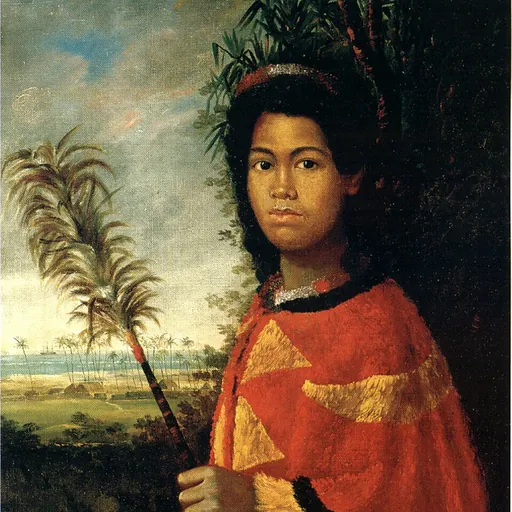
Nāhiʻenaʻena was born in 1815 at Keauhou Bay, South Kona, island of Hawaiʻi. Her parents were Kamehameha I and Keōpūolani, the Queen consort. She had two older brothers, hiapo (first born) Liholiho, and Kauikeaouli, who later became Kings Kamehameha II and III. Nāhiʻenaʻena was the sacred muli loa (last born) child, and was trained for the immense kuleana (privilege and responsibility) that would accompany someone of such high birth. The young princess Nāhiʻenaʻena wearing her ’ahu’ula and holding a royal kāhili in 1825.
In 1825, the ship returned with the bodies of King Kamehameha II and the Queen Kamāmalu, who had died on a trip to London. Ship's artist Robert Dampier painted a portrait of the ten-year-old princess, depicting her dressed in a red feather cloak despite her actually wearing a European style black dress. and the chiefs strongly encouraged their marriage, but the missionaries were opposed to the union, calling it incest and therefore a sin. The practice of marriage between siblings in the royal family was considered a way of keeping the bloodlines pure in ancient Hawaii. Nāhiʻenaʻena's own maternal grandparents were half sister and brother.
The missionary culture at the time meant that many people, including Nāhiʻenaʻena, practiced both Hawaiian and Christian beliefs. She practiced cultural traditions such as hula, but also drank rum just as the missionaries did. However, she showed rebellion and distaste for many Christian tasks. She would interrupt church services and openly defy missionary teachings.
Death On September 17, 1836, Nāhiʻenaʻena gave birth to a child. Kamehameha III announced that the child would be the heir to the throne because he believed it to be his, but the child lived for only a few hours.
After nearly five weeks of intense grieving, the princess's body was brought in procession to Kawaiahaʻo Church for funeral services. The procession was led by traditional warriors and kāhuna laʻau lapaʻau (healers). On April 12, 1837, her body was brought aboard the ship Don Qixote (purchased and renamed Kai Keōpūolani by her brother), to the resting place at the tomb on the premise of Halekamani in Lāhainā, Maui. She was interred next to her mother and Kaumualiʻi. Later their remains were transferred to a tomb on the island of Mokuʻula sometime in 1837 and eventually in 1884 to the cemetery of Waiola Church.
Her death had a sobering effect on her brother, King Kamehameha III.
Ancestry
Don’t just read it —
keep it.
Full-length biographies made to live with: read them, listen on the way to work, watch them tonight.
- E-book
- Audio
- Video
Instant download · yours to keep · every purchase keeps this site free
Important facts
Family & relationships
People in Nāhiʻenaʻena's life
Named in this biography and alive at the same time

Related people
Same field, nearest in time






Contemporaries
People whose lives overlapped Nāhiʻenaʻena's




Frequently asked questions
Who was Nāhiʻenaʻena?
hawaiian princess
When was Nāhiʻenaʻena born?
Nāhiʻenaʻena was born in 1815 in Keauhou Bay.
When did Nāhiʻenaʻena die?
Nāhiʻenaʻena died on 30 December 1836 in Honolulu.
What was Nāhiʻenaʻena's occupation?
Nāhiʻenaʻena was a politician.
What nationality was Nāhiʻenaʻena?
Nāhiʻenaʻena's recorded nationality: Kingdom of Hawaiʻi.
Sources & further reading
Cite this page
APA: Biography.guide. (2026). Nāhiʻenaʻena. https://biography.guide/nahi-ena-ena/
MLA: "Nāhiʻenaʻena." Biography.guide, https://biography.guide/nahi-ena-ena/.
Chicago: "Nāhiʻenaʻena." Biography.guide. https://biography.guide/nahi-ena-ena/.
Data last updated: 2026-09-21 · Spot an error? Report a correction.
Portrait: Wikimedia Commons · author & licence
Page generated 2026-09-27 04:59 UTC