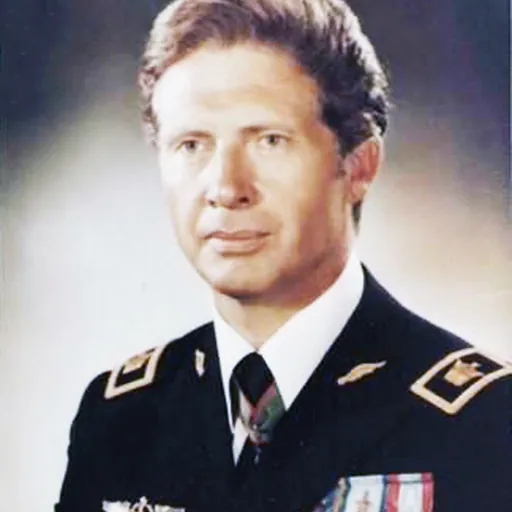
Nader Jahanbani
Iranian general, fighter pilot of Imperial Iranian Air Force (IIAF)
About Nader Jahanbani
Lived 1928 – 1979 (aged 50). Nader Jahanbani was an Iranian military personnel and aircraft pilot.
Nader Mirza Jahanbani (; 16 April 1928 – 13 March 1979) was a distinguished general, fighter pilot, and deputy commander of the Imperial Iranian Air Force (IIAF) under Mohammad Reza Pahlavi, the last Shah of Iran. He is widely regarded as one of the founding fathers of the Iranian Air Force along with General Mohammad Khatami and Lieutenant General Amir Hossein Rabii, for growing and modernizing the IIAF to become a world class air force with advanced equipment and training, including the F-14 Tomcat, which would save Iran's crucial infrastructure during the Iran–Iraq War. He was the founder and leader of the Golden Crown, Iran's first and only precision flying demonstration team, and one of the oldest in the world.
Early life and education The Jahanbani family; featuring Nader, his grandfather Amanullah Mirza I, his father Amanullah Mirza II and his older sister Mehr Monir Jahanbani. Nader Jahanbani was born on 16 April 1928 into a family with a long military history. Nader's mother, Helen Kasminsky, was from the Russian aristocracy in Petrograd. He trained many other pilots from early on in his career in the IIAF's only fighter brigade (هنگ شکاری) which was based in Ghale Morghi Air Base in Tehran, many of whom went on to become senior officers and commanders.
Transition to the Jet Age In 1956, Jahanbani was selected as part of a group of 15 IIAF pilots to be sent to Fürstenfeldbruck Air Base in West Germany to acquire for the first time jet training with NATO pilots under the US Air Force Europe, as Iran was taking delivery of its first jet aircraft - the Republic F-84 Thunderjet fighter and Lockheed T-33 Shooting Star trainer. The group included Colonel (later General) Mohammad Amir Khatami, Lt. (later Lt. General) Amir Hossein Rabii, and Lt. (later Major General) Abdolhossein Minusepehr. Upon completion of the training, 10 pilots returned to Iran while Jahanbani and four others, continued their training to become instructors upon return to Iran. During this time, he forged close ties and friendships with experienced American and NATO pilots, most notably members of the recently formed USAFE Skyblazers aerobatic team, flying the North American F-100 Super Sabres, America's first supersonic fighter jet.
Golden Crown
After returning to Iran, Jahanbani formed Iran's first and only aerobatic team, the Golden Crown (Taje Talaii) in 1958 together with other officers, including Mohammad Amir Khatami, Amir Hossein Rabii, Siamak Jahanbini, and Abdolhossein Minusepehr, with the support of General Khatami and the Shah. They started flying with F-84 Thunderjets and switched to F-86 Sabres. For the following twenty years, Golden Crown would symbolize Iran's military modernization under the Pahlavi government and set new standards for pilot skill, discipline, formation flying, precision, and teamwork - principles later reflected in the combat-ready IIAF culture during the Iran–Iraq war. Throughout the years, Golden Crown would give joint demonstrations and compete with teams of allied nations, including the USAF Skyblazers, the US Navy Blue Angels, Britain's Royal Air Force, French Air Force (Patrouille de France), and the Italian Air Force.
Upon its founding, Jahanbani led the Golden Crown team from 1958–1962, and then again in 1969 a total of six years, the longest tenure of any Golden Crown leader. He would personally select and evaluate candidates for the team, train them, and challenge their limits. Many of these team members went on to become accomplished pilots, officers, and commanders, some of whom served in the Iran–Iraq War.
Colonel Jahanbani (standing, 6th from right) next to General Khatami and with other pilots at Tehran's Mehrabad airbase in 1965 in front of a recently delivered F-5 Freedom Fighter. General Jahanbani (center) led the 1969 IIAF Golden Crown team with all new members.
Leadership Jahanbani played a crucial role in the Iranian air force during the 1960s and 1970s by helping to create an effective air force. In 1963 Jahanbani went back to pilot training and leadership roles, and was stationed at the IIAF High Command in Tehran. Over the next few years, he would go on to attend advanced leadership training including Air Command and Staff College in the US Air Force. He transferred to the 4th Tactical Fighter Base, known as Vahdati, in Dezful where he became Deputy Wing Commander of that base while also leading the Golden Crown team once again. Throughout this period he flew F-86's and the newly arrived F-5 Freedom Fighter supersonic fighter. During the 1969 Iran Iraq maritime border crisis, Iran conducted Joint Operation Arvand, in which an Iranian vessel navigated the Shatt-al-Arab waterway under the overhead protection of Iranian fighter jets, Jahanbani personally flew and led the aerial combat escort mission. a position he held until shortly before the end of the IIAF in the 1979 Islamic Revolution in Iran. thumb
Personal life and family Jahanbani had two children from two wives, a son, Anushiravan, and a daughter, Golnar. His son was from his first wife, Azar Etessam, and his daughter from his second wife, Farah Zangeneh. Zangeneh was the daughter of Colonel Yadolah Azam Zangeneh. Both children live in the United States. In response Jahanbani stated that all his ancestors were more Iranian than everyone in the current regime.
He was charged and convicted with: Association with the Shah's idolatrous regime; Corruption on earth; Unspecified anti-revolutionary offense; War on God, God's Prophet, and the deputy of the Twelfth Imam
Anushirvan Jahanbani answers why his father, like many other military officials and politicians, did not leave Iran after the revolution:
"Incidentally, at that time I was very insistent on my father leaving Iran, because we had access to planes. We could have left Iran both through Iran Air and with IIAF transport aircraft. My father, however, always said that I am a soldier of this country and it is my duty to stay here. He said that it is impossible for me to leave my country. Even when the Shah left, we said, "Now that your king has left, why don't you leave too? He said, no, it is my duty to stay in this country." He rejected this offer, saying that I have not done anything that would make me afraid and want to run away, and he was not convinced to leave Iran in any way. I think that if he had left Iran, he would have suffered every day. My father's place was his own country."
Jahanbani was taken to Qasr Prison, and in the early hours of 13 March 1979 he was shot in the courtyard. He is buried in Behesht-e Zahra cemetery, Tehran. Since his execution, people started calling him "the blue eyed general".
Empress Farah Pahlavi wrote:
"A bit later, I managed to contact by phone a dear friend whose husband, Air Force Lieutenant General Nader Jahanbani, had just been executed. Insulted by one of the guardians of the revolution, he had the courage to slap him in the face before dying. She was sobbing and I, who should have been able to find words to comfort her, could do nothing but cry with her. That evening, in despair, I wrote these few lines in my notebook: "I don't feel I have the strength in me to go on fighting. I would prefer to die for my country with honor rather than be dragged toward death by the depression that is overtaking me. Dear God, if you are there, give me the strength to go on."He was survived by his mother, his two children, and his brothers and sisters.
Honours and awards
Don’t just read it —
keep it.
Full-length biographies made to live with: read them, listen on the way to work, watch them tonight.
- E-book
- Audio
- Video
Instant download · yours to keep · every purchase keeps this site free
Important facts
People in Nader Jahanbani's life
Named in this biography and alive at the same time





Related people
Same field, nearest in time


Contemporaries
People whose lives overlapped Nader Jahanbani's




Frequently asked questions
Who was Nader Jahanbani?
Iranian general, fighter pilot of Imperial Iranian Air Force (IIAF)
When was Nader Jahanbani born?
Nader Jahanbani was born on 16 April 1928 in Tehran.
When did Nader Jahanbani die?
Nader Jahanbani died on 12 March 1979 in Qasr Prison.
What was Nader Jahanbani's occupation?
Nader Jahanbani was a military personnel and aircraft pilot.
What nationality was Nader Jahanbani?
Nader Jahanbani was Iranian.
Sources & further reading
Cite this page
APA: Biography.guide. (2026). Nader Jahanbani. https://biography.guide/nader-jahanbani/
MLA: "Nader Jahanbani." Biography.guide, https://biography.guide/nader-jahanbani/.
Chicago: "Nader Jahanbani." Biography.guide. https://biography.guide/nader-jahanbani/.
Data last updated: 2026-09-22 · Spot an error? Report a correction.
Portrait: Wikimedia Commons · author & licence
Page generated 2026-09-27 05:04 UTC