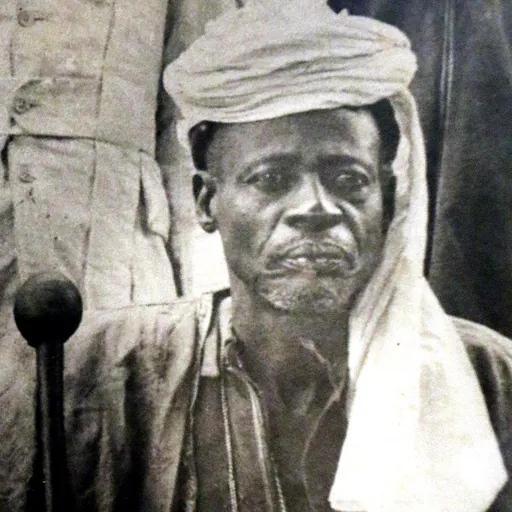
Nabongo Mumia
Leader of Wanga kingdom and official in colonial Kenya
About Nabongo Mumia
Lived 1849 – 1949 (aged 99–100). Nabongo Mumia was a monarch, paramount chief and wanga Kingdom, known for History of Kenya.
Nabongo Mumia Shiundu (c. 1849 – 1949) was the 17th King of the Wanga Kingdom, a pre-colonial kingdom in Kenya and Uganda prominent for being a centralised, highly organised kingdom and the most advanced form of government in terms of politics, economy and military in pre-colonial Kenya. He later became paramount chief of an expansive region of Kenya and Uganda at the beginning of British imposition of colonial rule in East Africa. This slave trade between the Arab and the Wanga led to capturing of non-Wanga tribes into slavery such as Luo-Nyanza and Bukusu who were also enemies of the Wanga kingdom because of their repeated insurgents against the kingdom.
At the time the Wanga Kingdom extended from present day Jinja, Uganda to present day Naivasha, Kenya with the main ruling town present day Mumias. Nabongo Mumia's gazetement as a paramount chief in 1913 legitimized his rule as a king of the Wanga and paramount chief. In 1926, the British colonial government regazetted his region of management to North kavirondo equivalent to western region of Kenya today. This regazetement led to the eventual loss of political relevance of the Wanga Kingdom, although Nabongo Mumia remained a powerful and influential figure until his death in 1949. His prominence, power and influence was evident in during his burial in 1949 when high-ranking members of the colonial government were in attendance.
Biography Early life Nabongo Mumia was born a prince between 1849 and 1852. His parents were Nabongo Shiundu Wamukoya and Wamanya.
Personal life
Nabongo Mumia married multiple wives. Polygamy was largely practised by the Wanga Kingdom to ensure stability with other communities through inter-marriage.
The Arabs were able to capture slaves from the Luo and Bukusu by directly participating in fighting enemies of the Wanga Kingdom. During this time when the American Singer Corporation was expanding its products around the world, its first products were sold in the Wanga Kingdom in East Africa.
By 1926, when the British were beginning to get concerned about Nabongo Mumia's influence on their conflicting interests with their leadership direction about the colonial administration management, they retired him and regazetted his administrative region of management. The colonial administration continued to pay his salary until his death.
Because Nabongo Mumia was illiterate, he failed to lead the kingdom in making changes and adapting to new political developments in regard to technicalities of the administration. For instance when the British regazetted the geographical region previously under Nabongo Mumia as paramount chief, he still thought that he exercised authority in regions regazetted out of his region. Although he still had personal influence before and after the regazettement, he did not utilize it for political relevance. This inability to distinguish technicalities of his personal influence and that of the kingdom eventually led to the loss of political relevance of the Wanga Kingdom.
Despite cognisance of his floundering influence and that of the Wanga Kingdom, Nabongo Mumia remained fiercely loyal to the colonial administration until his death.
Death
When Mumia died in 1949 of old age, major high-ranking members of the colonial administration such as Philip Mitchell were in attendance.
Following Nabongo Mumia's death, the British government declined to recognize a royal successor to the Paramount Chieftainship, effectively ending the Wanga Kingdom's political authority and replacing it with direct bureaucratic colonial administration, under which subsequent Wanga leaders were treated merely as government employees, with no independent political authority or significance as a kingdom.
Descendants
Mumia's royal background caused a dilemma to the colonial officers. He was “retired” by the colonial authorities in 1926, but maintained influence until his death on April 24, 1949. He left behind multiple descendants including 109 sons, 60 daughters and 400 grandchildren.
Don’t just read it —
keep it.
Full-length biographies made to live with: read them, listen on the way to work, watch them tonight.
- E-book
- Audio
- Video
Instant download · yours to keep · every purchase keeps this site free
Important facts
Related people
Same field, nearest in time


Contemporaries
People whose lives overlapped Nabongo Mumia's



Frequently asked questions
Who was Nabongo Mumia?
leader of Wanga kingdom and official in colonial Kenya
When was Nabongo Mumia born?
Nabongo Mumia was born in 1849 in Wanga tribe.
When did Nabongo Mumia die?
Nabongo Mumia died on 24 April 1949.
What was Nabongo Mumia's occupation?
Nabongo Mumia was a monarch, paramount chief and wanga Kingdom.
What was Nabongo Mumia known for?
Nabongo Mumia was known for History of Kenya.
What nationality was Nabongo Mumia?
Nabongo Mumia's recorded nationality: Wanga tribe.
Sources & further reading
Cite this page
APA: Biography.guide. (2026). Nabongo Mumia. https://biography.guide/nabongo-mumia/
MLA: "Nabongo Mumia." Biography.guide, https://biography.guide/nabongo-mumia/.
Chicago: "Nabongo Mumia." Biography.guide. https://biography.guide/nabongo-mumia/.
Data last updated: 2026-09-24 · Spot an error? Report a correction.
Portrait: Wikimedia Commons · author & licence
Page generated 2026-09-27 05:09 UTC