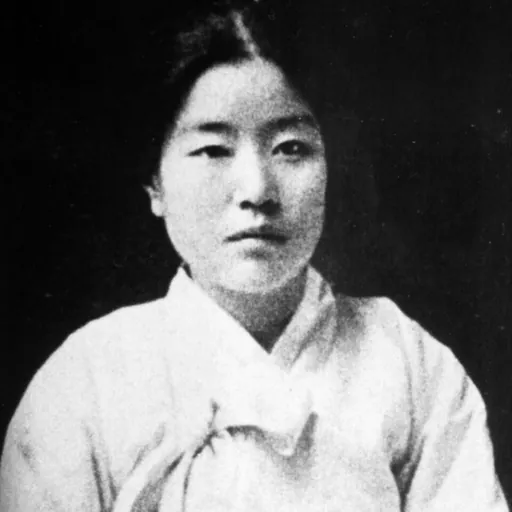
About Na Hye-sok
Lived 1896 – 1948 (aged 52). Na Hye-sok was a South Korean poet, journalist, philosopher, painter, writer and politician.
Na Hye-sŏk (, April 28, 1896 – December 10, 1948) was a Korean feminist, poet, writer, painter, educator, and journalist. Her art name was Jeongwol . She was a pioneering Korean feminist writer and painter. She was the first female professional painter and the first feminist writer in Korea. She created some of the earliest Western-style paintings in Korea, and published feminist novels and short stories. She became well known as a feminist because of her criticism of the marital institution in the early 20th century.
Early life Na Hye-sŏk was born on April 28, 1896, in Suwon, Joseon. She was the fourth child of father Na Gi-jeong and mother Choi Si-ui, and a member of the aristocratic Naju Na clan. Na demonstrated her artistic talent from an early age and graduated at the top of her class at Jinmyeong Girls' High School in 1913.
Career As a young woman, Na was known for her high spirits and outspokenness, making it clear she wanted to be a painter and an intellectual, rejecting the traditional "Good Wife, Wise Mother" archetype. Her major written work, Kyonghui , published in 1918, concerns a woman's self-discovery and her subsequent search for meaning in life as a "new woman."
After her graduation from Jinmyeong Girls' High School in 1913, Na majored in Western oil painting at Tokyo Arts College for Women. As a student, Na wrote several essays critiquing the standard "good wife, wise mother" Korean archetype, saying she wanted a career as an artist. In April 1915, Na became the main organizer of the Association of Korean Women Students in Japan. It was around this time that she fell in love with Choe Sung-gu, a student at Keio University and the then editor and publisher of the magazine Hakchigwang. The relationship between Na and Choe was highly publicized among Korean students in Japan, as was Na's close literary and personal association with Yi Gwangsu. In the spring of 1915, Na's father summoned her back home and pressured her to accept a marriage proposal from a well-established family. Na was able to escape this by accepting a teaching position in a primary school, according to her later account. After a year of teaching and saving money for tuition, Na returned to Tokyo toward the end of 1915 to resume her studies. In April 1916, however, Choe Sung-gu died of tuberculosis, and Na had to temporarily stop her studies while recovering from a mental breakdown.
In 1919, she participated in the March 1st Movement against Japanese rule. She was jailed for this.
In 1920 Na, along with Kim Iryeop and ten men, contributed to the coterie literary magazine Pyeho. Early in the 1920s, both Kim and Na contributed a series of articles to the first magazine for Korean women, called Sinyoja, or "New Woman", on the subject of improving Korean women's clothing. They argued for a more functional and practical outfit for Korean women to help improve their hygiene, health, and self-image, and denounced traditional Korean dresses which were designed with no consideration for women's physical comfort, protection, and convenience. On March 18, 1921, Na had her first exhibition of paintings and the first exhibition by a Korean woman painter in Seoul. In 1923, Na attracted much attention for her essay "Thoughts on becoming a mother," in which she criticized her husband for leaving child-rearing entirely up to her. They first visited Paris, France and then the American cities New York, Chicago, and San Francisco. While there, she studied at the Académie Ranson under the artist Roger Bissière. It was A Divorce Testimony that ultimately ruined Na's career, as her views were regarded as scandalous and shocking, since traditional Korean Confucian culture considered premarital sex to be taboo and women were not to speak frankly of their sexuality.
She died of malnutrition on December 10, 1948, at a charity hospital, with no one to claim her remains. News of her death was not published in any major newspapers. This resulted in a "Post-Impressionist and Naturalist style" which emphasized form, color, and lighting.
A Google Doodle on April 28, 2019, commemorated the 123rd anniversary of Na’s birth.
Don’t just read it —
keep it.
Full-length biographies made to live with: read them, listen on the way to work, watch them tonight.
- E-book
- Audio
- Video
Instant download · yours to keep · every purchase keeps this site free
Important facts
People in Na Hye-sok's life
Named in this biography and alive at the same time
Related people
Same field, nearest in time

Contemporaries
People whose lives overlapped Na Hye-sok's




Frequently asked questions
Who was Na Hye-sok?
writer and painter from Korea (1896-1948)
When was Na Hye-sok born?
Na Hye-sok was born on 18 April 1896 in Suwon.
When did Na Hye-sok die?
Na Hye-sok died on 10 December 1948 in Seoul.
What was Na Hye-sok's occupation?
Na Hye-sok was a poet, journalist, philosopher, painter, writer and politician.
What nationality was Na Hye-sok?
Na Hye-sok was South Korean.
Sources & further reading
Cite this page
APA: Biography.guide. (2026). Na Hye-sok. https://biography.guide/na-hye-sok/
MLA: "Na Hye-sok." Biography.guide, https://biography.guide/na-hye-sok/.
Chicago: "Na Hye-sok." Biography.guide. https://biography.guide/na-hye-sok/.
Data last updated: 2026-09-22 · Spot an error? Report a correction.
Portrait: Wikimedia Commons · author & licence
Page generated 2026-09-27 05:03 UTC