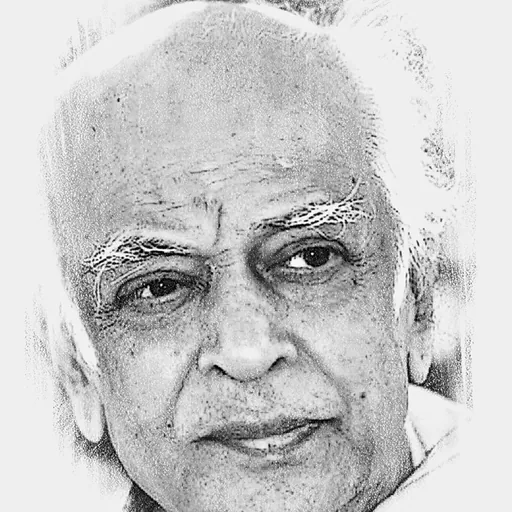
About Muzharul Islam
Lived 1923 – 2012 (aged 88). Muzharul Islam was a Bangladeshi, Indian and Pakistani architect.
Muzharul Islam (25 December 1923 – 15 July 2012) was a Bangladeshi architect, urban planner, educator, and activist. He is considered the grand master of regional modernism in South Asia. Islam is the pioneer of modern architecture in Bangladesh and the father of Bangali modernism. Islam's style and influence dominated the architectural scene in the country during the 1960s and 70s, along with major US architects he brought to work in Dhaka.
As a teacher, architect, and social and political activist, Islam set the course of architectural practice in the country not only through his own many varied works but also through being instrumental in inviting architects such as Louis Kahn, Richard Neutra, Stanley Tigerman, Paul Rudolph, Robert Boughey, and Konstantinos Doxiadis to work in Bangladesh.
Early life Muzharul Islam was born on 25 December 1923 in Murshidabad. He went to the United States in 1950, where he received his bachelor's degree in architecture from the University of Oregon. In 1956, he received a scholarship to study tropical architecture at the AA School of Architecture, London. In 1961, he completed his post-graduation under Paul Rudolph from Yale University. At Yale, Stanley Tigerman was one of his classmates, and there he came in touch with Louis I. Kahn. Muzharul Islam began his career by designing two buildings in the Shahbag area in 1955 – Dhaka University Library and College of Arts and Crafts. Between 1958 and 1964, Islam was an architect in the C&B Department of the government of East Pakistan.
A documentary film on Mazharul Islam named Tini (The Architect) was released by the Institute of Architects Bangladesh in 2000, which was directed by Enamul Karim Nirjhar.
Notable works
Sher-e-Bangla Nagar, Dhaka 1962 Housing for class IV Employees Azimpur Estate, Dhaka 1963–64 Railway Rehabilitation Zone Khilgaon, Dhaka Plan for the project Rangamati Town Rangamati, CHT Plan for the project 1963–65 BCSIR Laboratory Buildings Dhanmondi, Dhaka 1964 National Institute of Public Administration Building Shahbag, Dhaka 1965–71 Headquarters Building, Agricultural Development Corporation Motijheel, Dhaka 14 storied 5 polytechnic institutes Rangpur, Bogra, Pabna, Sylhet, and Barisal In collaboration with Arch. Stanley Tigerman EFU Building (Jiban Bima Bhaban) Project Motijheel, Dhaka 27 storied Road Research Laboratories Dhaka, Bangladesh 1968–71 Chittagong University master plan and designs 200px Chittagong University, Chittagong Designs for students' hostel, humanities building, science building, administrative building, readers' quarters, VC's quarters, professors' quarters, storage, and godowns Housing for Ruppur Atomic Energy Complex Savar, Dhaka Jahangirnagar University Master Plan and designs 200px Jahangirnagar University, Dhaka Designs for students' hostel, readers' quarters and class IV employees' quarters 1980–84 Jaipurhat Limestone and cement Project Jaipurhat, Bangladesh Master plan, housing for 200 officers, housing for 1700 employees, clinic and hospital, clinic and hospital, bazaar and mosque National Library Sher-e-Bangla Nagar, Dhaka 1987 Office Building for the World Bank Dhaka, Bangladesh 1995 Garden City Project Dhaka, Bangladesh 20 storied 2008 Mausoleum of Kazi Nazrul Islam Dhaka, Bangladesh
Death Muzharul Islam died on 15 July 2012 at 12.06 am in Dhaka, Bangladesh. He was aged 88.
Publications Some publications featured Muzharul Islam: Encyclopædia Britannica, Volume 22, 15th Edition, 1986, page 99. Architectural Review, London, April 1960, Page 155. Environments, Volume 19, Number 2, 1988, University of Waterloo, Ontario, Canada, Page-55 to 60. Architecture + Design, New Delhi, India, May–June 1988, page- 26 to 32 & 36. + Mimar magazine, 1989, Page 55-63. The Sangbad, Dhaka, 23 December 1993, Page-12. Daily Bhorer Kagoj, Dhaka, 24 December 1993, Page-9. Daily Bhorer Kagoj, Dhaka, 7 March 1994, Page-12. Weekly Holiday, Dhaka, 31 December 1993, Page-6. Daily Star, Dhaka, August 2000. Exhibition, "An Architecture of Independence: The Making of Modern South Asia," on the Works of Four Architects of the Indian Sub-Continent; New York, Philadelphia, 1997, Curated by Kazi Khaleed Ashraf and James Bellurado. Exhibition of Architecture in Bangladesh, "Pundranagar" to Sher-e-Bangla Nagar (350 B.C. to present time), 1997. Edited by Raziul Ahsan, Kazi Khaleed Ashraf and Saif Ul Haque. An Architecture of Independence : The Making of Modern South Asia, 1997, University of Pennsylvania, Edited by Kazi Khaleed Ashraf and James Belluardo. The India International Centre Quarterly: Monsoon 1997, Volume- 24, Number 2–3. Architect Muzharul Islam and Chicago Architect Stanly Tigerman did the elaborate study on typology and tectonics, ecology, climate and materials. Their study resulted in a major report, which was featured in the September 1968 issue of "Architectural Record". Vastukatha: Selected Sayings of Architect Muzharul Islam | বাস্তুকথা: স্থপতি মাজহারুল ইসলামের নির্বাচিত উক্তি, Edited by Kazi Khaleed Ashraf and Saif Ul Haque, Published by BI Books -Bengal Publications Muzharul Islam Architect, Edited by Fuad H Mallick, Zainab Faruqui Ali স্থপতি মাজহারুল ইসলাম, সম্পাদনা - আবুল হাসনাত
Quotes "Symbol for what? Symbol of what? Symbol of whom?... The hesitation in my mind has deep roots. I feel that human society has been kept in darkness for thousands of years by the use of symbols. I revolt against it. By raising the issue of symbols, in the name of symbols, my perspective has been kept limited." "Cities should provide the environment for civilized life within the context of our own culture... The city can develop only as a part of the physical environment of the country- with the ultimate aim of abolishing all differences between the city and the rural areas. The traditional relationship with nature (still existing to a certain extent in the village of Bangladesh) should be continued in the cities." "The artistic qualities are essence of architecture. The practical aspects of architecture are measurable – such as, the practical requirements, climatic judgements, the advantages and limitations of the site etc. – but the humanistic aspects are not measurable. This depends on the talent, sensitivity and creativity of the architect. Only some bookish knowledge is not a sufficient tool in this regard. One has to be creative. One has to love his own land, its people and its culture and think profoundly about these. The love of one's own land is the eternal source of creative power, which in turn, makes a proper architect." "You have to be a world man and a Bengali. It's impossible otherwise... When I mention standing on one's own soil... it is to find oneself, but not to find oneself and become stagnant. What I am seeking is to stand on one's own feet and then to proceed forward. If for that reason I have to take two steps backward to go one step forward. I have no problem with that. I think that there is no other way of moving forward."
Don’t just read it —
keep it.
Full-length biographies made to live with: read them, listen on the way to work, watch them tonight.
- E-book
- Audio
- Video
Instant download · yours to keep · every purchase keeps this site free
Important facts
People in Muzharul Islam's life
Named in this biography and alive at the same time





Related people
Same field, nearest in time

Contemporaries
People whose lives overlapped Muzharul Islam's

Frequently asked questions
Who was Muzharul Islam?
Bangladeshi architect, professor
When was Muzharul Islam born?
Muzharul Islam was born on 25 December 1923 in Murshidabad.
When did Muzharul Islam die?
Muzharul Islam died on 15 July 2012 in Dhaka.
What was Muzharul Islam's occupation?
Muzharul Islam was an architect.
What nationality was Muzharul Islam?
Muzharul Islam was Bangladeshi, Indian and Pakistani.
Sources & further reading
Cite this page
APA: Biography.guide. (2026). Muzharul Islam. https://biography.guide/muzharul-islam/
MLA: "Muzharul Islam." Biography.guide, https://biography.guide/muzharul-islam/.
Chicago: "Muzharul Islam." Biography.guide. https://biography.guide/muzharul-islam/.
Data last updated: 2026-09-20 · Spot an error? Report a correction.
Portrait: Wikimedia Commons · author & licence
Page generated 2026-09-27 04:58 UTC