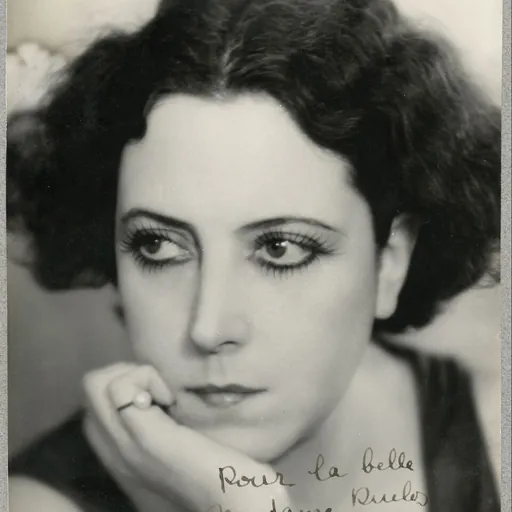
About Musidora
Lived 1889 – 1957 (aged 68). Musidora was a French actor, film director, screenwriter, writer, journalist and stage actor.
Jeanne Roques (23 February 1889 – 11 December 1957), known professionally as Musidora, was a French actress, film director, screenwriter, playwright and novelist. A major figure of French silent cinema, she became internationally known for portraying Irma Vep in Louis Feuillade's serial (1915–1916), and Diana Monti in Judex.
Musidora was one of the earliest "vamps" in cinema, and was later embraced by surrealist writers and filmmakers as a cultural icon. She was also among the first women to direct films, also screenwriting and producing several features in the 1910s and 1920s.
Life and career Early life
Jeanne Roques was born in Paris to the music composer and theorist of socialism Jacques Roques (1852–1931) and the painter and feminist Adèle Clémence Porchez (1855–1928), who instilled in her a love of literature. Her paternal grandmother was of Spanish descent. She began her career at an early age, encouraged by her mother. She wrote her first novel at the age of fifteen, she painted and sculpted, attending Emmanuel Frémiet's school for three years.
Jeanne adopted the stage name "Musidora" (Greek for "gift of the muses"), after the heroine in Théophile Gautier's novel Fortunio, and began performing in cabarets, , revues and plays in Paris in 1910, gaining recognition in Aristide Bruant's play , where she played the part of La Môme Liquette (The Shirt Chick). Her first success was two years later at the Bataclan theatre, in the revue , where she shared the stage with Colette, who became a lifelong friend. Musidora also performed in cabarets and on the stages of the l'Odéon and Châtelet theatres, and appeared in revues at the Folies Bergère and Bataclan theatre from 1912 to 1914, singing, dancing (especially tango), comic acting, sometimes cross-dressing.
After a few appearances in short films, almost all of which have been lost, she made her film debut in (Miseries of the Needle) (1914), a feminist social drama produced by the socialist film collective and directed by , one of her colleagues at the Théâtre du Châtelet. The film tells the story of a seamstress who, after the death of her husband, attempts suicide with her child to escape poverty. The film highlights the problems of urban women of the French working-class.
After signing a contract with Gaumont, she appeared in a handful of films for Gaston Ravel in 1914. The film director Louis Feuillade had seen her perform as a tango dancer in at the Folies Bergère and they began a professional collaboration, with her first major roles coming in his adaptation of François Coppée's play , and in . She was then one of the many actresses Feuillade employed in patriotic productions and vaudevilles. She also made several films with Gaumont's in-house directors, who were all pulled from their work by war mobilisation. Historical dramas, slapstick comedies, patriotic films, and sentimental scenes followed one another from 1914 to 1917.
Stardom – and Judex Publicity photo of Musidora as Irma Vep, dressed for burgling in her black bodysuit. She performed in cabarets and alongside her film work, and wore the bodysuit and reprised the role several times. Irma Vep (Musidora) sings in the "Howling Cat" nightclub, in (1916). Diana Monti (Musidora) makes a daring escape, wearing a bathing suit, in Judex (1916). In late 1915, having returned to civilian life, Louis Feuillade offered her the role of Irma Vep (an anagram of "vampire"), a cabaret singer, in (The Vampires). (The serial was not about vampires, but about a criminal secret society, inspired by the exploits of the real-life Bonnot Gang.) Irma Vep plays a leading role in the Vampires' crimes, and is a master of disguise. In the third episode, Musidora appears dressed for burgling, clad in a tight black silken hooded bodysuit, sometimes masked. She also appears in other episodes disguised as a maid, a typist, a sailor, a viscount, and a telephone operator, and spends two episodes under the hypnotic control of Moreno, a rival criminal, who makes her his mistress and induces her to assassinate the Grand Vampire. In another episode, she escapes captivity and conceals herself under a steam train: Musidora did her own stunts, hiding beneath the moving train, dropping off and lying between the rails as it moved away.
Musidora said later, "In the stunning , I introduced the most discreet luxury. The black tight bodysuit had been worn before me by Josette Andriot, but it had been made of decent cotton. The micromesh silk of my suit would for a long time set astir the youth of 1916." Her biographer, Patrick Cazals, considers the scenes in which Musidora appears in her black silken bodysuit to be among the most erotic ones in the first quarter century of cinema. In Annette Förster's analysis, "film historic and feminist accounts treat the figure of Irma Vep in the black bodysuit as an embodiment of eroticism, evil, criminality, sexual difference, ambiguity, mobility, and silent film-experience."
The series was an immediate success with French cinema-goers and ran in ten installments until 1916. As a criminal antiheroine and , Irma Vep was an immediate sensation; the role brought Musidora international fame and established Irma Vep as an enduring figure in silent cinema. The strange character enjoyed great popular success and Musidora was admired by members of the Surrealist movement, who later made her one of their poetic emblems. Her heavily stylised appearance, with her dark eyes heavily lined with kohl, her pale skin, her dramatic makeup, and her exotic wardrobe, contributed to Musidora becoming one of the most recognisable stars of French silent cinema. Her vamp persona was popularised in the United States by actress Theda Bara at about the same time.
After the serial, Musidora starred as the criminal adventuress Diana Monti in Judex, another popular Feuillade serial filmed in 1916 but delayed for release until 1917. Diana Monti is even more seductive and wicked than Irma Vep. Disguised as the governess Marie Verdier, she attempts to seduces the banker Favraux, and tries throughout the series to seize his fortune.
In the fifth episode, Diana Monti escapes capture by removing her outer clothes to reveal a black bathing suit, in which she dives into water and swims away. A contemporary reviewer wrote admiringly, "Miss Musidora, who has to flee in great haste, plunges into the river in such a marvellous way, that one forgets the blackness of her soul for the moment." Judex was an even greater popular success than , and confirmed her position as a French film star or .
By the time her contract with Gaumont expired in 1917, she had appeared in more than forty dramas and farces, and had become one of the stars of French silent film. She subsequently acted in films directed by André Hugon: (The Jackals) (1917), (Johannes, Son of Johannes) (1918), and Mam'zelle Chiffon (1918); by Gaston Ravel: (The Jail) (1918); by Germaine Dulac: (The Most Deserving Girl in France) (1918); and by Fred LeRoy Granville: (Shadows of the Past The Cradle of God) (1926). At the same time, she continued to appear on stage in revues, vaudeville, and melodramas.
Musidora and the Surrealists Publicity shot of Musidora wearing her iconic costume from . André Breton, Louis Aragon, and the other founders of the Surrealist movement were avid viewers of Feuillade's serial films, particularly . Though not intended to be avant-garde, and Judex were lauded by Aragon and Breton in the 1920s for the films' elements of surprise, fantasy/science fiction, unexpected juxtapositions and visual non sequitors. They adopted Musidora as a cultural icon, and invited her to several of their events.
Aragon wrote:
Breton sent her roses, and the actress attended a Dada evening. He wrote to her:
At the end of 1928, Aragon and Breton wrote a play in her honour, (The Jesuits' Treasure), in which all the characters' names are anagrams of "Musidora" (Mad Souri, Doramusi, etc.) The play was originally intended to be performed at the "Gala Judex", a gala organised to support the widow of actor René Cresté (who had played the title character in Judex) on 1 December 1928. The play was published in the special issue of the Belgian avant-garde review and was performed only once, in 1935, at the (New Theatre) founded by Oldřich Nový in Prague, in a production directed by Jindřich Honzl, with sets by Jindřich Štyrský.
Filmmakers Fritz Lang, Luis Buñuel, Georges Franju, Alain Resnais, and Olivier Assayas have all been influenced by and Judex in their careers as directors.
As a director and producer At a time when many women in the film industry were confined to acting, Musidora achieved a degree of success as a film producer and director. She was among the earliest French women to work as a film director, screenwriter, and producer during the silent era. Following pioneers such as Alice Guy-Blaché and alongside contemporaries including Germaine Dulac, she belonged to a small group of women who exercised creative control behind the camera in early French cinema. Between 1917 and 1924, she directed or co-directed several films in France and Spain, although most are now lost. Her work has since been reassessed by feminist film historians as an important contribution to women's authorship in silent cinema.
She set up her own film production company, Musidora went to Spain in 1921 with a three-month contract to perform at the Teatro de la Comedia in Madrid. Through the mediation of the cuplé singer Raquel Meller, wife of the Guatemalan writer Enrique Gómez Carrillo, Musidora met the Cordoban painter Julio Romero de Torres, who portrayed her in more than one painting that same year. In Romero de Torres's circle she met the bullfighter Antonio Cañero, a wealthy landowner from Córdoba, with whom she had a romantic relationship,
Return to France In 1924, Musidora ended her career as a filmmaker and turned to theatre and writing. After spending five years in Spain, she returned to Paris in 1926, and made her final film appearance in the religious epic (The Cradle of God) alongside Léon Mathot, France Dhélia, and Lucien Dalsace. In the same year, she was elected (Queen of Cinema).
After her marriage in 1927, she distanced herself from film and devoted herself primarily to the theatre until the early 1950s. In 1930, she was part of the production of 's touring play, (Checkmate to the Queen), in Dinard.
She sculpted, and also published two novels, (Arabella and Harlequin) (1928) and (Paroxysms) (1934), as well as numerous songs and a collection of poems, Halos (1940). According to her biographer, Francis Lacassin, Musidora left behind many unpublished works at her death. She also taught diction at the Reims Conservatory in 1938. Late in her life, she would occasionally work in the ticket booth of the Cinémathèque Française, where patrons might not have realised that the older woman in the foyer was starring in the film they were watching. She also worked as a journalist, writing many articles on cinema.
Death Musidora died in Paris on 11 December 1957 at the Broussais Hospital in Paris. She was buried next to her parents in Bois-le-Roi, Seine-et-Marne, where her son practised as a dentist.
Personal life Musidora married Clément Marot (1895–1975), a medical doctor and childhood friend, Their marriage lasted 15 years and produced one child, Clément Marot Jr. (1928–2010). The couple divorced in 1944.
Legacy and in popular culture
Advertisement for the Le Nil cigarettes "" (Little Mouse). Musidora, dons her black silken Irma Vep bodysuit once again, even though she only wore it twice in .
In 1974, the feminist film collective organised the first feminist film festival in France, named after Musidora.
"" (The Friends of Musidora) association was founded in 2014, and regularly publishes in its journals the results of its research on her life and work.
In 2019, the Bologna Film Festival honoured Musidora by screening a biographical documentary as well as the 1922 film (Sun and Shadow), and by using as the logo for its 33rd edition the stylised portrait of the actress and director.
In 2019, through a vote, users of the community centre on rue François-Truffaut in Paris (12th arrondissement) chose "Musidora" as the centre's name. Following this participatory process, the Paris City Council officially adopted the name "" at its July 2019 meeting.
In 2020, , Marie-Claude Cherqui, and Laurent Véray organised the first symposium dedicated to Musidora. The proceedings of this symposium were published in 2022 by Éditions de Grenelle under the title Musidora, Who Are You?
In 2022, actor and director Hugo Bardin (in character as his drag queen Paloma) and his friend Kameliya paid tribute to Musidora in episode 7 of the show Drag Race France, performing a mime in costume and makeup as Irma Vep.
In 2022, a biographical graphic novel titled Musidora, Once Upon a Time in Cinema, written by Arnaud Delalande and illustrated by Nicolas Puzenat, was published by Éditions Robinson.
On 9 November 2023, the municipal council of Bois-le-Roi, decided to name its new cultural facility as "". The centre was inaugurated on 28 June 2025.
In 2026 announced that they had rediscovered (1950), and it was screened by the , as part of the 13th Cinémathèque Festival.
Filmography As actress Year !! Title !! Role !! Director !! Archive status Musidora, Interview with Renée Sylvaire. Manuscript. Committee on Historical Research Collection (Fonds Commission des Recherches Historiques), CHR29-B1. Bibliothèque du Film, Cinémathèque Française.
Colette (2014) [A Very Great Love: Letters to Musidora 1908–1953] – L'Herne
Lacassin, Francis (November 1970) no. 108
Cahiers Musidora
Radio [Musidora, silent film star, radio drama by , programme by , France Inter, 26 November 2017 [Musidora, Who Are You? – France Culture – [Without Daring to Ask] – , 21 April 2022 "Musidora", sung by Xane, 2024
Filmed biographies Musidora, directed by Jean-Christophe Averty, broadcast on French television on 29 December 1973 [Musidora, the tenth muse], , 2013
Don’t just read it —
keep it.
Full-length biographies made to live with: read them, listen on the way to work, watch them tonight.
- E-book
- Audio
- Video
Instant download · yours to keep · every purchase keeps this site free
Important facts
People in Musidora's life
Named in this biography and alive at the same time





Related people
Same field, nearest in time

Contemporaries
People whose lives overlapped Musidora's



Frequently asked questions
Who was Musidora?
actress, writer, producer (1889–1957)
When was Musidora born?
Musidora was born on 23 February 1889 in Paris, 5th arrondissement of Paris.
When did Musidora die?
Musidora died on 11 December 1957 in Paris, 14th arrondissement of Paris.
What was Musidora's occupation?
Musidora was an actor, film director, screenwriter, writer, journalist and stage actor.
What nationality was Musidora?
Musidora was French.
Sources & further reading
Cite this page
APA: Biography.guide. (2026). Musidora. https://biography.guide/musidora/
MLA: "Musidora." Biography.guide, https://biography.guide/musidora/.
Chicago: "Musidora." Biography.guide. https://biography.guide/musidora/.
Data last updated: 2026-09-20 · Spot an error? Report a correction.
Page generated 2026-09-27 05:10 UTC