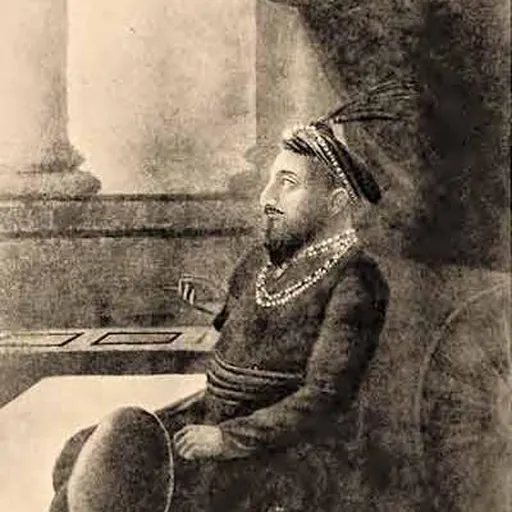
About Murshid Quli Khan
Lived 1670 – 1727 (aged 56–57). Murshid Quli Khan was a ruler and monarch.
Murshid Quli Khan ( 1660 – 30 June 1727), also known as Mohammad Hadi (born as Suryanarayana Mishra), was the first Nawab of Bengal, serving from 1717 to 1727.
According to some writers, he was born a Hindu in the Deccan Plateau 1670, Murshid Quli Khan was bought by Mughal noble Haji Shafi. After Shafi's death, he worked under the Divan of Vidarbha, during which time he piqued the attention of the then-emperor Aurangzeb, who sent him to Bengal as the divan 1700. However, he entered into a bloody conflict with the province's subahdar, Azim-us-Shan. After Aurangzeb's death in 1707, he was transferred to the Deccan Plateau by Azim-us-Shan's father the Mughal Emperor Bahadur Shah I. However, he was brought back as deputy subahdar in 1710. In 1717, he was appointed as the Nawab Nazim of Murshidabad by Farrukhsiyar. During his reign, he changed the jagirdari system (land management) to the mal jasmani, which would later transform into the zamindari system. He also continued sending revenues from the state to the Mughal Empire. He received various titles from the Mughal emperors such as Kārtalab Khān, Murshid Quli Khān, Jafar Khān and Mutamin al-Mulk Ála' al-Dauläh Jafar Khān Nasiri Nasir Jang Bahadur successively. He built the Katra Masjid mosque at Murshidabad where he was buried under the staircase after his death on 30 June 1727. He was succeeded by his son-in-law Shuja ud Din Muhammad Khan.
Early life According to Sir Jadunath Sarkar, Murshid Quli Khan was originally a Hindu Brahmin and named as Surya Narayan Mishra, born in Deccan 1670. The book Ma'asir al-umara supports this statement. At the age of around ten years, he was sold to a Persian named Haji Shafi who converted him to Islam, and raised him with the name Mohammad Hadi.
First appointment in Bengal
Conflict with Azim-us-Shan Aurangzeb appointed Quli Khan the Diwan of Bengal 1700. At that time, Azim-us-Shan, a grandson of the Mughal emperor, was the subahdar of the province. He was not pleased at this appointment as he intend to use the revenue collected from the state to fund his campaign to occupy the Mughal throne after Aurangzeb's death. Immediately after being appointed to the post, Quli Khan went to Jahangirnagar (present day Dhaka) and transferred officials from the service of Azim-us-Shan to himself, enraging Azim-us-Shan.
Azim-us-Shan was extremely worried Quli Khan knew of his assassination plans and was fearful of Aurangzeb's reaction. Quli Khan behaved as if he knew nothing of the plan assuring us-Shan they would remain friends in the future. However, he wrote about the matter to Aurangzeb, who in turn sent a letter to us-Shan warning him that if Quli Khan was "harmed, then he would take revenge on him".
Foundation of Murshidabad Quli Khan felt unsafe in Dhaka, so he moved the diwani office to Murshidabad. He said that he relocated the office since Mukshudabad was situated in the central part of Bengal, making it easy to communicate throughout the province. As the city was on the banks of the Ganges, European trading companies had also set up their bases there. Quli Khan thought that it would be easy for him to keep a vigil over their actions. He also relocated the bankers to the new city. Azim-us-Shan felt betrayed as this was done without his permission. Historian Chowdhury says that Quli Khan was able to do this because he had the "support" of Aurangzeb. A year later, in 1703, Aurangzeb transferred us-Shan from Bengal to Bihar and Farrukhsiyar was made the titular subahdar of the province. The subah office was then relocated to Mukshudabad. The city became a centre for all activities of the region. But according to the newspaper Tarikh-i-Bangla, and Persian historian Riwaz-us-Salatin, the city was renamed in 1704. Chowdhury opines that this "might be the correct date" as the representative of the British East Indian Company in Orissa province met Quli Khan in early 1704. The fact that the first coins issued in Murshidabad are dated 1704 is strong evidence of the year of the name change.
Reign
Death of Aurangzeb Until the death of Aurangzeb in 1707, all the powers of the subahdar were vested in the hands of Quli Khan. He was succeeded by Azim-us-Shan's father Bahadur Shah I. He reappointed his son as the subahdar of the province and made Quli Khan his deputy. Azim-us-Shan influenced his father to throw Quli Khan out of the province. As a result, he was appointed the Diwan of Deccan in 1708, and served in the post until 1709.
But, in 1710, Quli Khan was brought back as the diwan (revenue officer) of the province on the advice of us-Shan. According to Sarkar, he did so to form an allegiance with him, as he thought that it would be impossible to occupy the Delhi throne without the support of local nobility. Though he was brought back, his relationship with the Mughal prince remained stained.
Shah was succeeded by Jahandar Shah in 1712, (27 February 1712 – 11 February 1713) and he was followed by Farrukhsiyar in 1713. In 1717, (Historian Abdul Karim disputes the date and claims it to be 1716, but all other sources use 1717.) The capital was shifted from Dhaka to Murshidabad.
Quli Khan continued his policy of sending part of the revenue collected to the Mughal Empire. He did so even when the empire was in decline with the emperor vesting no power, as the power became concentrated in the hands of kingmakers. He justified his action by saying that it would be impossible to run the Mughal Empire without the revenue he sent. Historian Chowdhury says that his real reason was to show his loyalty to the Mughal Emperor so that he could run the state according to his own wishes.
Records show that every year 1 crore 30 lakh rupees was sent as the revenue to the Mughal emperor. Besides money revenue was also paid in kind. Quli Khan himself used to carry the money and other forms of revenue with the infantry and the cavalry to Bihar where they were given to the Mughal collector. In the eastern end of the city he built the Katra Masjid mosque in 1724 where he was buried after his death.
Conditions in Murshidabad During Quli Khan's reign the people of the Murshidabad used to participate in many festivals. One of them was the Punyah which occurred in the last week of the Bengali month of Chaitra. The zamindars, or their representatives, took part in it. However, the festival which was celebrated with the greatest pomp and grandeur was Mawlid the festival to celebrate the birth of the Islamic prophet Muhammad. During Mawlid people from neighbouring provinces came to the city to celebrate. On Quli Khan's order chirag or lamps were lit in all religious places such as mosques, and imambararas.
Quli Khan also imitated the Mughal tradition of holding a durbar in the city which was attended by the city's bankers, foreign tourists, and European companies' representatives. Because of the increase in trade, a new class of businessmen arose who also attended his durbar. Due to his pious nature, Quli Khan followed Islam strictly and, according to Islamic rules, visitors were fed twice a day.
Death and succession
Quli Khan died on 30 June 1727. He was succeeded initially by his grandson Sarfaraz Khan. But his son-in-law Shuja-ud-Din Muhammad Khan did not accept the succession, and planned to fight a war against him. Khan gave up without a fight and Shuja-ud-Din became the nawab in 1727. Sarfaraz would ascend the throne after his father's death in 1739 only to be defeated and replaced by Alivardi Khan in 1740.
Quli Khan remains buried under the stairs to the main-floor of Katra Masjid—a five-bayed rectangular mosque constructed by himself—pursuant to his wishes. Popular belief holds the mosque to have been constructed of material obtained upon destruction of several Hindu temples and residences.
Don’t just read it —
keep it.
Full-length biographies made to live with: read them, listen on the way to work, watch them tonight.
- E-book
- Audio
- Video
Instant download · yours to keep · every purchase keeps this site free
Important facts
more
Murshid Qulī KhānPeople in Murshid Quli Khan's life
Named in this biography and alive at the same time



Related people
Same field, nearest in time




Contemporaries
People whose lives overlapped Murshid Quli Khan's




Frequently asked questions
Who was Murshid Quli Khan?
Nawab of Bengal
When was Murshid Quli Khan born?
Murshid Quli Khan was born in 1670 in Deccan sultanates.
When did Murshid Quli Khan die?
Murshid Quli Khan died on 30 June 1727 in Murshidabad.
What was Murshid Quli Khan's occupation?
Murshid Quli Khan was a ruler and monarch.
Sources & further reading
· Wikipedia: Murshid Quli Khan
Cite this page
APA: Biography.guide. (2026). Murshid Quli Khan. https://biography.guide/murshid-quli-khan/
MLA: "Murshid Quli Khan." Biography.guide, https://biography.guide/murshid-quli-khan/.
Chicago: "Murshid Quli Khan." Biography.guide. https://biography.guide/murshid-quli-khan/.
Data last updated: 2026-09-23 · Spot an error? Report a correction.
Portrait: Wikimedia Commons · author & licence
Page generated 2026-09-27 05:06 UTC