
About Murphy Anderson
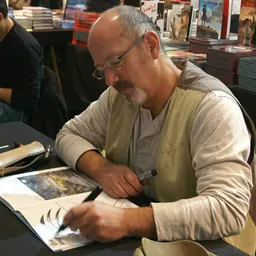
Lived 1926 – 2015 (aged 89). Murphy Anderson was an American comics artist, visual artist and draftsperson.
Murphy C. Anderson Jr. (July 9, 1926 – October 22, 2015) was an American comics artist, known as one of the premier inkers of his era, who worked for companies such as DC Comics for over fifty years, starting in the Golden Age of Comic Books in the 1940s. He worked on such characters as Hawkman, Batgirl, Zatanna, the Spectre, and Superman, as well as on the Buck Rogers daily syndicated newspaper comic strip. Anderson also contributed for many years to PS, the preventive maintenance comics magazine of the U.S. Army.
Early life and career Murphy Anderson was born on July 9, 1926, in Asheville, North Carolina, and while in grade school moved with his family to Greensboro, North Carolina. After graduating high school in 1943, he briefly attended the University of North Carolina before moving to New York City seeking work in the comics industry, and was hired by Jack Byrne as a staff artist at the pulp magazine publisher Fiction House, His first confirmed credit is the two-and-two-thirds-page nonfiction aviation featurette "Jet Propulsion" in Wings Comics #48 (cover-dated Aug. 1944), and his first fiction feature was an eight-page "Suicide Smith and the Air Commanders" story in Wings Comics #50 (Oct. 1944). By the following month he was the regular artist on the Planet Comics features "Life on Other Worlds" and "Star Pirate". "Star Pirate" splash page, Planet Comics #50 (Sept. 1947), penciled and inked by Anderson
Anderson succeeded artist and co-creator Carmine Infantino on the superhero feature "Captain Comet" beginning with the story "The Girl from the Diamond Planet" in Strange Adventures #12 (cover-dated Sept. 1951). which Anderson later described as his favorite assignment. Anderson and writer Gardner Fox launched the Hawkman series in May 1964 and introduced the Zatanna character in issue #4 (Nov. 1964). Comics historian Les Daniels noted that "Hawkman really took off when artist Murphy Anderson took over... Anderson came into his own with his elegantly ornamental version of the Winged Wonder." The Spectre was revived by Fox and Anderson in Showcase #60 (Feb. 1966) and was given his own series in December 1967. In the 1960s Anderson proposed that comics pages be drawn at 10x15 inches rather than the prevailing standard of 12x18 inches, which allowed two pages to be photographed at the same time, and this subsequently became the industry standard.
Anderson designed the costume of Adam Strange. With his frequent collaborator, penciler Curt Swan, the pair's artwork on Superman and Action Comics in the 1970s came to be called "Swanderson" by fans. He often hid his initials somewhere within the stories he inked. In the early 1970s, DC assigned Anderson, among other artists, to redraw the heads of Jack Kirby's renditions of Superman and Jimmy Olsen, fearing Kirby's versions were too different from the established images of the characters. In 1972, he drew Wonder Woman for the cover of the first issue of Ms. Magazine. In 1973, he established Murphy Anderson Visual Concepts, which provided color separations and lettering for comic books.
Beginning in 1967, Anderson also contributed for many years to PS Magazine, the preventive maintenance comics magazine of the U.S. Army, working under a childhood favorite artist, Will Eisner.
Awards Anderson's accolades include the 1962 Alley Award for "Best Inker"; a 1963 Alley for "Artist Preferred on Justice League of America"; 1964 Alleys for "Best Inking Artist" and for "Best Comic Book Cover" (Detective Comics #329, with penciler Carmine Infantino); 1965 Alleys for, again, "Best Inking Artist" and "Best Comic Book Cover" (The Brave and the Bold #61), as well as for "Best Novel" ('Solomon Grundy Goes On A Rampage') in Showcase #55, with writer Gardner Fox.
Anderson received an Inkpot Award in 1984 and was inducted into the Jack Kirby Hall of Fame in 1998 the Will Eisner Hall of Fame in 1999, and the Inkwell Awards Joe Sinnott Hall of Fame in 2013.
Don’t just read it —
keep it.
Full-length biographies made to live with: read them, listen on the way to work, watch them tonight.
- E-book
- Audio
- Video
Instant download · yours to keep · every purchase keeps this site free
Important facts
People in Murphy Anderson's life
Named in this biography and alive at the same time




Related people
Same field, nearest in time




Contemporaries
People whose lives overlapped Murphy Anderson's

Frequently asked questions
Who was Murphy Anderson?
Comic artist (1926–2015)
When was Murphy Anderson born?
Murphy Anderson was born on 9 July 1926 in Asheville.
When did Murphy Anderson die?
Murphy Anderson died on 22 October 2015 in Somerset.
What was Murphy Anderson's occupation?
Murphy Anderson was a comics artist, visual artist and draftsperson.
What nationality was Murphy Anderson?
Murphy Anderson was American.
Sources & further reading
Cite this page
APA: Biography.guide. (2026). Murphy Anderson. https://biography.guide/murphy-anderson/
MLA: "Murphy Anderson." Biography.guide, https://biography.guide/murphy-anderson/.
Chicago: "Murphy Anderson." Biography.guide. https://biography.guide/murphy-anderson/.
Data last updated: 2026-09-20 · Spot an error? Report a correction.
Page generated 2026-09-27 05:13 UTC