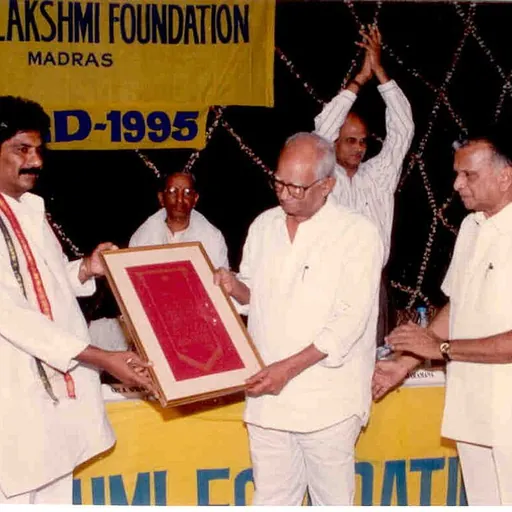
About Mullapudi Venkataramana
Lived 1931 – 2011 (aged 79). Mullapudi Venkataramana was an Indian screenwriter, lyricist, songwriter, writer and film producer.
Mullapudi Venkata Ramana (28 June 1931 – 24 February 2011) was an Indian writer known for his work in Telugu language. Noted for his humorous and metaphorical style of writing, Mullapudi received Raghupathi Venkaiah Award from the Government of Andhra Pradesh in 1986 for his contributions to Telugu cinema and he also won six Nandi Awards.
Mullapudi is noted for his association with Bapu, who both worked together as Bapu–Ramana. The director–writer duo went onto make many successful films such as Bangaru Pichika (1968), Andala Ramudu (1973), Sampoorna Ramayanam (1973), Mutyala Muggu (1975), Pelli Pustakam (1993), Mister Pellam (1995), and Radha Gopalam (2005). He is also an essayist and cartoonist who is known for creating Budugu, a character considered as a corner stone for Telugu children's literature.
Early life Mullapudi Venkata Ramana was born in middle-class traditional family and his childhood mostly spent in a tiny village called Dowleswaram near Rajahmundry, Andhra Pradesh. Mullapudi had one elder sister and a younger brother. It was a happy family with no troubles until his father expired when Mullapudi was 9 years old. This turned their status upside down and they shifted to Chennai (called Madras in those days) for better opportunities. Mullapudi's mother Mrs. Adilakshmi took all the pains to raise the family in such situation. Mullapudi's education and career happened in Madras. During his study days, he had shown penchant for literature in Telugu and inclination in writing up short, effective storylines.
During the same period, he got a friend, 'Bapu'. Their friendship was mutually expanding capacities as Mullapudi did write-ups whereas Bapu painted and did caricature drawing. Later in their lives, they worked together on a number of Telugu films.
Katha Ramaneeyam' Part-1 having around 40 stories off 8 chapters each of them representing one of Navarasams (Nine emotions each human has). Some of them were made Films later viz. Seetha Kalyanam, Bhogimanta, Swayamvaram etc..
Katha Ramaneeyam' Part-2 having about 45 stories, some of which represent Indian middle-class' tryst with life in hilarious way.
Runanandalahiri is representation of average Indians, leading life in the times of inflation, joblessness, less privileged society and their tryst with their lives' problems. Mullapudi himself suffered such upsets in his life and even frank enough that some characters inspired from his own sufferings but dealt with in a humorous way.
Career After completing SSLC in Madras, Mullapudi had to do many odd jobs before starting as a reporter for then-popular newspaper Andhra Patrika in 1953. Here he got the opportunity to interact with eminent writers of Telugu literature like Nanduri Ramamohana Rao, Pilaka Ganapati Sastri, Surampudi Seetaram etc. who were working for the same newspaper.
Sri. Mullapudi was first working for the "Daily" section of the newspaper and then shifted to "Weekly" section. While working here, his stories for children in the name of 'Budugu' (lil kid) were published and became very popular. He authored these stories to present the views of the little kids off their elders in the family. These stories are humorous, informative, knowledgeable to children and at the same time helping the elderly to know the thought process of their kids. Later, these stories were published in the form of a book, which was well received.
While writing for the "Cinema Page" section in the paper, Mullapudi's short and crisp writing helped him to gain popularity for his film reviews. That was the same time when he got introduced to film industry and befriended the famous stars of film fraternity. He got introduced to some great directors of those times, Adurthi SubbaRao and Dundi, who encouraged him to work for films. RakthaSambandam was his first break as a writer; since then he never lagged in his progress as story, screenplay, dialogue writer.
Films
Mullapudi's writing talent highlighted with his movie reviews and stories he wrote for films. Some of the initial films for story, screenplay dialogue Velugu needalu, Kanney manasulu were runaway hits, that has kept Mullapudi in good stead. Mooga manasulu, Bharya Bharthalu, Velugu Needalu and Teney manasulu have firmly established him as story writer. Some of these films had ANR (Akkineni NageswarRao) in the lead and their association brought their talent to the fore.
Soon, he became sought after film story writer and gave up his journalist job at Andhra Patrika. He partnered with his childhood friend Bapu and co-produced their first film Sakshi featuring actor Krishna which got accolades for its storyline and direction.
Bhakta Kannappa (great disciple of 'Lord Siva') with actor Krishnam Raju, who was till then doing villain roles, was a commercial success. However, the milestone in his career is Sampoorna Ramayanam (1971), featuring Shoban Babu as Lord Rama, was a commercial success.
Association with Bapu
Mullapudi's association with Bapu has a 60-year career plan. They first met in 1942 in P.S. High School, Madras where they studied V and VI level and then continued schooling at Kesari High School. Mullapudi's first short story "Amma Maata Vinakapothe" was published in 1945 in Bala, a children's magazine published by Radio Annayya (Nyayapathi Raghava Rao). He was 14 then. Bapu illustrated the story. His paintings were liked and that was the beginning of their long-standing association.
While Bapu achieved much of his fame for a more-subtle style of art, Mullapudi's work featured more-talkative characters who were less focused on making sense of the world around them. They began as an illustrator-story writer team and then turned into a film-director-writer duo. They have contributed immensely to the enrichment of Telugu cultural ethos through literature and cinema
Mullapudi collaborated with Bapu by providing scripts and dialogue that complemented Bapu's visual style. Their long-standing professional association resulted in several social films, including Radha Kalyanam, Vamsa Vruksham, Pelli Pustakam, Mr. Pellam, Sundarakanda, and Radhaagopalam.
MuthyalaMuggu is regarded as a notable film of its time, with themes and characters that have continued to be discussed in later years. The film marked an early negative-role performance by Rao Gopal Rao, who later became known for portraying antagonistic characters. The dialogue, written by Mullapudi, received widespread attention and remained popular with audiences.
Mullapudi translated the Thiruppavai written by the Tamil Vaishnavite saint Andal into Telugu as Melupalukula Melukolupu. This translation used Bapu's illustrations for each translated verse. Second Best Story Writer – Poola Rangadu (1967) Best Story Writer – Kathanayakudu (1969) Second Best Story Writer – Andala Ramudu (1973) Best Dialogue Writer – Pelli Pusthakam (1991) Second Best Feature Film – Silver – Pelli Pusthakam (1991) Second Best Story Writer – Mister Pellam (1993)
Death Mullapudi died of old-age related illness in Chennai on 24 February 2011. At the time of the death, he just completed the work for another mythological film Sri RamaRajyam.
Filmography This is partial list of his films. Kindly help expanding it. Year Film Credits 1960 Rakta Sambandham Dialogues 1961 Iddaru Mitrulu Dialogues 1963 Mooga Manasulu Writer 1964 Velugu Needalu Dialogues 1964 Daagudu Mootalu Writer 1965 Preminchi Choodu Dialogues 1965 Tene Manasulu Story and Dialogues 1966 Kanne Manasulu Story and Dialogues 1966 Navarathri Dialogues 1967 Poola Rangadu Story 1967 Prana Mitrulu Story and Dialogues 1967 Saakshi Writer 1968 Bangaru Pichika Writer 1969 Buddhimantudu Story and Screenplay 1969 Kathanayakudu Story 1970 Balaraju Katha Dialogues 1971 Bhale Rangadu Story 1971 Sampoorna Ramayanam Writer 1972 Kathanayakudu Story 1973 Andala Ramudu Writer 1975 Muthyala Muggu Writer 1976 Bhakta Kannappa Writer 1976 Seetha Kalyanam Writer 1978 Gorantha Deepam Story, Screenplay and Dialugues 1978 Mana Voori Pandavulu Dialogues 1980 Kaliyuga Ravanaasurudu Writer 1980 Rajadhi Raju Story, Screenplay and Dialogues 1980 Vamsa Vruksham Screenplay and Dialogues 1981 Radha Kalyanam Writer 1981 Tyagayya Writer 1982 Pelleedu Pillalu Story and Dialogues 1983 Manthrigari Viyyankudu Writer 1985 Bullet Story, Screenplay and Dialogues 1985 Jackie Writer 1986 Kalyana Tamboolam Writer 1991 Pelli Pusthakam Dialogues, Screenplay and Dialogues 1993 Mr. Pellam Writer 1993 Srinatha Kavi Sarvabhowmudu Writer 1994 Pelli Koduku Writer 1996 Rambantu Writer 1999 Panchadara Chilaka Writer 2004 Xtra Music director 2005 Radha Gopalam Story, Screenplay and Dialogues 2008 Sundarakanda Story, Screenplay and Dialogues 2011 Sri Rama Rajyam Story and Dialogues
Don’t just read it —
keep it.
Full-length biographies made to live with: read them, listen on the way to work, watch them tonight.
- E-book
- Audio
- Video
Instant download · yours to keep · every purchase keeps this site free
Important facts
People in Mullapudi Venkataramana's life
Named in this biography and alive at the same time


Related people
Same field, nearest in time


Contemporaries
People whose lives overlapped Mullapudi Venkataramana's

Frequently asked questions
Who was Mullapudi Venkataramana?
Telugu writer
When was Mullapudi Venkataramana born?
Mullapudi Venkataramana was born on 28 June 1931 in Dowleswaram.
When did Mullapudi Venkataramana die?
Mullapudi Venkataramana died on 23 February 2011 in Chennai.
What was Mullapudi Venkataramana's occupation?
Mullapudi Venkataramana was a screenwriter, lyricist, songwriter, writer and film producer.
What nationality was Mullapudi Venkataramana?
Mullapudi Venkataramana was Indian.
Sources & further reading
· Wikipedia: Mullapudi Venkataramana
· DBpedia: Mullapudi Venkata Ramana
Cite this page
APA: Biography.guide. (2026). Mullapudi Venkataramana. https://biography.guide/mullapudi-venkataramana/
MLA: "Mullapudi Venkataramana." Biography.guide, https://biography.guide/mullapudi-venkataramana/.
Chicago: "Mullapudi Venkataramana." Biography.guide. https://biography.guide/mullapudi-venkataramana/.
Data last updated: 2026-09-22 · Spot an error? Report a correction.
Portrait: Wikimedia Commons · author & licence
Page generated 2026-09-27 05:02 UTC