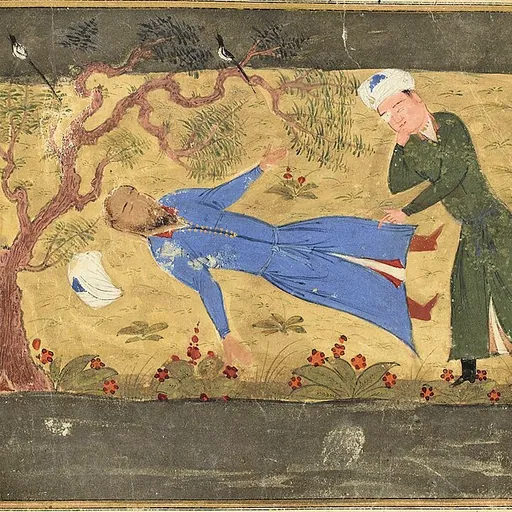
About Muhammad II of Khwarazm
Lived 1170 – 1220 (aged 49–50). Muhammad II of Khwarazm was a military leader and governor.
'Alā' al-Din Muhammad II (Persian: علاءالدین محمد خوارزمشاه; full name: Ala ad-Dunya wa ad-Din Abul-Fath Muhammad Sanjar ibn Tekish) was the Shah of the Khwarazmian Empire from 3 August 1200 to December 1220. His ancestor was Anushtegin Gharchai, a Turkic Ghulam who eventually became a viceroy of a small province in Central Asia named Khwarazm. The expansion seen under the rule of Muhammad constituted the pinnacle of the developing Khwarazmian military culture, and in various campaigns of conquest created a realm extending from Shirvan to the Indus river and the outer periphery of Mongolia after defeating his adversaries, namely the Qara Khitai, Ghurids, and Eldiguzids. He was able to rally as much as 400,000 men, and with these massive tribal armies his empire was as large as 2,400,000-3,600,000 km². By 1218, he brought the empire to its political and military zenith, but after a skirmish with the Mongols, Muhammad's realm was destroyed when they entered into Transoxiana and sacked Gurganj, Bukhara, his capital in Samarkand, Otrar, Herat among others. Muhammad died on the Caspian island of Ashur-Ada in December 1220.
Early life Ala ad-Din Muhammad II was born Qutb ad-Din Muhammad in Gurganj and served in the court of his father Ala al-Din Tekish. He served as wali of Merv upon his appointment in December 1193, and became the heir to the throne in Spring 1197 when the eldest, Malik-Shah, passed away. Throughout the last years of Tekish's rule, Muhammad accompanied him both in diplomatic missions and military campaigns; Muhammad personally led an expedition against the Ismaili fort of Turshiz in early 1200, concluding a peace deal in which 100,000 dinars were given as concession to the Khwarazmshah.
Muhammad's nephew, Hindu-Khan went from Nishapur where he served as wali to Merv, intentionally missing the coronation ceremony and gathering forces there. He requested support from Ghiyath al-Din Muhammad of Ghor, an overture that was accepted; Muhammad reciprocated to this open act of desertion by dispatching an army under Amir Chaqir; Hindu-Khan fled to Ghor and Merv was recaptured including Hindu-Khan's children and wives.
Simultaneously, Ardashir, the ispahbadh of the Bavandid realm in Mazandaran captured Ustunavand, Damghan, Folui and Firuzkuh, sabotaging Khwarazmian garrisons in Persian Iraq, which fell into anarchy until its seizure by the Eldiguzids 1203-4 when a former Mamluk of atabeg Jahan Pahlawan invaded and defeated and killed the most powerful local ruler, Izz ad-Din Gokcha/Kukjeh.
Fall of Khorasan Main article: Ghurid conquest of Khorasan & Battle of Qarasu
Muhammad recalled his brother, Taj ad-Din Ali-Shah from the western frontier in 1201 in order to support the defense of Khorasan as swarms of Ghurid troops began overrunning the region. Muhammad ibn Kharnak, Ghiyath's governor of Taliqan besieged Merv and was joined by Muizz al-din Muhammad and Ghiyath with Indian war elephants shortly after, causing it to fall when Amir Chaqir surrendered the fortress and was exiled in Ghurid captivity. Throughout early 1201, Sarakhs, Nasa, and Abivard fell, which were given to a cousin of Ghiyath, Emir Zangi ibn Mas'ud. Tus fell following this after a 3-day siege. On 7 April 1201, the Ghurids under Muizz al-Din besieged Nishapur under Taj ad-Din 'Ali Shah, which surrendered a few days later. The city was plundered for an hour before Ghiyath received word and ordered everything looted be restored. Some Khwarazmian troops hid in the Friday mosque, but it was breached and they were captured. Ghiyath went to Herat and appointed DIya al-Din Muhammad ib Abi' Ali al-Ghori, another of his cousins, to govern Khorasan militarily and financially. Muizz al-Din led one last series of incursions in Khorasan in 1201 where he attacked and destroyed an Isma'ili village in Quhistan massacring and plundering it, and then besieged another nearby Isma'ili fortress. Their leader sent a complaint to Ghiyath al-Din Muhammad, who had returned to Afghanistan, likely Firozkoh. Ghiyath sent a messenger who ordered Muizz to depart while he was besieging one of their towns, which he was angrily forced to agree to, proceeding to Ghazna, and then India.
Ala ad-Din Muhammad had finally gathered his army and completed organizing his government, departing from Gurganj and recaptured Abivard and Nasa in 1201. Hindu-Khan, who had been re-instated in Merv, fled to Ghiyath in Firozkoh. Muhammad continued expanding in Khorasan and captured Merv in September 1201, besieging Nishapur on the 18th. Diya ad-Din al-Ghuri was forced to surrender after a two-month siege, and Muhammad allowed the garrison to return home, destroying the city fortifications. Somewhere in 1201–1202, Ala ad-Din Muhammad attempted to capture Sarakhs from Emir Zangi ibn Mas'ud, but was deceived when the Ghurids said they would surrender if allowed to leave the fortress, but they simply gathered food from around the city, returned behind the walls, and locked them. Muhammad withdrew and left some emirs to continue the siege, but then, Muhammad ibn Kharnak of Taliqan them marched on Sarakhs to surprise the Khwarazmians, but they caught wind of it and withdrew. Zanki and Kharnak regrouped at Marw al-Rudh, and Muhammad sent an army under his maternal uncle with 3,000 cavalry, which was defeated.
Muhammad appealed to the Qara Khitai to save him, which they agreed to. The Ghurids besieged Gurganj, resulting in a struggle for the city. The leader of the Shafi'ites in Khwarazm, Shihab ad-Din al-Khivaqi helped rally the defenses and donated his property to fund it, while Muhammad's mother Terken Khatun helped reorganize the defense and arm the locals, with an army of 70,000 assembled. Muizz al-Din was eventually forced to retreat after the Qara Khitai army arrived, and he was pursued to Andkhud by them and the Khwarazmians. On 28 September 1204, he skirmished with the Qara Khitai and on 29 September, the Battle of Andkhud took place during which the Ghurids were defeated. Muhammad returned to Khwarazm and signed a truce on the condition of the Ghurid withdrawal from Khorasan and cession of Marw al-Rudh, while Muizz al-Din was besieged in Andkhud, being forced to cede treasures including one war elephant (although he kept Balkh) due to turmoil in his home territory and rumors of his death. Muhammad began marching back on Herat, where a plot against the Khwarazmians emerged. Ibn Kharmil grew apprehensive and disappointed with Muhammad and had the Khwarazmian troops removed from the city, but when two conspirators, the faqih Ibn Ziyad and the city's Qadi, Sa'id, began instigating to return the city to the Ghurid fold, Ibn Kharmil rejoined Muhammad, feigning approval of the plot before sending a messenger to Muhammad, receiving some troops back. When Ghiyath al-Din Mahmud send a commander under 'Ali ibn Abi'Ali to retake Herat, they were defeated by Ibn Kharmil at the pastures outside of the city in a surprise attack; this was followed by raids on Badghi territory, and the execution of Ibn Ziyad and banishment of Sa'id the Qadi, who managed to escape Herat. Throughout September 1206, Ibn Kharmil also besieged Isfizar, whose ruler had paid homage to Ghiyath al-Din, and the city surrendered after a month, Kharmil being rewarded by the Khwarazmshah with an iqta worth 250,000 dinars.
Around this period of time, 10,000 Khwarazmians raided as far as Zanjan and fought Aydughmish, the Eldiguzid who had seized Persian Iraq, but were defeated and their captives released.
Muhammad had appointed his maternal uncle Amir Malik to govern Herat and told him to go to Firuzkuh and demand the extradition of Taj ad-Din Ali Shah. Upon reaching the city, Ghiyath al-Din Mahmud agreed, but both he and Ali were arrested, sent to Khwarazm, and subsequently executed, resulting in all Ghurid territory becoming vassals of Khwarazm including Firuzkuh, Bamian, Ghazni (under Tajuddin Yildiz) and Multan (under Nasir ad-Din Qabacha). In 1209, as Muhammad prepared to fight the Qara Khitai, a diplomatic mission under a representative named Tushi was sent to Gurganj to negotiate, but he violated etiquette and sat on the Khwarazmshah's throne. Muhammad was enraged and ordered he and his retinue to be cut to pieces, and Muhammad marched on Bukhara in 1209 where he secured the support of various magnates including 'Uthman of Samarkand, but Samarkand was then occupied by the Qara Khitai, until Muhammad arrived and forced them to withdraw. Things came to a head around 1209-1210 when the Qara Khitai dispatched an immense force under a general named Tayangu, and everything culminated in a major battle near the Talas River in the Ilamish Steppe in September 1210, where the Qara Khitai were utterly defeated, with Tayangu being captured and either drowned in the Oxus or spared.
Muhammad then demanded that the territories of the Qara Khitai beyond Transoxiana be divided between the two, among other terms including sending the captured Khitai Gurkhan, one of his princesses and a large portion of the treasury, which Kuchlug refused. But the latter had a larger army, so Muhammad began resorting to harassing his baggage train and detachments split from their vanguard. Apprehensive about possibly losing Transoxiana after hearing about a huge Mongol empire emerging under Temujin/Genghis Khan, Muhammad also devastated his frontal cities of Shah, Ferghana, Isfijah, Kashan and other surrounding ones to deprive invaders of supplies, while also evacuating the locals, before leaving the front for Khorasan and securing his gains, first stopping at Ferghana around 1213 where he conquered it from the last Karakhanid garrisons there, depleting that city too.
The battle lasted for three days and only through the tenacity of Jalal al-Din did the Khwarazmians survive, suffering heavy losses. The Mongols left the battle on the fourth day. Muhammad went back to Samarkand in haste after the battle. Genghis Khan first heard about the Irghiz Skirmish, and then about the earlier incident at Otrar. He sent demands to Muhammad II to hand over Inalchuq, which were refused. This and the killing of the merchants went against his moral code as those merchants had been civilians, not warriors, and therefore attacking them was a sacrilege. In the summer of 1219, Genghis Khan assembled near the town of Qayaligh, joined by the governor of Almaligh named Suqnaq-tegin, the Uyghur Idiqut Bawurchiq and the Karluk Arslan-Khan. Muhammad struggled to muster ample forces or rally his subjects as he had subdivided his empire via iqta to such an extent that it had become highly decentralized.
A council was held at the divan right as the Mongols planned to commence their invasion; the Khwarazmian army was likely slightly under 150,000 to slightly over 200,000 men. Shihab ad-Din Abu Sa’d ibn Imran al-Khivaqi told Muhammad he should gather 400,000 men and launch a surprise attack, but Muhammad rejected this course. Jalal al-Din suggested using guerilla warfare in Transoxiana, others wanted to occupy mountain passes and gorges, and another suggested fleeing to Ghazna to organize a defense there. Muhammad rejected all of these ideas, tripled the kharaj from 1219 to 1220 and decided to divide his army into garrisons to defend each town one by one. The Khwarazmshah, in panic, moved toward Balkh and urged the people to build new defenses. Before leaving Samarkand, he ordered a new wall be built around the city. Muhammad wielded a much larger force yet chose to divide it in Transoxiana rendering him vulnerable, and a plot against Muhammad's life was unveiled, with the Sultan fleeing from his tent at midnight, finding it pierced with arrows the next morning. This exacerbated his already critical paranoia.
This plot was possibly perpetrated by certain elements of his army like the Ghurs; despite being his former adversaries they had to provide militiamen alongside every other part of the empire; Terken Khatun may have been involved too. Genghis Khan started his offensive on the town of Otrar, where the incident had occurred in September 1219, and divided his forces, sending a detachment forward to Bukhara, another under Jochi to Jand and another under Ulaq-Noyan, Suketu Cherbi, and his son Tolui to besiege Khujand with just 5,000 men. Genghis Khan was accompanied by his generals Jebe and Subuta in making the main push in Transoxiana. While being besieged in Otrar, Inalchuq delegated command of his 50,000 men to a hajib, Qaracha, who suggested he surrender, but the former refused. Qaracha betrayed him and opened the Sufi-Khan gate, allowing the Mongols to storm Otrar. Inalchuq and 20,000 men barricaded themselves in the citadel for a last stand, but they were eventually finished off; Inalchuq was arrested and executed. Qaracha was also arrested and executed as the Mongols did not trust him to not betray them. This occurred in February 1220 and the city was destroyed. Skilled craftsmen were enslaved sent back to the Mongol homelands while the other survivors were retained for future use as human shields. Genghis Khan was advised by the former governor of Otrar, Badr ad-Din al-’Amid, who defected to him before the siege and had much of his family killed under Muhammad’s watch due to their disobedience to his rule, to sow division among Muhammad’s ranks. The Mongols soon appealed to Muhammad’s opposition (the various cultures in the Khwarazmian force). Muhammad was unable to prevent this and it resulted in him dissolving his large force out of apathy, diminishing any hope for defending the frontier. While this happened, Jand was captured on 21 April 1219 with no fighting when commander Qutlugh-Khan and 10,000 men left the city at night with the garrison and went to Khwarazm. Sighnaq was captured at a similar time after a 7-day siege, and the population of the city was massacred. Uzkend, Barjinligh-kend, and Ashnas fell soon thereafter. The Mongol detachment sent after Khujand arrived at Banaket, capturing the city after a surrender, and apparently bolstered their numbers to 20,000 accompanied by 50,000 local residents as fodder (hashar). Once the Mongols arrived at Khujand they found it under control of the kutwal Timur Malik. However, he was forced to flee to a nearby island in the Syr Darya with 1,000 men.
The Mongols tried to dislodge him with boulders from some mountains to build a dam and flood Timur Malik, so Timur built 12 barges covered with clay and vinegar-puttied felt. This made them invulnerable to arrows and flammable weapons, so Timur Malik and his soldiers ruined the Mongols’ efforts daily. Eventually, Timur chose to flee knowing he could not fight off the Mongols forever. He brought his troops aboard 70 boats and sailed down the Syr Darya, fending off Mongol attempts to intercept him. Near Banaket, the Mongols threw an iron chain across the river, but Timur managed to break through and reached as far as Barjinligh-kend via Otrar, Sighnaq, and Jand. There the Mongols attempted to place pontoons with catapults mounted on them, so Timur disembarked and went around them.
Timur Malik personally fought off the three Mongol commanders after multiple days of brutal fighting, wounding one with his arrow and driving the others away, and made it to Gurganj where he joined the defense there. Simultaneously, Genghis Khan led a large army with Tolui, Subutai and Jebe on to Bukhara. Along the way, the city of Zarnuq surrendered after being convinced by the turncoat Hajib Danishmend and was renamed to Qutlugh-Belik, but some residents were conscripted as hashar. He then moved south to Bukhara, along the way a town nearby called Nur-i Bukhara surrendered and 600 were taken as hashar along with a tribute of 1,500 dinars. Eventually, Genghis Khan reached Bukhara and besieged it on 7 February 1220. Ala ad-Din Muhammad sent 30,000 men to defend it under Amir Ikhtiyar ad-Din Kushlu and hajib Oghul Inanch-khan.
The Mongols fought outside the city for three days, but eventually the Bukharans launched a sudden attack that almost routed the Mongols. However, they then turned back and consolidated, giving Genghis Khan's army time to regroup and slaughter the garrison on the field, taking their loot. Only Ikhtiyar Kushlu and a small number of troops survived and Bukhara surrendered on 10 February 1220 after a delegation under Qadi Badr ad-Din Qadi-Khan personally visited him. Some soldiers and civilians hid in the citadel and resisted for 12 days. Genghis Khan was infuriated. He massacred them and proceeded to destroy the main mosque and kill civilians indiscriminately. A protest erupted, led by Imam Rukn ad-Din Imamzada and his son Qadi Sadr ad-Din, but they were both executed. Property and money were taken and the people of the city were even stripped of their clothes, apart from the undergarments, and forced to leave the town. The women were distributed amongst Mongol soldiers and Bukhara was burned. Genghis Khan then moved on Samarkand, while Muhammad effectively lost all will to fight back after both Balkh and Qunduz defected.
The garrison of Samarkand included 110,000 soldiers (50,000 Khwarazmians but also 60,000 Turks, Ghurs Khalaji and Khurasanians) and 20 war elephants. It was led by Terken Khatun's brother Taghay-Khan and some amirs: Barishmaz, Sarsigh, Ulagh, Alp-Erkhan, Shaykh-Khan and Bala. Genghis Khan sent a small detachment to besiege the city to bait the defenders out before ambushing them, defeating another sortie and forcing the defenders to come to terms. The Qadi and Shaykh al-Islam opened negotiations and surrendered the city on 17 March 1220, and the city and its defenders were annihilated. Again, women were taken by the Mongols and massacres occurred, including those perpetrated on the Turks; about 20,000 civilians and 20 Turkic amirs were killed, and many more who fought in the garrison.
Tens of thousands more artisans were taken to the Mongol capital, Karakorum. By the time Bukhara fell, Muhammad was already on the run from Balkh, to Transoxiana, and then west. He avoided an assassination attempt in Khorasan and reached Nishapur on 18 April 1220, fleeing to Bistam after a few hours and ordering the wakildar (representative/civil administrator) to conceal 10 trunks of precious stones in the fort of Ardahn. However, Muhammad was being chased by Jebe and Subutai who were sent with 20,000 men to pursue him. Muhammad reached Farrazin and met one of his sons, Rukn ad-Din Ghursanjti with 30,000 men. They went to Farun between Ray and Tabaristan, Sarjahan in Gilan for several days, and finally Dabuya near Amol on the Caspian sea. When the Mongols arrived in Tabaristan, he fled east again toward the port of Abaskun and embarked on a boat to the island of Ashur-Ada. The Mongols failed to catch up without access to boats.
Death
While there, Muhammad fell ill and named Jalal al-Din Mangburni as his successor. Meanwhile, the Mongols attacked Gurganj where the defense was led by Terken Khatun, however, their morale was lowered by the frantic evacuation of Muhammad despite the military culture of the city. Terken Khatun fled toward Mazandaran with the vizier Muhammad ibn Salih, and son of Yazir's ruler ‘Umar Khan. But she executed her guides from a lack of gratitude and was besieged in Ilal, which fell after four months. She was taken prisoner and her retinue was killed, but a courtier named Badr ad-Din Hilal escaped and informed Jalal al-Din about this, claiming she would rather be a Mongol captive than that of Jalal al-Din.
Terken Khatun, who held the title Khudawand-i Jahan (Lord of the World/Sovereign) was subject to poor conditions in captivity, being forced to eat Genghis Khan's leftovers before being sent to live in poverty until her death in 1233. Gurganj, in the meanwhile had command dedicated to an adventurer named Ali Kuh-i Darughan, who acted with great corruption as he appropriated land and money with the help of various cronies.
More officials began to enter Gurganj to rally a defense including Mushrif ‘Imad ad-Din, Sharaf ad-Din Kopek, heir to the throne Jalal al-Din Mangburni and his brothers Ozlag-Shah and Aq-Shah. However, Jalal al-Din was not supported and the brother of Terken Khatun, Khumar-Tegin, who commanded 90,000 Turks was proclaimed Shah by some amirs including Hajib Oghul, Shaykh-Khan, Er-Burga Pahlawan and Qutlugh-Khan. Jalal al-Din escaped with 300 soldiers alongside Timur Malik after hearing of this. The Mongols then attacked Khwarazm under the command of Baiju-Noyan, Ogedei, Chagatai, Tolan-Cherbi, Ustun and Qadan with over 100,000. They employed onager siege weapons and, due to the lack of stones, took wooden logs and soaked them in water to make them hard. The Mongols pelted the city with these, but the people of Gurganj did not budge, many of them being soldiers or having combat experience. So the Mongols used the same tactic in Samarkand by hiding most of their units, intercepting and defeating a contingent at the Bagh-I Khurram gardens, killing 1,000, but 2,000 escaped to Khorasan.
The Mongols nearly broke through, but soldiers, joined by common civilians held them off. The next day the Mongols attacked the Qabilan gate and failed again, being repelled by Amir Faridun Ghuri. Eventually, Jochi arrived to reinforce the Mongol invasion and the assaults intensified. They broke a dam on the Amu Darya and flooded Gurganj, but the effort failed and they lost 3,000 in another assault. Eventually, the Mongols filled the ditch and inflicted enough pressure after 7 months that they broke in after Genghis Khan co-ordinated an assault. Gurganj fell but street fighting persisted for several days; 100,000 artisans were sent to Mongolia, all men and children were killed and the women were stripped naked and forced to fight to the death outside the city in two groups, with all survivors killed after.
It was around this point in time where the ill Ala ad-Din Muhammad II of Khwarazm died in December 1220 on the island of Ashur-Ada.
Legacy Ala ad-DIn Muhammad (r. 1200–1220) is highly criticised by historians as an incompetent and irrational tyrant. Buniyatov writes that a chronicler discredited his achievements, and that he took advantage of other countries' turmoil to conquer their land and add more to his name.
Juvayni describes him in a similar manner; in the second volume of "The History of the World conqueror", Ala ad-Din Muhammad is depicted as ruthless, greedy, and unfit for ruling, and that his only success was in having his son, Jalal al-Din, who acquired a better record of defeat and victory in battle.
Conclusion The disastrous strategy that Muhammad chose to employ, in which the Khwarazmians were divided sporadically amongst frontier garrisons was a blunder that led to the empire's defeat and absorption at Mongol hands, yet the majority of contemporary sources were written by members of rival courts (e.g. Ghurid, Mongol and Iraqi historians).
Not omitting previous successes seen during conflicts against Ghurid and Qara Khitai adversaries, Muhammad was a tyrant who, while displaying skill and pragmatism in the army, and in some cases diplomacy, lacked the multi-faceted skill of a statesman displayed and utilized by his father, Ala al-Din Tekish. Examples of this increasingly customary impudence are manifested for example during the arrest of the Mongol caravan, defeat to al-Nasir, and heavy-handed approaches to the Ghurids and Qara Khitai.
Don’t just read it —
keep it.
Full-length biographies made to live with: read them, listen on the way to work, watch them tonight.
- E-book
- Audio
- Video
Instant download · yours to keep · every purchase keeps this site free
Important facts
Family & relationships
People in Muhammad II of Khwarazm's life
Named in this biography and alive at the same time


Related people
Same field, nearest in time



Contemporaries
People whose lives overlapped Muhammad II of Khwarazm's






Frequently asked questions
Who was Muhammad II of Khwarazm?
Soltan of Khwarezm Empire (1200–1220)
When was Muhammad II of Khwarazm born?
Muhammad II of Khwarazm was born in 1170.
When did Muhammad II of Khwarazm die?
Muhammad II of Khwarazm died on 1 December 1220 in Abaskun.
What was Muhammad II of Khwarazm's occupation?
Muhammad II of Khwarazm was a military leader and governor.
Sources & further reading
· Wikipedia: Muhammad II of Khwarazm
· DBpedia: Muhammad II of Khwarazm
Cite this page
APA: Biography.guide. (2026). Muhammad II of Khwarazm. https://biography.guide/muhammad-ii-of-khwarazm/
MLA: "Muhammad II of Khwarazm." Biography.guide, https://biography.guide/muhammad-ii-of-khwarazm/.
Chicago: "Muhammad II of Khwarazm." Biography.guide. https://biography.guide/muhammad-ii-of-khwarazm/.
Data last updated: 2026-09-21 · Spot an error? Report a correction.
Portrait: Wikimedia Commons · author & licence
Page generated 2026-09-27 04:59 UTC