
About Mostowfi ol-Mamalek
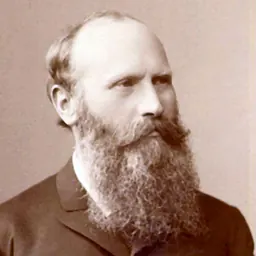
Lived 1875 – 1932 (aged 56). Mostowfi ol-Mamalek was an Iranian politician and minister.
Mirza Hasan Ashtiani , commonly known by the bestowed title Mostowfi ol-Mamalek (; 5 October 1871 – 28 August 1932) Mostowfi's father was Mirza Yousof Mostowfi al-Mamalek, a bureaucrat of the Qajar court, Naser al-Din Shah's grand vizier and a prime minister. His father was also assigned to determine the new reaches of the city of Tehran when the population reached 150,000. His grandfather was Mirza Hasan Mostowfi al-Mamalek I and was given the title of Mostofi al Mamalek under Mohammad Shah Qajar. Mostowfi was also second cousins with Mohammad Mosaddegh, who served as Iran's Prime Minister from 1951 to 1953.
One year before his father's death, Naser al-Din Shah Qajar granted the title Mostowfi ol-Mamalek ("chief financier of the country") to the very young Hasan. The Mostowfi ol-Mamalek family passed on the central office at the finance ministry from father to son throughout the 19th century and until the 1920s. During this period he visited many European countries and observed their systems of government.
Political career During the Persian Constitutional Revolution era, Mostowfi was appointed Minister 15 times, and Prime Minister 6 times. At various points in his career he held the positions of prime minister, minister of war, majlis member and minister without portfolio. Like his father, Mostowfi is said to have carried himself as a gentleman and was considered kind, honest, steadfast, humble and generous.
Criticism Despite his perceived popularity Mostowfi has at times been criticised for being unable to form a strong government with the ability to exercise what it presented to the Majlis. It has also been suggested that on occasion Mostowfi showed a lack of strong leadership.
Imperial allegiances Sources disagree on his allegiances to foreign powers with some claiming he was a Russophile and others stating he favoured the Germans and Turks.
Prime minister The First Term Sometime after his return to Iran, Mostowfi became the minister of war until the bombardment of Majlis. Following the conquest of Tehran, first he was appointed the minister of finance in Sepahdar Azam's cabinet and then became the minister of Ahmad Shah Qajar's court. Following to the resignation of Sepadar's first cabinet, he became Ahmad Shah’s prime minister. Almost all pro-Democrat forces obliged, however some pro-Moderates forces ignored the order, including Sattar Khan. As a result of the pro-Moderates forces actions the government used the newly appointed Tehran police chief, Yeprem Khan to exercise the order. With this Mostowfi proved he was able to make tough decisions when necessary.
The Second Term Mostowfi's second appointment as prime minister coincided with the onset of World War I. Iran had declared neutrality in the war and the country further reinforced its neutral stance by appointing Mostowfi, who was known to support neutrality. However, his government leaned towards the German and the Turks. Being pro-German in this regard was simply seen as a political move to support a third nation that may aid in curbing the influence of the British and Russians in Iran.
Mostowfi approached the Russian authorities and asked that they withdraw their troops from Azerbaijan as their presence gave the Turks a reason to invade. The Russians responded by asking what guarantees could be given that their withdrawal would not be followed by the insertion of the Turks. The absence of a centralised state in Iran can help explain why Mostowfi's cabinet, and the Shah, were both impotent on this matter.
In this second term Mostowfi also showed he was taking a stance in relation to the modernisation of Iran. In the program of his second cabinet Mostowfi proposed the abolition of the old pensions system, completion of the new Code, the founding of a secular law school to train personnel for the Ministry of Justice, the founding of several schools for girls and new laws to govern telegraphic communications. These proposals were rejected by the Majlis in 1914.
Mostowfi was also elected as MP for Tehran, but resigned in order to become prime minister.
The Third Term In August 1915, less than six months after resigning, Mostowfi once again was prime minister. By the time he took office, German popularity had increased amongst the nationalists.
During the Third Majlis the Czarist Russian Army expeditionary force left Qazvin for Tehran. Mostowfi suggested the Germans guarantee Iranian independence and territorial integrity. Mostowfi also attached a number of stipulations, including the Germans giving Iran a loan and providing officers. If these were all met, his government would be prepared to declare war on the Allies. He also stated that if all stipulations were not met he would have to stop all German activities in Iran.
In a show of good faith the Germans secured the withdrawal of Ottoman Forces and offered to help financially but did not agree to the stipulations. Due to the non-committal answer firm the Germans, the negotiations did not lead to a policy that could be executed. Additionally the Allies had discovered the secret negotiations.
By 7 November 1915, Russian troops were marching on the capital. The German envoy had left the day before and Mostowfi recommend that his deputies and the Shah to also leave and go to Qom. Forty-four deputies, newspaper editors and the Gendarmerie left for Qom. This was known as the ‘emigration’ with the hope of forming a government free of British and Russian Influence. The Shah having initially agreed, had his mind changed by the Russian and British Ministers in Tehran. With this change in mindset any chance of forming an independent government was gone.
The Fourth Term Mostowfi's fourth term of office as prime minister was marked by severe drought and famine that devastated the country. By some accounts 25% of those living in the North perished. This was accompanied by the Persian influenza epidemic of 1918 which was rapid and devastating.
The Fifth Term Mostowfi's fifth term began in February 1923. The First World War was over and the Russian Revolution was well established. Reza Khan who was then called Sardar Sepah had the post of Minister of War in Mostowfi's cabinet.
One of his most formidable opponents in politics at the time was Hassan Modarres who made numerous efforts to pull down Mostowfi's cabinet.
Mostowfi's cabinet finally collapsed under pressure from political opponents despite the full backing of Ahmad Shah Qajar. During the run-up to the elections for the 5th Majlis, Modarres and his followers in the Parliament were actively campaigning against Mostowfi's cabinet. They tabled a formal question to the government, which was customarily followed by a vote of confidence. The ministers answered the questions convincingly. Mostowfi, who was not used to this kind of street politics, was said to be angry and disappointed. He delivered his most famous speech to Parliament, blaming members of Parliament for "giving and taking ajil [dried nuts]", which in Persian means giving and taking bribes. He is believed to have said, "I have problems with my digestive system, and I do not take or give any ajil".
He was the first prime minister to call Parliamentarians corrupt instead of cajoling and flattering them. He and his ministers left the Parliament, went straight to the Shah and resigned.
Hassan Modarres went on to abolish the 1919 accord between Iran and the Great Britain. The society built a state museum, a state library and several mausoleums, which incorporated motifs from ancient Iranian architecture. The society was formed by modernist government officials and Westernized intellectuals, and Mostowfi was among them.
Despite Mostowfi's ostensible role in creating Iran's first historical preservation society he was also involved in the removal and sale of Iranian cultural heritage as was the case on the occasion of the Exposition Universelle of 1900 during which Mostowfi and his companions sold ceramic tiles to raise money for themselves after extensive buys.
It was at this time that Mostowfi had the luster mihrab of the Imamzadeh Yahya at Varamin taken out of Iran and transported to Paris where it remained largely in storage until 1913 when it was sold to Armenian-American art dealer Hagop Kevorkian who would later sold it in 1940 to American heiress Doris Duke.
Death and legacy
Mirza Hassan Mostowfi al Mamalek died of a heart attack on 28 August 1932. He was buried in the family mausoleum in Vanak village. The funeral procession was marked by the Armenian residents of Vanak carrying the coffin for a mile to the Mausoleum, followed by a procession of 80 or more cars. The mausoleum is currently on the grounds of Alzahra University.
Mostowfi had several children including a son, Mirza Yousof Mostowfi al-Mamalek II, who may have been named after his father.
His descendants now bear the surname "Mostofi al-Mamaleki", "Mostowfi", "Tahriri", "Dabiri".
Hassan Abad Square
The square and the buildings around it were built in a ten-year period. Hassan Abad was built by Mirza Yousof Mostowfi al-Mamalek, Naser ed-Din Shah's vizier. He named the place after his son Mirza Hassan Mostofi al-Mamalek. It was inspired by the Renaissance architecture, and adapted from the works of Palladio, the Italian architect of the Renaissance period.
Following the Iranian revolution in 1979, the square was renamed to "31st of Shahrivar Square", however the new name did not stick and it is still known as "Hassan Abad Square".
Don’t just read it —
keep it.
Full-length biographies made to live with: read them, listen on the way to work, watch them tonight.
- E-book
- Audio
- Video
Instant download · yours to keep · every purchase keeps this site free
Important facts
Family & relationships
People in Mostowfi ol-Mamalek's life
Named in this biography and alive at the same time




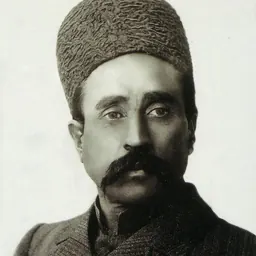
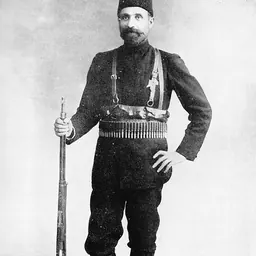
Related people
Same field, nearest in time




Contemporaries
People whose lives overlapped Mostowfi ol-Mamalek's


Frequently asked questions
Who was Mostowfi ol-Mamalek?
Iranian politician (1875-1932)
When was Mostowfi ol-Mamalek born?
Mostowfi ol-Mamalek was born on 5 October 1875 in Tehran.
When did Mostowfi ol-Mamalek die?
Mostowfi ol-Mamalek died on 28 August 1932 in Tehran.
What was Mostowfi ol-Mamalek's occupation?
Mostowfi ol-Mamalek was a politician and minister.
What nationality was Mostowfi ol-Mamalek?
Mostowfi ol-Mamalek was Iranian.
Sources & further reading
· Wikipedia: Mostowfi ol-Mamalek
· DBpedia: Mostowfi ol-Mamalek
Cite this page
APA: Biography.guide. (2026). Mostowfi ol-Mamalek. https://biography.guide/mostowfi-ol-mamalek/
MLA: "Mostowfi ol-Mamalek." Biography.guide, https://biography.guide/mostowfi-ol-mamalek/.
Chicago: "Mostowfi ol-Mamalek." Biography.guide. https://biography.guide/mostowfi-ol-mamalek/.
Data last updated: 2026-09-20 · Spot an error? Report a correction.
Page generated 2026-09-27 05:21 UTC