
About Mordecai Aaron Günzburg
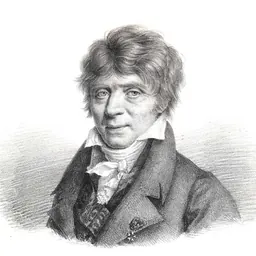
Lived 1795 – 1846 (aged 50). Mordecai Aaron Günzburg was a Russian writer, translator, teacher and rabbi.
Mordecai Aaron Günzburg (, ; 3 December 1795 – 5 November 1846), also known by the acronym Remag and the pen name Yonah ben Amitai , was a Lithuanian Jewish writer, translator, and educator. He was a leading member of the Haskalah in Vilnius, and is regarded as the "Father of Hebrew Prose."
Biography Günzburg was born into a prominent Jewish family in Salantai in 1795. His father Yehuda Asher (1765–1823), under whom he studied Hebrew and Talmud, was one of the early members of the Haskalah in Russia, and wrote treatises on mathematics and Hebrew grammar. Günzburg was engaged at the age of twelve, and married two years later, whereupon he went to live with his in-laws at Shavly. He continued his studies under his father-in-law until 1816. From there Günzburg went to Palanga and Mitau, Courland, where he taught Hebrew and translated legal papers into German. He did not stay in Courland long, and after a period of wandering settled in Vilnius in 1835.
In 1841, he founded with Shlomo Salkind the first secular Jewish school in Lithuania, which he headed until his death in 1846 at the age of fifty-one. A. B. Lebensohn, , and Michel Gordon, among others, published eulogies in his memory.
Work Günzburg was best known for his series of histories of contemporary Europe. His first major publication was Sefer gelot ha-aretz (1823), an adaption into Hebrew of Joachim Heinrich Campe's Die Entdeckung von Amerika, a Yiddish translation of which he released the following year as Di entdekung fun Amerike. In 1835, he published the first volume of his universal history Toldot bnei ha-adam, adapted from 's Handbuch der weltgeschichte. (A few chapters of the second volume would later be published in the Leket Amarim, a supplement to Ha-Melitz, in 1889.) In the same genre he wrote Ittote Russiya (1839), a history of Russia, and Ha-Tzarfatim be-Russiya (1842) and Pi ha-ḥerut (1844), accounts of the Napoleonic Wars.
Among his other publications were Malakhut Filon ha-Yehudi (1836), a translation from German of Philo's embassy to Caligula, and the anthology Devir (1844), an eclectic collection of letters, tales, and sketches. Many of Günzburg's works were published posthumously, most notably his autobiography Aviezer (1863, composed between 1828 and 1845), as well as Ḥamat Dammeshek (1860), a history of the Damascus affair of 1840, and the satirical poem Tikkun Lavan ha-Arami (1864).
Günzburg's outlook was influenced by Moses Mendelssohn's Phaedon and the Sefer ha-Berit of . He struggled energetically against Kabbalah and superstition as the sources of the Ḥasidic movement, but he was at the same time opposed to the free thought and proto-Reform movements.
Selected publications
Later published as Masa Kolumbus, o, gelot ha-aretz ha-ḥadashah [Columbus' Voyage; or, Discovery of the New Land].
A letter-writing manual.
A history of Russia.
A refutation of Max Lilienthal's Maggid Yeshuah.
A history of Europe from 1770 to 1812.
Don’t just read it —
keep it.
Full-length biographies made to live with: read them, listen on the way to work, watch them tonight.
- E-book
- Audio
- Video
Instant download · yours to keep · every purchase keeps this site free
Important facts
more
Yonah ben Amitai, Markus Aron Gincburg, Mordekhai Ginzburg, Mordechai Gunzburg, Mordecai Aaron Guenzburg, Mordechai Aaron Ginsburg, Mordecai Aaron Ginzburg, Mordekhai Aharon Gintsburg, Mordechai Aharon GinzburgPeople in Mordecai Aaron Günzburg's life
Named in this biography and alive at the same time
Related people
Same field, nearest in time




Contemporaries
People whose lives overlapped Mordecai Aaron Günzburg's




Frequently asked questions
Who was Mordecai Aaron Günzburg?
Hebrew writer (1795–1846)
When was Mordecai Aaron Günzburg born?
Mordecai Aaron Günzburg was born on 3 December 1795 in Salantai.
When did Mordecai Aaron Günzburg die?
Mordecai Aaron Günzburg died on 5 November 1846 in Vilnius.
What was Mordecai Aaron Günzburg's occupation?
Mordecai Aaron Günzburg was a writer, translator, teacher and rabbi.
What nationality was Mordecai Aaron Günzburg?
Mordecai Aaron Günzburg was Russian.
Sources & further reading
· Wikipedia: Mordecai Aaron Günzburg
· DBpedia: Mordecai Aaron Günzburg
Cite this page
APA: Biography.guide. (2026). Mordecai Aaron Günzburg. https://biography.guide/mordecai-aaron-gunzburg/
MLA: "Mordecai Aaron Günzburg." Biography.guide, https://biography.guide/mordecai-aaron-gunzburg/.
Chicago: "Mordecai Aaron Günzburg." Biography.guide. https://biography.guide/mordecai-aaron-gunzburg/.
Data last updated: 2026-09-26 · Spot an error? Report a correction.
Page generated 2026-09-27 05:16 UTC