Moira Forsyth
British artist
About Moira Forsyth
Lived 1905 – 1991 (aged 85–86). Moira Forsyth was a glass artist.
Moira Forsyth (3 May 1905 – 19 March 1991) was an English stained-glass artist who designed and manufactured windows for churches across the United Kingdom. Her work is most closely associated with the later period of the Arts and Crafts movement in England. Among Forsyth's most notable commissions are windows for the Anglican cathedrals of Guildford and Norwich. Forsyth also practiced as a ceramicist, particularly during the early part of her career.
Early life and education
Moira Forsyth was born in Creswell, Staffordshire, on 3 May 1905. Her father, Gordon Forsyth, was a Scottish ceramicist and teacher, who had been appointed art director of the Minton Hollins & Co tileworks in Stoke-on-Trent in 1903. In 1906 the family moved to Manchester when Forsyth's father took up a position at Pilkington's Tile & Pottery Company. The family returned to Staffordshire in 1920 when he was appointed to the position of Superintendent of Art Instruction for Stoke-on-Trent City Art Schools.
Early career in ceramics
Forsyth's decision to pursue a career in the applied arts was heavily influenced by her father. In 1921 she entered the Burslem School of Art, where he was principal. Studying under him, she created and exhibited works, primarily in the medium of ceramics. In 1925 Forsyth opened her own ceramics studio in Stoke-on-Trent. She found early success, exhibiting to some acclaim at the British Industries Fair at White City in London in February 1926. Examples of Forsyth's ceramic lustreware made during this period are held in the collection of the Potteries Museum & Art Gallery and demonstrate her early adherence to the Arts and Crafts style. However, due to the 1926 general strike when the kilns in Stoke-on-Trent were not operating, Forsyth was forced to close down her studio.
Transition to stained glass
Faced with unemployment, in 1926 Forsyth applied for and won a national scholarship to the Royal College of Art in London to study pottery. However, a visit to Chartres Cathedral convinced Forsyth to refocus her studies on glass design under the tutelage of Martin Travers, who had recently been appointed chief instructor in stained glass at the RCA. Among Forsyth's archive (which is preserved in the Victoria and Albert Museum) is an undated note that provides some insight into her motivations for this change in professional direction. In it, Forsyth describes stained glass manufacturing as "not specifically a career for women ... physically tiring and heavy work. But for the enthusiast for light and colour, perhaps the most wonderful medium in the world". She later wrote that "I know of no medium, other than that of music, capable of saying more effectively 'Sursum corda' – lift up your hearts!"
In 1930 Forsyth submitted her portfolio to Heal's department store on Tottenham Court Road, where the artistic director, Prudence Maufe, was sufficiently impressed to commission her to design that year's Christmas catalogue. This patronage would prove to be highly significant for Forsyth's future career. In 1933 Prudence's husband,Edward Maufe, was appointed as architect for the new church of St Thomas the Apostle, Hanwell. His brief allowed for the engagement of a number of emerging artists to produce new work for the church, among whom was Eric Gill. However, it was through Prudence that Edward was introduced to three female artists, Kathleen Roberts, Elisabeth Starling and Forsyth. The engagement that followed, for two sets of windows, was Forsyth's first formal commission in stained glass. The four panels she made for the Children's chapel, showing children playing in a forest with angels, was exhibited at the Royal Academy of Arts before being installed.
Guildford Cathedral
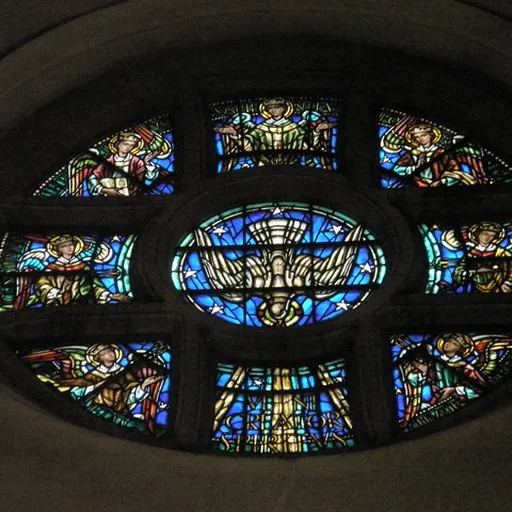
Forsyth's first major assignment for stained glass came through the professional relationship she had established with Gerald Maufe. In 1932, Maufe had won the competition to design the new cathedral for Guildford, a project that would take many years to realise. In 1939, Maufe asked Forsyth to provide a design for the rose window that was to be positioned high up in the east chancel wall. Visible from the west entrance, it is among the most prominent works of art in an otherwise relatively plainly decorated modern Gothic interior. While Maufe had previously exercised paternalistic influence over Forsyth's designs for St Thomas's Church in 1933, at Guildford she was afforded more creative agency. In response to the brief she landed on what would become her own distinct approach to late Arts and Crafts style, one that would be mirrored in much of Forsyth's later work. The window incorporates the Gifts of the Holy Spirit - to which the cathedral is dedicated - against a background of shimmering blue Norman slab glass. Its circular frame has stone mullions that form a voided cross dividing the glass into nine sections – a circular panel to the centre depicting the dove of the Holy Spirit and eight smaller surrounding panels, all but the lower one depicting an angel, which instead contains the legend "Veni Creator Spiritus" ("Come, Holy Spirit"). Dedicated in 1952, the window was partly made in Forsyth's London studio during the Second World War under difficult conditions that included bomb damage to the studio than partly ruined the cartoon. In total Forsyth produced 12 windows for the cathedral, the majority primarily situated in the south aisle.
St Columba's Church, Knightsbridge
Forsyth's productive partnership with Maufe continued at the Scottish Presbyterian church of St Columba in Knightsbridge, London. Built between 1950 and 1955 to replace a Victorian church lost during The Blitz, Maufe's design for St Columba shares many similarities of style with his cathedral at Guildford. This extends to the rose window, similarly installed high in the east chancel wall. Forsyth's design for the window shares the same blue background as that at Guildford, though here it is divided into four sections by mullions that form an intersecting cross of St Andrew. The four sections depict the dove of the Holy Spirit at the top, above the Nativity of Jesus. To either side is one of the Maji and a shepherd adoring the Christ Child. Around the edge is a quote from the Book of John, "The Word was made flesh and dwelt among us, and we beheld his glory". A second window by Forsyth can be found in the London Scottish Regimental Chapel south of the chancel. Installed in 1956, it takes the distinctive form of a narrow cross, filled with glass depicting a ceremonial sword.
Eton College Chapel
Between 1954 and 1959, Forsyth created eight armorial windows for the chapel of Eton College hourouring former headmasters, provosts and benefactors. One of her most significant commissions, Forsyth's windows for Eton, installed in the western end of the nave, four to the north and four to the south, form part of a complete reglazing scheme for the chapel following bomb damage during the Second World War, her work installed alongside that of Evie Hone and John Piper.
Church of the Holy Family, Heath End
The largest single body of work by Forsyth can be found at the Roman Catholic Church of the Holy Family in Heath End, Farnham, Surrey. This unassuming brick-built church opened in 1954 and was expanded in 1967 and 1971. Over a period of 16 years from 1960 Forsyth created 14 windows for church as it went through its various stages of construction. The highlight is the 1960 Epiphany window that dominates the east wall behind the altar. It was the first of her works for the church to be completed. In her retirement Forsyth moved to Farnham and was known to worship at the church.
Norwich Cathedral
Among Forsyth's most significant commissions is the Benedictine window for Norwich Cathedral, located in the 14th-century Bauchun Chapel of Our Lady of Pity (named for its benefactor, William Bauchun). Dedicated in 1964, the window was given in memory of Harriet Campbell. Across four lights of Perpendicular Gothic tracery, it depicts the development of Benedictine monasticism from St Benedict’s career as a young hermit to the commissioning of St Augustine by the Benedictine Pope Gregory the Great and the accomplishments of notable monastics in England, including St Julian of Norwich and Herbert de Losinga. Forsyth's design includes the Benedictine mottoes Ora et Labora (pray and work) and Ut in omnibus glorificatur (God may be glorified in all things). It was said to be among Forsyth's own favourite works, in part because of the importance of leading in the design, and in part because of her love of lettering.
Death and legacy
During her career Forsyth served as President of the International Society of Christian Artists and the Society of Catholic Artists. She also received the Queen's award for lifelong services to the arts.
Forsyth retired to Farnham in the late 1970s, where she died on 19 March 1991. Her requiem was held at St Joan of Arc's Church, Farnham where she was a member of the congregation.
Selected works Church of St Thomas the Apostle, Hanwell, Ealing Four glass panels for the Children's Chapel (1933) Five glass panels for the Baptistry (1933)
St Joseph's Church RC, Burslem, Stoke-on-Trent Sanctuary mural - Christ in Majesty (1935-1937)
Guildford Cathedral, Surrey Rose window - Gifts of the Holy Spirit (1939-1952)
St Columba's Church, Pont Street, Knightsbridge, London Rose window - Nativity of Jesus (1955) Memorial chapel window - Ceremonial sword (1956)
Eton College Chapel, Eton, Berkshire Eight armourial windows (1955-1959)
Church of the Holy Family RC, Heath End, Farnham, Surrey Complete glazing scheme of 14 windows (1960-1976)
Norwich Cathedral, Norfolk Bauchun Chapel - Benedictine Window (1964)
Don’t just read it —
keep it.
Full-length biographies made to live with: read them, listen on the way to work, watch them tonight.
- E-book
- Audio
- Video
Instant download · yours to keep · every purchase keeps this site free
Important facts
People in Moira Forsyth's life
Named in this biography and alive at the same time






Related people
Same field, nearest in time
Contemporaries
People whose lives overlapped Moira Forsyth's




Frequently asked questions
Who was Moira Forsyth?
British artist (1905–1991)
When was Moira Forsyth born?
Moira Forsyth was born in 1905 in Stafford.
When did Moira Forsyth die?
Moira Forsyth died in 1991 in England.
What was Moira Forsyth's occupation?
Moira Forsyth was a glass artist.
Sources & further reading
Cite this page
APA: Biography.guide. (2026). Moira Forsyth. https://biography.guide/moira-forsyth/
MLA: "Moira Forsyth." Biography.guide, https://biography.guide/moira-forsyth/.
Chicago: "Moira Forsyth." Biography.guide. https://biography.guide/moira-forsyth/.
Data last updated: 2026-09-21 · Spot an error? Report a correction.
Portrait: Wikimedia Commons · author & licence
Page generated 2026-09-27 04:59 UTC