
About Mohammed Lakhdar-Hamina
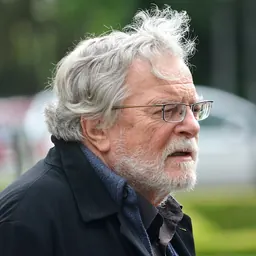
Lived 1934 – 2025 (aged 91). Mohammed Lakhdar-Hamina was an Algerian film director, film producer, screenwriter, cinematographer, actor and writer.
Mohammed Lakhdar-Hamina (; 26 February 1934 – 23 May 2025) was an Algerian film director and screenwriter. He is best known for his 1975 film Chronicle of the Years of Fire, which won the at the 1975 Cannes Film Festival and became the first Arab and African film to win the award. He is one of the most prominent figures in contemporary Arabic cinema.
Life and career Born on 26 February 1934 at M'Sila, Algeria, Lakhdar began his studies in his native country. He first became interested in the world of cinema at the Lycée Carnot in Cannes, France. After beginning studies of agriculture and law at French universities, he deserted the French Army in 1958 and joined the anti-French Algerian Resistance in Tunisia, where he worked for the provisional Algerian government in exile. His film career began as he joined the Algerian Maquis (guerrillas).
In 1959, the Algerian National Liberation Front (FLN) sent him to Prague, where he pursued his cinematography studies at the cinema school, Film and TV School of the Academy of Performing Arts in Prague, the Czech academy for cinema and television. However, he quit his studies in order to work for the Barrandov Studios. Also in 1959, the Algerian ministry of information in exile commissioned Lakhdar-Hamina, together with Djamel Chanderli and Pierre Chaulet, to produce a movie about Algeria's predicament under French colonialism. The documentary film, titled Djazzaïrouna (Our Algeria), aimed at portraying the goals pursued by the Algerian nationalist guerrilla movement, the Maquis.
In 1960, he joined the Service Cinema, created by the Algerian government in exile.
In 1961, Lakhdar-Hamina collaborated with Chanderli in the movie Yasmina, which tells the story of a refugee girl who must flee her village following its destruction. Lakhdar-Hamina collaborated again with Chanderli in the 1962 The people's voice and 1961 The guns of freedom. Upon Algerian independence in 1962, he returned to his homeland where, together with his colleagues from Tunisian exile, he founded the Office des actualités algériennes, of which he was director from 1963 until its dissolution in 1974.
From 1981 until 1984, he acted as director of the Office National pour le Commerce et l'Industrie Cinématographique, the most important institution for furtherance of the French film industry. One of his most recent films, The last image, was part of the Official Selection at Cannes Film Festival in 1986 and was nominated for the Golden Palm.
Lakhdar-Hamina's son, Malik Lakhdar-Hamina, became well known after the release of his first long film, Autumn: October in Algiers (1992), a film that explores the riots of October 1988 through the microcosm of an Algerian family split by a Westernized versus Islamicized view of contemporary Algeria. His other son, Tariq Lakhdar-Hamina, is a film producer.
Death On 23 May 2025, Lakhdar-Hamina died in his home in Algiers, at the age of 91.
Influences and contributions From its inception, Algerian cinema was intertwined with the ideological and existential debates that surrounded the Algerian war of independence and the postcolonial nation-building stage.
In this context, Lakhdar-Hamina's cinematographic career significantly contributed to the development of a new filmic language characteristic of contemporary Maghrebi cinema in general and Algerian in particular, notably distinct from the filmic experiences of other Arab countries and most particularly of the Egyptian cinematic industry.
Following Algeria's independence, Algerian cinema focused on new artistic forms concerned with the search for national identity, but financial difficulties and the lack of an Algerian industry made this task all the more challenging.
Lakhdar-Hamina's first films explore issues of national identity and the search for the Self in the context of postcolonial emancipation. In 1963, he wrote the script and dialogue for the film Under Neptune's sign. In 1965, he released his first long film, The Winds of the Aures. The film portrayed the story of an Algerian woman in search of her imprisoned sons during the Algerian war of independence.
The Winds of the Aures received the Best First Work Award at the 1966 Cannes Film Festival and was nominated for the Golden Palm. It was also nominated for the Grand Prix at the 5th Moscow International Film Festival in 1967. It may be considered in its own right the foundational stone of contemporary Algeria cinema. In The Winds of the Aures, Lakhdar-Hamina portrays with painstaking detail the disintegration of a peasant society marred by the structural violence of colonial occupation. The movie is clearly influenced by Soviet cinema and aesthetics, particularly that of Soviet Ukrainian director Alexander Dovzhenko. The director adeptly translated this influence on an Algerian scenario.
The Winds of the Aures consecrated Algerian cinema in the international scene. Lakhdar-Hamina's following film, Hassan Terro, explored in a comical manner the tragedy of Algeria's war of independence by portraying the misadventures of its main character, a bourgeois character trapped in the midst of the Algerian revolution.
North American audiences have remained for the most part unaware of Algeria's cinematographic experience. Following the nationalization of Algeria's film industry in June 1969, the American Motion Pictures Export Association of America (MPEAA) called for a boycott of all Algerian productions.
His third film December, released in 1972, explores the issue of torture. The movie narrated the case of a French officer troubled by the violent acts of torture perpetrated by the French army against members of the FLN.
Since its inception, Algerian cinema developed a clearly anti-imperialistic stance. In this regard, Algerian cinematographers in general and Lakhdar-Hamina in particular have remained deeply committed to the ideological tenets of the nonaligned movement and Third-worldism. In December 1973, African, Latin American, and Asian filmmakers gathered in Algiers for the first meeting of the Third World Cinema Committee, which became an effort to build an independent Third World cinematographic movement.
Chronicle of the Years of Fire (1975), however, is Lakhdar-Hamina's most important work. In 1975, he achieved worldwide recognition when the movie was awarded the at Cannes. The film, which offers a personal vision of the Algerian revolution, traces the evolution of the revolutionary movement from 1939 until the beginnings of the 1954 insurrection against the French.
To this day, Chronicle of the Years of Fire remains the only African and Arab film to have been awarded the at Cannes. Short film Director Screenwriter 1961 La Voix du Peuple Documentary Short film Director Screenwriter 1961 Guns of Freedom Short film Director 1961 Yasmina Short film Drama Director Screenwriter 1963 Prends soin Documentary Short film Director Screenwriter 1963 Sous le signe de Neptune Short Screenwriter 1964 Mais un jour de novembre Documentary Director 1966 Rih al awras Drama Director Screenwriter 1968 Hassan, Terrorist Comedy Drama Director Screenwriter 1973 Décembre Drama Director Producer
Screenwriter 1975 Chronicle of the Years of Fire Drama History Director Screenwriter 1982 Sandstorm Drama Director Screenwriter 1986 La dernière image Comedy Drama Director Producer
Screenwriter 2014 Twilight of Shadows Drama Director Producer
Screenwriter
Films presented at Cannes Year Title Contribution 2014 Crépuscule des ombres Director Script and Dialogue 1992 Automne Director Script and Dialogue 1986 La dernière image Director Script and Dialogue 1982 Director Script and Dialogue 1975 Chronique des années de braise (Chronicle of the Years of Fire) Director Script and Dialogue 1967 Le vent des Aurès (Rih al awras) Director Script and Dialogue Cinematography 1963 Sous le signe de Neptune Script and Dialogue
Awards 1975: Chronicle of the Years of Fire, Long métrage 1967: Prix de la premiere oeuvre The Winds of the Aures, Long métrage
Don’t just read it —
keep it.
Full-length biographies made to live with: read them, listen on the way to work, watch them tonight.
- E-book
- Audio
- Video
Instant download · yours to keep · every purchase keeps this site free
Important facts
People in Mohammed Lakhdar-Hamina's life
Named in this biography and alive at the same time




Related people
Same field, nearest in time


Contemporaries
People whose lives overlapped Mohammed Lakhdar-Hamina's






Frequently asked questions
Who was Mohammed Lakhdar-Hamina?
Algerian film director
When was Mohammed Lakhdar-Hamina born?
Mohammed Lakhdar-Hamina was born on 26 February 1934 in M'Sila.
When did Mohammed Lakhdar-Hamina die?
Mohammed Lakhdar-Hamina died on 23 May 2025 in Algiers.
What was Mohammed Lakhdar-Hamina's occupation?
Mohammed Lakhdar-Hamina was a film director, film producer, screenwriter, cinematographer, actor and writer.
What nationality was Mohammed Lakhdar-Hamina?
Mohammed Lakhdar-Hamina was Algerian.
Sources & further reading
· Wikipedia: Mohammed Lakhdar-Hamina
· DBpedia: Mohammed Lakhdar-Hamina
Cite this page
APA: Biography.guide. (2026). Mohammed Lakhdar-Hamina. https://biography.guide/mohammed-lakhdar-hamina/
MLA: "Mohammed Lakhdar-Hamina." Biography.guide, https://biography.guide/mohammed-lakhdar-hamina/.
Chicago: "Mohammed Lakhdar-Hamina." Biography.guide. https://biography.guide/mohammed-lakhdar-hamina/.
Data last updated: 2026-09-26 · Spot an error? Report a correction.
Page generated 2026-09-27 05:16 UTC