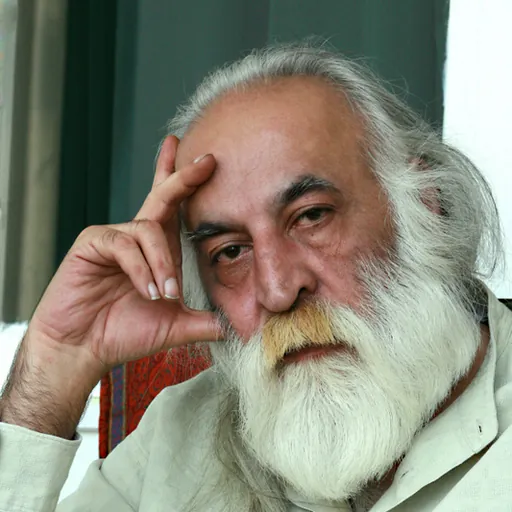
About Mohammad-Reza Lotfi
Lived 1947 – 2014 (aged 67). Mohammad-Reza Lotfi was an Iranian composer, conductor and recording artist.
Mohammad-Reza Lotfi (; 1 January 1947 – 2 May 2014) was an Iranian classical musician renowned for his mastery of the tar and setar. He collaborated with singers such as Mohammad-Rezā Shajarian, Hengameh Akhavan, Shahram Nazeri and Alireza Shahmohammadi.
Life and career Mohammad Reza Lotfi was born on January 17, 1947, in the city of Gorgan, in a cultured family where both his parents were teachers.
Encouraged by his older brother, he learned to play the tar and showed his talent by winning the first prize in Iran's Young Musicians Festival in 1964. The following year, he started his studies at the Persian National Music Conservatory in Tehran under Habibollah Salehi and Master Ali Akbar Shahnazi. He was a tar player for the Fine Arts Administration Orchestra (Saba Orchestra) under the direction of Hossein Dehlavi. Some of his other eminent teachers were Abdollah Davami, from whom he learned the Radif, and Master Sa'id Hormozi, who taught him the setar.
While attending the College of Fine Arts at Tehran University, Lotfi became the student of Master Nour-Ali Boroumand. He also worked at the Center for the Preservation and Propagation of Traditional Persian Music, both as a soloist and a conductor. His other accomplishments were teaching at the Center for Intellectual Development of Children and Adolescents, researching folk music for National Radio and Television, and appearing at the Shiraz Arts Festival. After graduating in 1973, Lotfi joined the faculty of Fine Arts at Tehran University.
He continued his collaboration with Radio and Television and co-founded the Shayda Ensemble. Between 1978 and 1980, Lotfi became the Head of the School of Music at The University of Tehran. He served as the director of the Center for the Preservation and Propagation of Traditional Persian Music and the "Chavosh" Center. In 1984, Lotfi was invited by Fondazione Cini to participate in a seminar and perform concerts in Italy, where he resided for two years. He lived in the United States from 1986 until his death and performed widely throughout Asia, Europe, and North America.
A prolific musician, he made numerous recordings both as a solo artist and with the celebrated Iranian musicians such as Mohammad Reza Shajarian, Shahram Nazeri, Hossein Alizadeh, and Parviz Meshkatian. Lotfi is one of the greatest contemporary masters of the tar and setar. He is among the major figures who, in the past twenty years, have revolutionized the Persian traditional (classical) music. His innovative approach of combining the classical with folk elements, both in terms of music and technique, has injected a new vitality into a very old tradition. His original creativity and the deep-rooted emotional quality of his playing have made him the father of a new aesthetics in Persian music.
Selected vocal works Mohammad Reza Lotfi has performed many works with Mohammad Reza Shajarian performed in radio or common concerts. He also has many self-vocal works.
This is important that Lotfi and Shajarian performed in the Rast-Panjgah mode in a live concert (1976), at which point no one had performed in this mode for at least 20 years. Raast-Panjgaah concert with Mohammad Reza Shajarian and Naser Farhangfar in Rast Panjgah (1976). In Remember of Aref with Mohammad Reza Shajarian and the Shayda Ensemble in Bayat Turk (1986). Sepideh Album with Mohammad Reza Shajarian and the Sheyda Ensemble in Mahoor Love Knows with Mohammad Reza Shajarian in Aboutata (1981). Cheshmeye Noush with Mohammad Reza Shajarian and Mjid Khaladj in Rast Panjgah (1994). Chehre be Chehre with Mohammad Reza Shajarian in Nava (1978). Karevan-e Shahid with Shahram Nazeri and Shayda Ensemble in Dashti ‘’’Mahour Concert and album with Alireza Shahmohammadi Vatanam Iran (Mohammad Motamedi & Hamnavazan-e Sheida (Sheyda Ensembl) – 2008 ’’’ Radif Mirza Abdollah (Alireza Shahmohammadi) Yadvareye Aref-e Ghazvini (Mohammad Motamedi & Hamnavazan-e Sheida (Sheyda Ensembl) – 2009) Ey Asheghan (Mohammad Motamedi & Banovan-e Sheida (Sheida Women) – 2009) Video album of Karavan-e-shahid’’’ (Alireza Shahmohammadi - 2009) Video album of Dashti Concert – Vatanam Iran (Mohammad Motamedi & Sheida Threefold Groups – 2008) Video album of Chavosh Concert 8-(Alireza Shahmohammadi Iran Ey Saraye Omid (Mohammad Motamedi & Hamnavazan-e Sheida (Sheyda
Death
Mohammad-Reza Lotfi died on 2 May 2014 (age of 67) suffering from prostate cancer. According to Hamid Dabashi, Lotfi's death marked "a crucial turning point in the history of classical Persian music and its spectacular rise and fall as a performing public art."
Don’t just read it —
keep it.
Full-length biographies made to live with: read them, listen on the way to work, watch them tonight.
- E-book
- Audio
- Video
Instant download · yours to keep · every purchase keeps this site free
Important facts
People in Mohammad-Reza Lotfi's life
Named in this biography and alive at the same time




Related people
Same field, nearest in time


Contemporaries
People whose lives overlapped Mohammad-Reza Lotfi's



Frequently asked questions
Who was Mohammad-Reza Lotfi?
Iranian musician (1947–2014)
When was Mohammad-Reza Lotfi born?
Mohammad-Reza Lotfi was born on 7 January 1947 in Gorgan.
When did Mohammad-Reza Lotfi die?
Mohammad-Reza Lotfi died on 2 May 2014 in Tehran.
What was Mohammad-Reza Lotfi's occupation?
Mohammad-Reza Lotfi was a composer, conductor and recording artist.
What nationality was Mohammad-Reza Lotfi?
Mohammad-Reza Lotfi was Iranian.
Sources & further reading
· Wikipedia: Mohammad-Reza Lotfi
· DBpedia: Mohammad-Reza Lotfi
Cite this page
APA: Biography.guide. (2026). Mohammad-Reza Lotfi. https://biography.guide/mohammad-reza-lotfi/
MLA: "Mohammad-Reza Lotfi." Biography.guide, https://biography.guide/mohammad-reza-lotfi/.
Chicago: "Mohammad-Reza Lotfi." Biography.guide. https://biography.guide/mohammad-reza-lotfi/.
Data last updated: 2026-09-20 · Spot an error? Report a correction.
Portrait: Wikimedia Commons · author & licence
Page generated 2026-09-27 04:57 UTC